In December 1531, a poor Indigenous farmer was walking across a hill near Mexico City when a woman called to him from the heights of Tepeyac. She spoke to him in his own language, Nahuatl, and called herself the Mother of the true God. The man was Juan Diego Cuauhtlatoatzin — and the encounter that followed would change the religious history of an entire continent. Out of his humble cloak, just a few days later, would unfold the image of Our Lady of Guadalupe that millions still venerate today. Seventy years into the third Christian millennium, the Church would call him a saint: the first Indigenous saint of the Americas.
Who Juan Diego was
Juan Diego was born around 1474, almost two decades before the first European ships reached the Caribbean. He belonged to the Chichimeca-Nahua world of central Mexico, and his Nahuatl name, Cuauhtlatoatzin, is usually rendered as something like the eagle who speaks. He was a man of the land — a worker, not a noble — who lived simply with his wife and, after her death, with his elderly uncle, Juan Bernardino.
He was among the early generation of Indigenous people baptized after the Spanish arrival, taking the Christian name Juan Diego. The faith he received was still new and fragile in that soil, learned in a second language, often shadowed by the violence and confusion of the conquest. None of that made him important in the eyes of the powerful. He was exactly the kind of person history usually forgets. Heaven, the story goes, chose him precisely for that reason.
The apparitions and the tilma
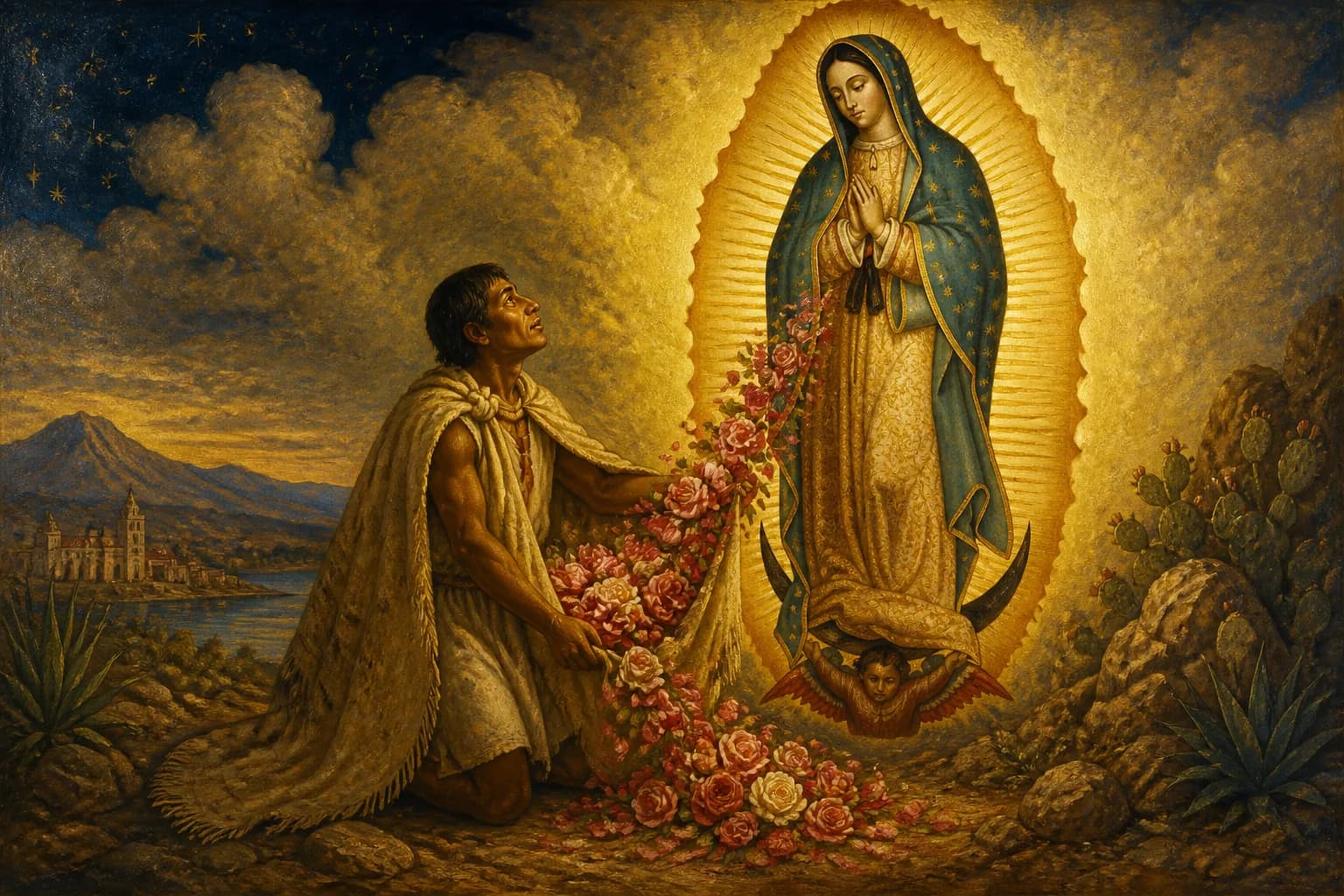
According to the traditional account preserved in the Nican Mopohua, a sixteenth-century narrative written in Nahuatl, the Virgin Mary appeared to Juan Diego several times on Tepeyac hill in December 1531. She asked that a church be built on that spot, so that she could show her love and compassion to all who sought her. She sent Juan Diego to carry this request to the local bishop, Juan de Zumarraga.
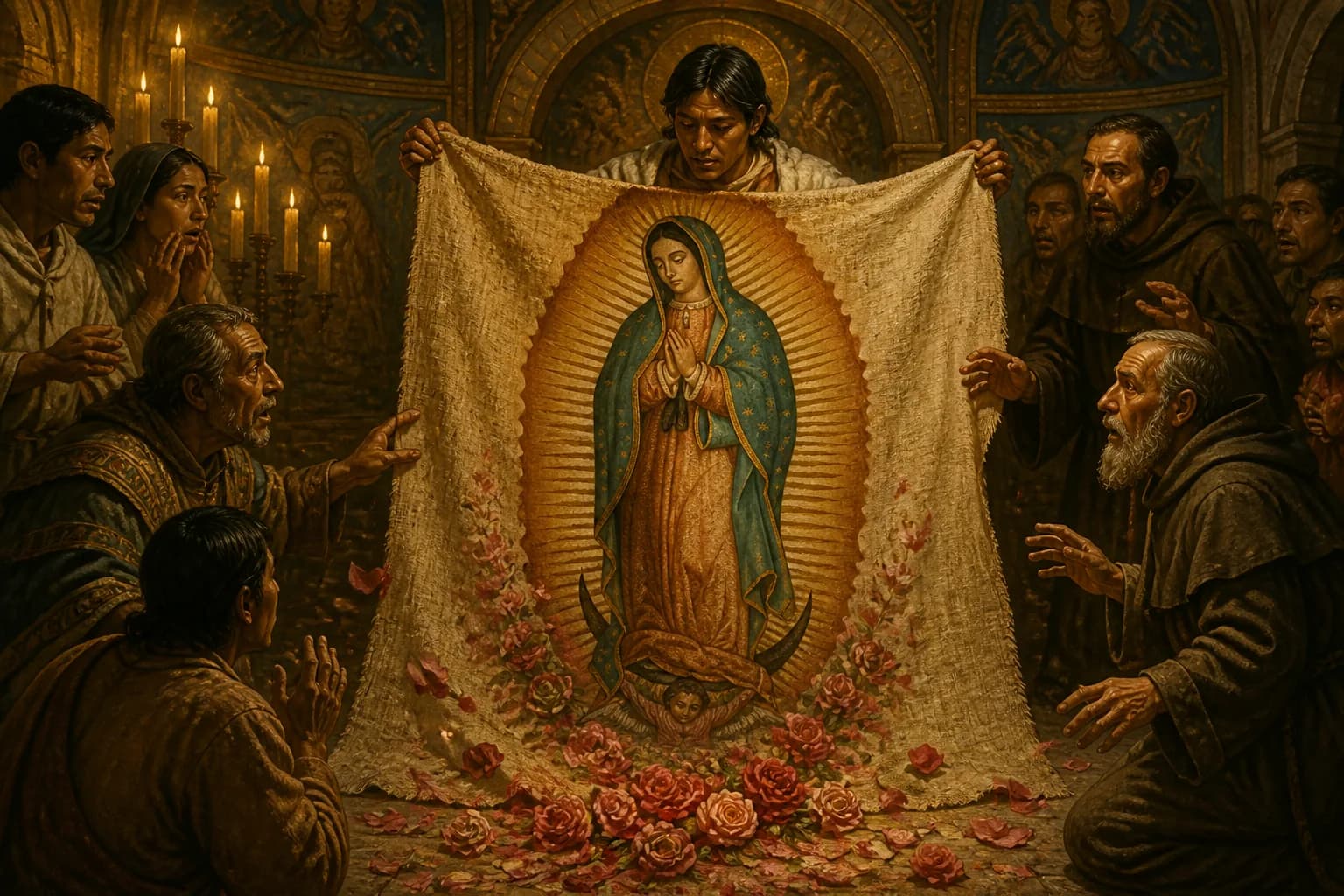
The bishop, understandably cautious, asked for a sign. Mary's answer came in a way no one expected. She directed Juan Diego to gather flowers on the hilltop — and there, in the cold of December, far out of season, he found roses in bloom. He gathered them into his tilma, the rough cloak woven from cactus fiber that Indigenous men wore. When he stood before the bishop and opened the cloak to let the roses fall, something else appeared: the image of Our Lady, imprinted on the cloth itself.
That tilma is still venerated today in the basilica built at Tepeyac. The image on it is traditionally held to be miraculous — not made by human hands — and it remains one of the most studied and most visited religious images in the world. A companion article in this series looks more closely at the science and the enduring questions surrounding the image itself.
"Am I not here, I who am your Mother?"
What makes Juan Diego's story so beloved is not only the miracle but the tenderness inside it. At one point in the apparitions he was overwhelmed by worry. His uncle, Juan Bernardino, had fallen gravely ill, and Juan Diego, fearing the man was dying, tried to avoid the Virgin so he could rush for a priest. He even took a different path around the hill, embarrassed to face her with his errand unfinished.
Mary met him anyway. Instead of reproaching him, she comforted him with words that have echoed through five centuries. She asked him, gently, why he was afraid, and reminded him of who she was to him: Am I not here, I who am your Mother? Are you not under my shadow and protection? She assured him that his uncle would recover — and, the account says, Juan Bernardino was healed in that same hour. Those few words have become, for countless people, the heart of the entire Guadalupe event: the promise of a Mother who is present, who is near, and who does not abandon the small.
Canonization and why it mattered
For most of his remaining years, Juan Diego lived quietly beside the chapel that was built at Tepeyac. He cared for the place, welcomed the pilgrims who began to arrive, and told and retold the story of what he had seen. He had no wealth, no title, no power. He had only the experience entrusted to him, and a life shaped by humility around it. He died around 1548.
Centuries later the Church formally recognized what the faithful had long believed about him. Pope John Paul II beatified Juan Diego in 1990 and then canonized him on 31 July 2002, during a journey to Mexico City, before immense crowds. With that act Juan Diego became the first Indigenous saint of the Americas — a recognition that holiness had been present among the native peoples of the continent from the very first generation of the faith there.
The significance went beyond one man. Guadalupe is widely seen as a turning point in the evangelization of the Americas. In the years following 1531, conversions across Mexico grew dramatically, and the image and story carried the message in a way sermons in a foreign tongue could not. Juan Diego stood at the center of that meeting between a young faith and an ancient Indigenous culture.
His legacy
Juan Diego is remembered as a patron of Indigenous peoples and a model of humility. His story insists on something the world keeps forgetting: that dignity does not depend on status, and that the poor and overlooked can carry the most important messages of all. He did not preach grand sermons or found institutions. He listened, he obeyed, and he stayed faithful to a single extraordinary trust placed in his hands.
For the Indigenous peoples of the Americas, his canonization was a long-awaited affirmation — proof that their cultures and their persons belonged fully within the life of the Church. For everyone else, he remains the figure who first opened the cloak and let the roses fall, revealing an image that has consoled the heartbroken and drawn the doubting for nearly five hundred years. The hill of Tepeyac is now one of the most visited shrines on earth, and the gentle question Mary asked him there still answers the fears of those who come.
Crucis Lux tells the story of Saint Juan Diego and Our Lady of Guadalupe as a narrated, illustrated series — discover it in the app.