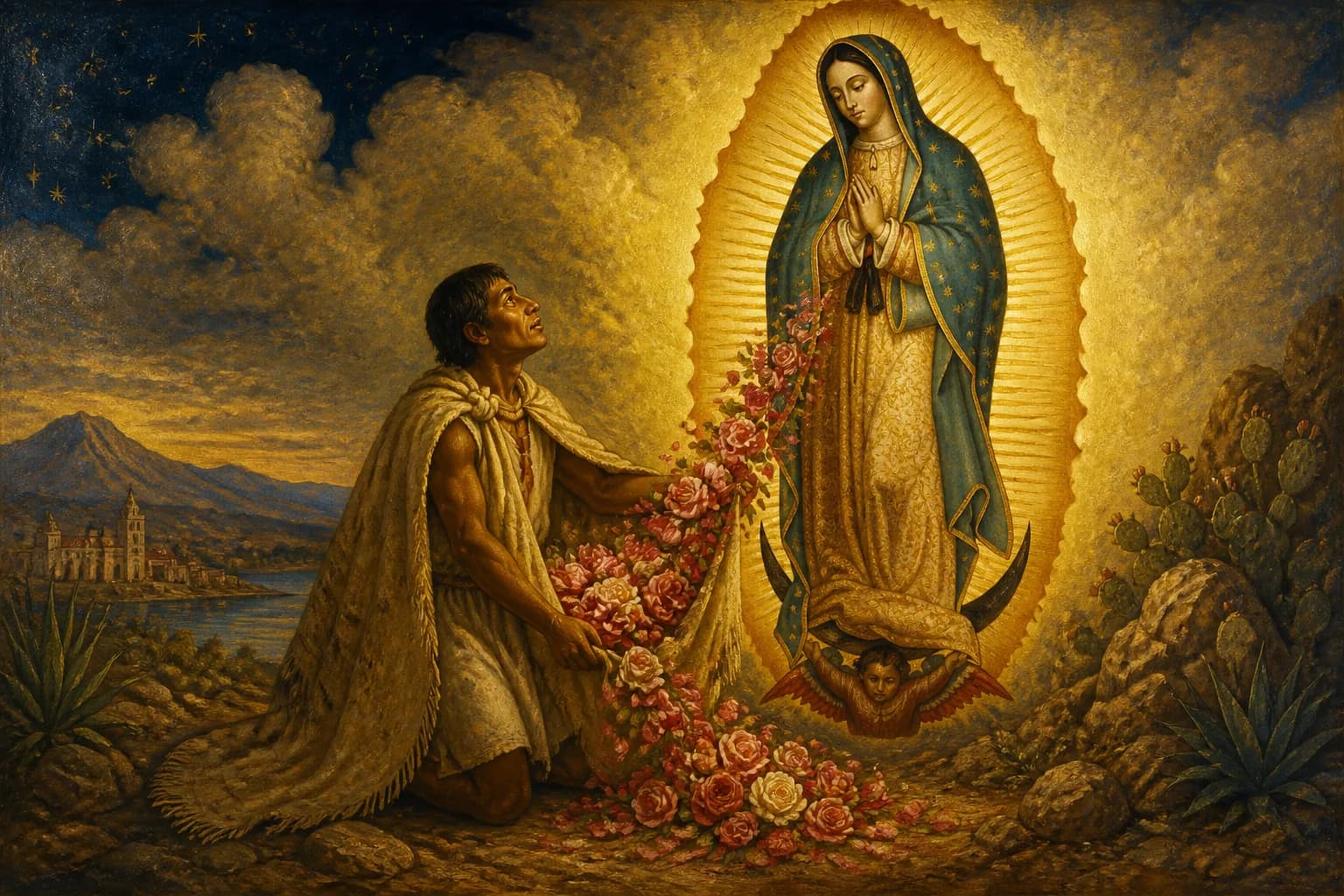
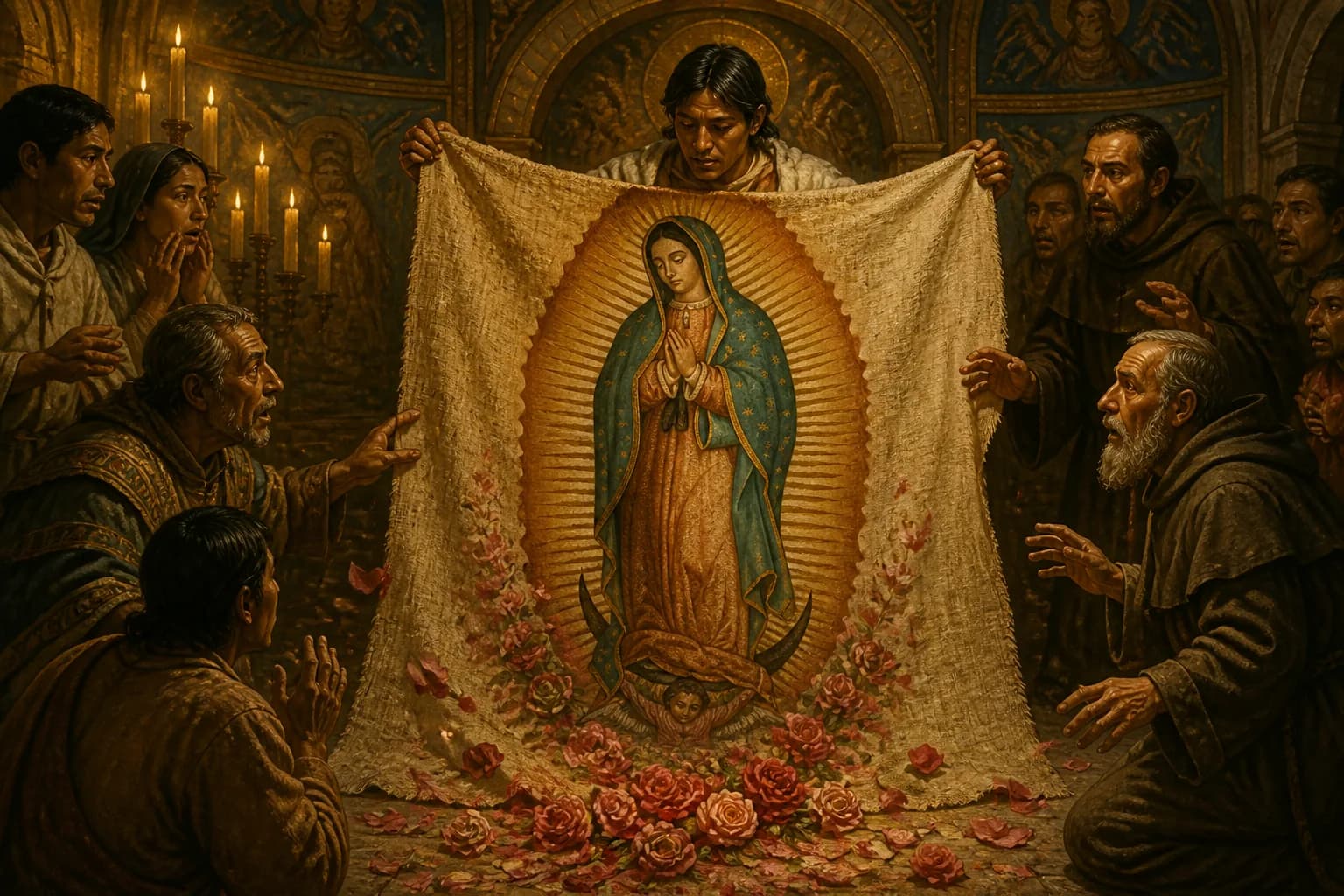
On the morning of December 12, 1531, a Nahua peasant in his late fifties walked into the residence of the bishop of Mexico City carrying roses in his cloak. The roses were impossible — it was winter, and they were Castilian, not native to the Mexican highlands. When Juan Diego opened the rough cactus-fiber cloak, called a tilma, to spill them at the bishop's feet, the bishop and his servants fell to their knees. Painted on the inside of the cloak, in a way no one could explain, was the image of a young pregnant woman with the features of a mestiza. The image is still there. The tilma is still hanging behind the altar of the Basilica of Guadalupe in Mexico City.
What follows is the documented history, the textual sources, the scientific examinations of the fabric over the last century, and what the Catholic Church teaches about the event.
Tepeyac, December 1531
The Spanish conquest of the Aztec empire had ended in 1521. Within a decade, missionaries were baptizing Indigenous Mexicans at a slow pace and against a backdrop of violence, disease, and political collapse. Juan Diego, born Cuauhtlatoatzin around 1474 in Cuauhtitlán, had been baptized by Franciscan missionaries in 1524 and walked the fourteen miles from his village to Mass on weekends.
On Saturday, December 9, 1531, walking past the hill of Tepeyac, he heard music and saw a young woman who addressed him in Nahuatl. She identified herself as Tlecuauhtlapcupeuh — phonetically rendered "Coatlaxopeuh" — meaning "she who crushes the serpent." Spanish ears heard it as Guadalupe. She sent him to ask Bishop Juan de Zumárraga to build a church on the hill in her honor.
Zumárraga, a careful Franciscan bishop wary of pious enthusiasm in a recently converted population, asked for a sign. Juan Diego returned to Tepeyac. The Lady appeared again, told him to gather flowers on the hill, and arranged them with her own hands in his tilma. He returned to the bishop's house on December 12. When he unfolded the cloak — de Castilian roses tumbling out — the image was already there.
The Nican Mopohua: The Primary Text
The standard account is preserved in a sixteenth-century Nahuatl text called the Nican Mopohua — "Here it is told" — generally attributed to the Indigenous scholar Antonio Valeriano, a colleague of the Franciscan missionary Bernardino de Sahagún. The earliest extant manuscript dates from the late sixteenth or early seventeenth century. There is scholarly debate about whether Valeriano was the author or a later compiler; what is not debated is that the Nican Mopohua is a polished work of Nahuatl prose written by someone who knew the Indigenous worldview from the inside.
The text is remarkable for its courtesy and its theology. The Lady addresses Juan Diego as Juantzin, Juan Diegotzin — affectionate diminutive forms — and calls herself "the perfect ever-virgin holy Mary, mother of the true God by whom we all live." She speaks Nahuatl, not Spanish. She does not introduce herself by the title the Spaniards will use.
The Tilma and the Fabric
The cloak is woven from ayate, a coarse fiber spun from the maguey (agave) plant. Ayate textiles in normal use lasted twenty to thirty years before disintegrating. The tilma of Juan Diego has survived almost five centuries — through the floods of Mexico City, an 1785 acid spill that splashed nitric acid across the gold leaf of the frame, and a 1921 bomb planted in a flower arrangement beneath the image that blew apart a heavy brass crucifix and cracked the marble of the altar but did not even crease the tilma. The crucifix, twisted in the explosion, is preserved at the basilica as a relic.
For its first hundred years the tilma was displayed without glass. Indigenous and Spanish pilgrims touched it, kissed it, held rosaries to it. Yet the image is intact.
What Modern Examinations Have Found
The image has been examined repeatedly over the past century. The major studies:
- Richard Kuhn, Nobel Prize chemist (1936). Asked to analyze pigment samples taken from the tilma, Kuhn reportedly concluded that the colors were not from any known mineral, vegetable, or animal source. The Kuhn analysis is referenced widely in popular literature; the primary documentation is thin and has been challenged by skeptics.
- Philip Callahan, biophysicist, University of Florida (1979). Working with infrared photography under contract from CARA — the Centro de Estudios Guadalupanos — Callahan reported that the image showed no underlying drawing or sketch lines, no brush strokes visible at high resolution, and no signs of preparation of the cloth. His report, published in 1981, also documented that later retouching — gold leaf added to the rays, additional paint on the angel and the moon — was visible as expected human work, but the central image of the woman appeared anomalous.
- José Aste Tonsmann, ophthalmologist and engineer (1979 and following). Tonsmann digitized high-resolution photographs of the pupils of the eyes in the image. He reported finding tiny reflections in both pupils — figures that appear to be Juan Diego, Bishop Zumárraga, an Indigenous translator, and others — placed roughly as they would be in a Purkinje–Sanson reflection from a living human eye. The findings are disputed by skeptics, but Tonsmann's photographs are independently verifiable.
Skeptical analyses also exist. The art restorer José Sol Rosales examined the image in 1982 on commission from the Mexican Episcopal Conference and reported that he saw evidence of preparation and pigment use consistent with sixteenth-century painting techniques on the later additions — the gold rays, the angel, the moon, the cherub — but did not claim to explain the central figure.
The Catholic Church has not declared the image scientifically miraculous. It permits both belief and reasoned investigation. The Vatican's position, repeated by every pope since Pius X, has been to confirm the apparitions as worthy of belief and to honor the tilma as an authentic icon.
The Symbolism the Aztecs Saw
To Spanish eyes in 1531, the image is the Immaculate Conception in iconography familiar from European devotion. To Nahua eyes in 1531, the image is something more pointed.
- She stands on the moon — in Nahua cosmology, the moon was associated with darker forces. To stand on the moon is to crush them.
- She blocks the sun with her body — but is not consuming it; she is in front of it, mediating it. The sun deity Huitzilopochtli had been the patron of the empire that ended in 1521.
- She wears the cinta — a black sash tied above the waist in Indigenous fashion to indicate pregnancy.
- The flower at the center of her dress, a four-petaled nahui-ollin glyph, marked the heart of the cosmos in Nahua art.
- Her face is mestiza — neither European nor purely Indigenous.
In a single image, the Lady declares: the old gods are conquered, the new God is being born, I am the mother of God, and I share your skin. The image is an entire catechism in iconography.
Within twenty years of December 12, 1531, an estimated nine million Indigenous Mexicans had been baptized — a wave of conversion the missionary friars had not been able to produce by preaching alone. The image did what no sermon could.
Juan Diego the Person
For centuries, Juan Diego was treated by some scholars as a literary figure — a stand-in invented by missionaries — because the historical records about him in the immediate decades after 1531 were thin. Renewed historical research in the late twentieth century recovered colonial documents, including an Indigenous land record signed by relatives, that strengthened the case for his historicity. He died around 1548, having spent the last sixteen years of his life as a hermit caring for the small first chapel at Tepeyac and telling pilgrims what had happened.
He was beatified by John Paul II in 1990 and canonized in 2002. He is the first Indigenous American saint of the Catholic Church.
Pilgrimage and Influence
The Basilica of Guadalupe draws roughly twenty million pilgrims a year, making it the most visited Marian shrine in the world — more than Lourdes and Fátima combined. The feast day, December 12, is a public holiday across most of Latin America.
The image has shaped Mexican identity, Latin American Catholicism, and the modern theology of inculturation. Pope Francis has cited Guadalupe repeatedly in his pontificate as the model of an evangelization that meets a people in their own language and form. The Vatican news service regularly covers the December 12 pilgrimage.
What the Tilma Still Asks
The image hangs five centuries on, behind bulletproof glass now, with moving walkways below to handle the volume of pilgrims. The Catholic Church does not require any Catholic to believe Juan Diego saw what he said he saw. It does require, in the very ordinary practice of canonization, that miracles attributed to his intercession be investigated and verified, and they have been.
What is asked of the visitor — Catholic or not — is to look. The cloak is there. The image is there. The fibers are five hundred years old. The eyes have been photographed at twenty-five hundred times magnification. Some things the natural sciences can explain; some things they can't yet; some things they may never. The honest position is to look without flinching from either side.
Listen to Guadalupe on Crucis Lux
Crucis Lux tells the story of Juan Diego and Our Lady of Guadalupe as a slow-paced, illustrated audio series — every apparition narrated, every panel illustrated in the style of medieval frescoes, in five languages.