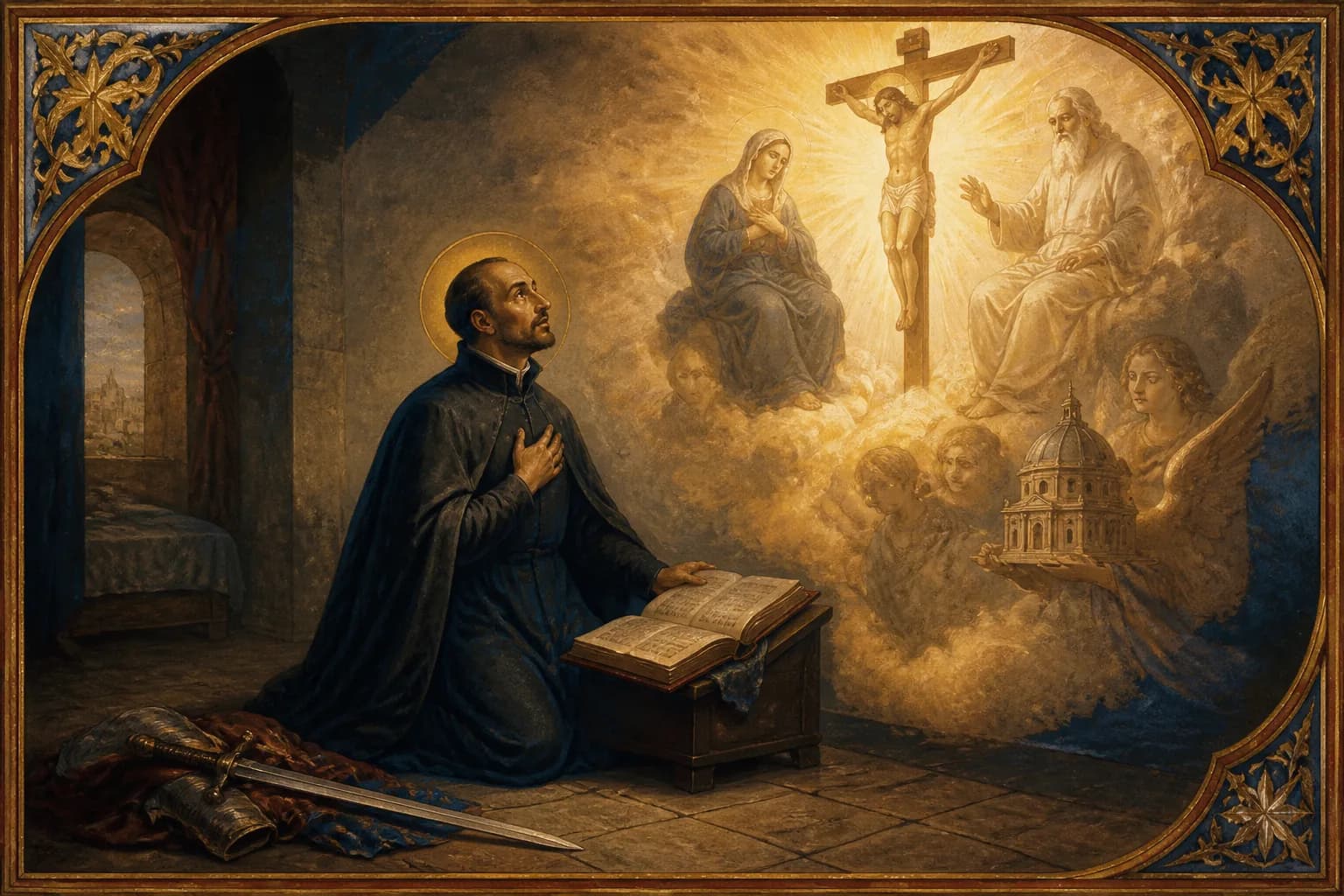
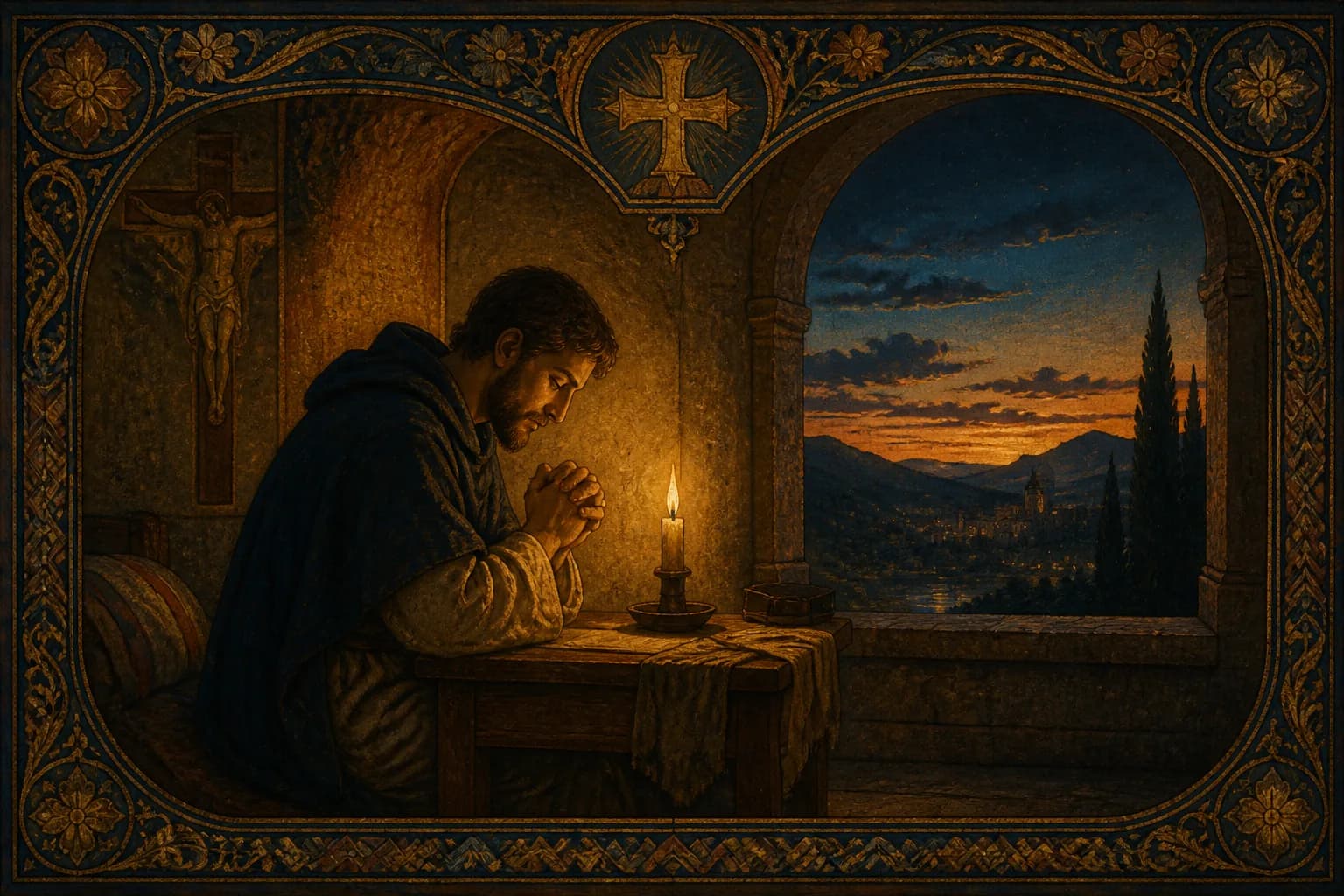
Most of us reach the end of a day without ever really looking at it. The hours blur — work, messages, meals, errands — and we fall asleep with the vague sense that the day simply happened to us. St. Ignatius of Loyola, the soldier-turned-mystic who founded the Jesuits, offered a remedy so simple that anyone can do it and so powerful that he refused to let his men skip it. He called it the Examen: a short, daily review of your day in God's company. Ignatius told the Jesuits that of all their prayers, this was the one never to omit — even on the busiest day. It takes about ten to fifteen minutes, needs no special place, and you can begin tonight.
What the Examen actually is
The Examen comes from Ignatius's Spiritual Exercises, the manual he wrote after a long conversion and years of paying close attention to what was happening inside him. He noticed that God speaks not only in churches and Scripture but in the ordinary movements of the heart — the lift of gratitude, the sting of regret, the pull toward something good or away from it. The Examen is the daily habit of catching those movements before they slip away.
It is not a guilt-trip and it is not a productivity audit. It is a prayerful walk back through your day, holding it up to God's light, so that over time you start to recognize where He was already present. Here are the five classic steps.
1. Give thanks
Begin with gratitude. Before analyzing anything, simply thank God for the gifts of the day — and start with concrete ones, not abstractions. The coffee that was hot. A message from a friend. Work that went better than expected. The fact that you are breathing at all.
Ignatius put gratitude first on purpose. It sets the tone: you are reviewing your life as a gift received, not a performance to be graded. Linger here a moment. Naming a few real things you are thankful for, out loud or in your mind, changes how you see everything that follows.
2. Ask for light
Next, ask the Holy Spirit to help you see the day honestly. This is a small but crucial step. Left to ourselves, we either excuse everything or condemn everything — we rarely see clearly. So you pause and pray, in your own words: Lord, show me my day as You see it.
This is what keeps the Examen from becoming mere introspection. You are not psychoanalyzing yourself; you are asking God to walk through the hours with you and show you what matters.
3. Review the day
Now replay the day, roughly hour by hour, from when you woke up until this moment. Don't rush to judgment — just notice. Where was God present? Where did you respond well, and where did you miss the moment?
Ignatius's special insight is to pay attention to your feelings and inner movements, not only your actions. When did you feel peace, joy, energy, love? When did you feel restless, anxious, irritable, flat? Those feelings are clues. They often mark the places where you were drawn toward God or away from Him without realizing it. You are not trying to fix anything yet. You are simply watching the day go by with honest eyes.
4. Ask for forgiveness
Out of that honest review, sorrow comes naturally — and so does mercy. Where you failed today — the sharp word, the avoided task, the kindness you withheld — acknowledge it plainly and ask God's pardon. No drama, no spiral. Ignatius wanted clear-eyed contrition, not self-loathing.
This step is freeing precisely because it is honest. You are not pretending the day was flawless, and you are not crushed by its faults. You name them, you hand them to a God who already knows and already loves you, and you let them go.
5. Resolve for tomorrow
Finally, look forward. Choose one concrete thing for tomorrow — not a sweeping list of resolutions, just one. Maybe it's patience with a particular person, a phone call you've put off, ten minutes of quiet, a temptation you want to meet differently. Then ask God for the grace to actually do it, because resolve without grace rarely survives contact with a real day.
Close however feels natural — an Our Father, a simple "thank you," a moment of silence. That's the whole prayer.
Why it works: learning to read the spirits
Done once, the Examen is a nice reflection. Done daily, it becomes something deeper: training in what Ignatius called the discernment of spirits.
He observed two basic interior movements. Consolation is any movement that draws you toward God — increasing faith, hope, and love, leaving you more peaceful, more generous, more alive. Desolation is the opposite pull — toward discouragement, restlessness, isolation, the slow drift away from what is good. Both can be quiet and easy to miss in the moment.
The nightly Examen is where you learn to spot the pattern. Over weeks, you begin to notice that certain choices, places, or habits reliably bring consolation, and others reliably leave you in desolation. That knowledge is gold. It teaches you, day by day, to recognize how God actually prompts and leads you — not in theory, but in the concrete texture of your own life.
You can start tonight
The beauty of the Examen is that it fits anywhere. You can pray it on the commute home, while doing the dishes, in the few minutes after the kids are finally asleep, or lying in bed before you close your eyes. It needs no book, no perfect silence, no special skill. It bends to your life rather than demanding your life bend to it — which is exactly why Ignatius, a busy man running a fast-growing order, prized it above almost everything else.
So try it once, tonight. Thank God for one thing. Ask for light. Walk back through your hours. Ask pardon for one failing. Choose one thing for tomorrow. That's it. Do it again tomorrow, and the day after, and you will slowly find that you are no longer just sleepwalking through your life — you are living it with God, one ordinary day at a time.
Crucis Lux tells the life of Saint Ignatius of Loyola as a narrated, illustrated series — from the cannonball that shattered his old life to the founding of the Jesuits. The series is coming soon to the app.