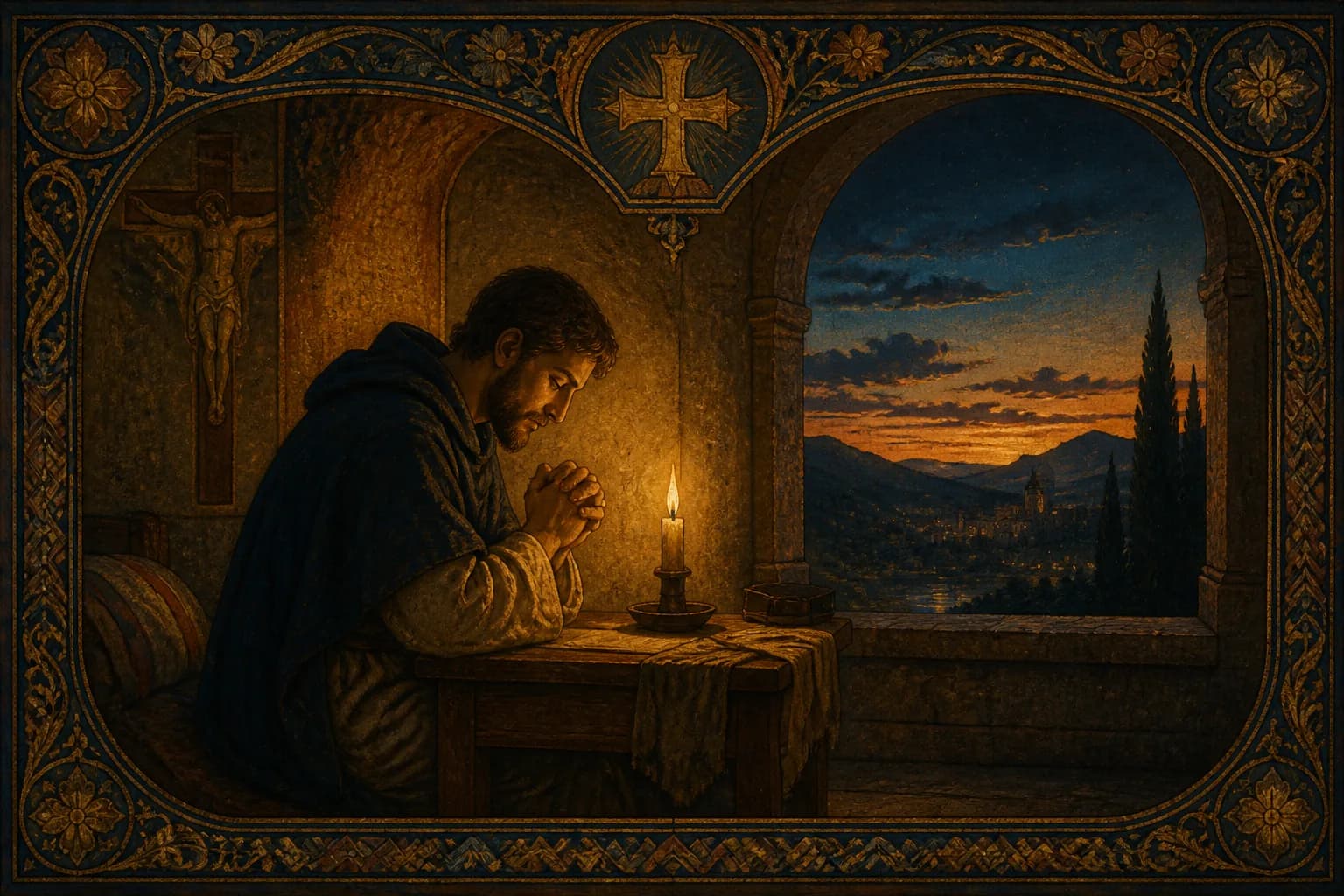
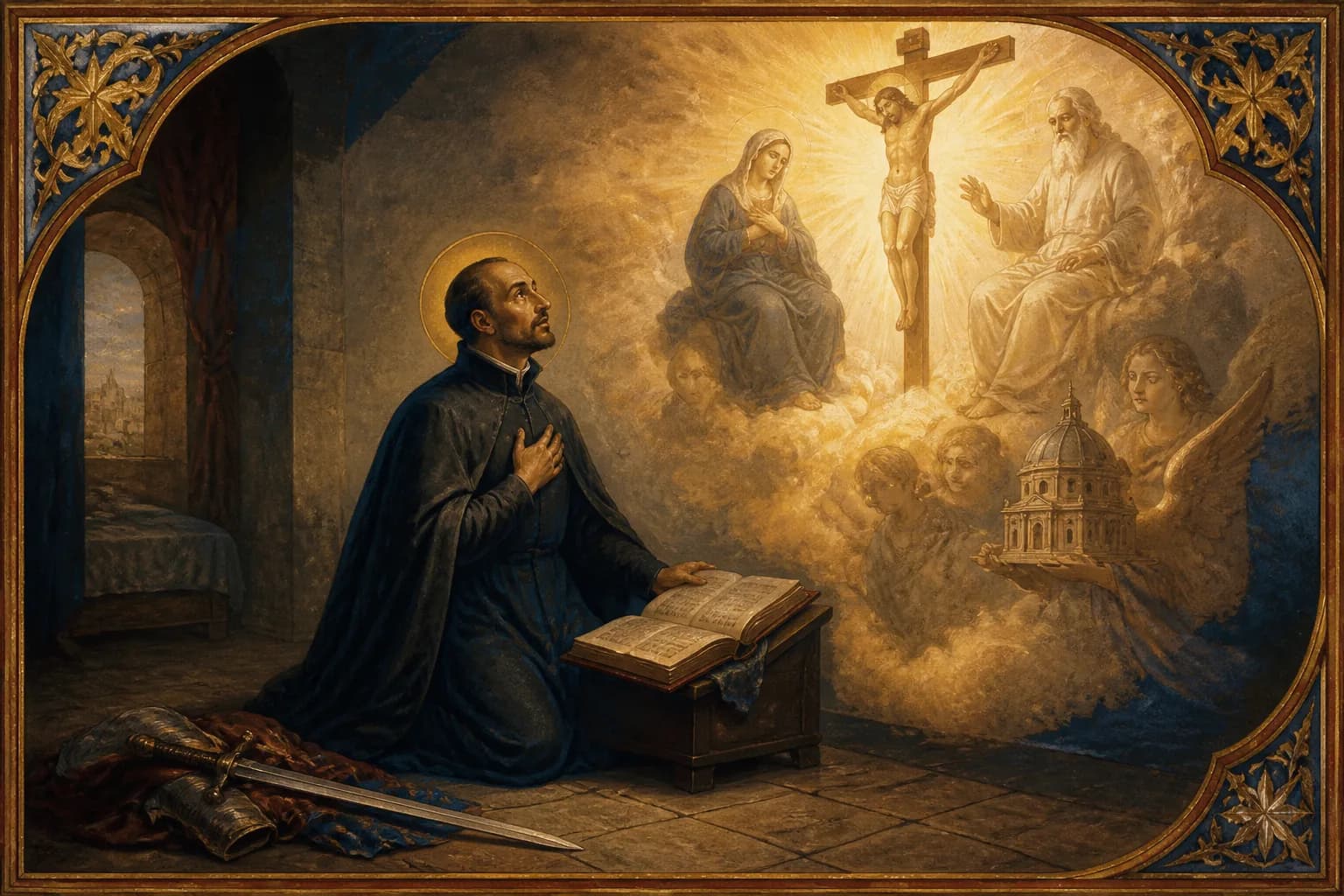
A soldier lies in a castle bed, his leg shattered by a cannonball at Pamplona. He is bored and vain, and he wants romances and tales of chivalry to pass the time. The only books in the house are a life of Christ and a collection of lives of the saints. Reluctantly, Íñigo López de Loyola reads them — and notices something strange. When he daydreams of worldly glory, the excitement fades and leaves him empty. When he imagines following Christ as the saints did, the joy stays. That small act of paying attention to his own inner reactions is the seed of everything we now call the Spiritual Exercises of St. Ignatius of Loyola.
A retreat born from a wound
Ignatius (1491–1556) was not a theologian when this happened. He was a courtier and minor nobleman whose conversion began with that wound in 1521 and deepened during a year of intense prayer at Manresa, near Barcelona, in 1522–23. There, scribbling notes about what helped his soul and what harmed it, he began assembling a practical handbook. He kept refining it for years before Pope Paul III formally approved it in 1548.
The result is not a book to be read so much as a program to be done. The Spiritual Exercises are a structured retreat — classically about thirty days — designed to lead a person, step by step, toward one goal: the interior freedom to seek and find God's will. Ignatius compared them to physical exercises. Just as walking and running train the body, these prayers, examinations, and meditations train the soul.
The Principle and Foundation
Before the retreat proper begins, Ignatius lays down a starting point he calls the Principle and Foundation. In plain terms: a human being is created to praise, reverence, and serve God, and everything else in the world is given to help us toward that end. From this he draws a striking conclusion he names indifference — not coldness, but freedom. We should not be so attached to health or sickness, wealth or poverty, a long life or a short one, that these things choose for us. We hold them loosely, "insofar as they help," so that we remain free to choose what leads us closer to God.
That word freedom is the key to the whole enterprise. The Exercises exist to loosen the grip of what Ignatius called "disordered attachments" — the fears, appetites, and compulsions that quietly make our decisions for us.
The four Weeks
The retreat unfolds in four movements that Ignatius calls Weeks. They are stages of the soul, not strict seven-day blocks; a "Week" might be shorter or longer depending on the person.
The First Week confronts the reality of sin — but always inside the larger reality of God's love and mercy. The retreatant looks honestly at their own life and the brokenness of the world, and arrives not at despair but at gratitude: I am a loved sinner.
The Second Week turns to the life of Christ. Here come the most famous Ignatian meditations — the Call of the King, where Christ invites each person to labor with him, and the Two Standards, which lays bare the choice between the way of Christ and the way of the enemy. This Week builds toward what Ignatius calls the election: a concrete decision about how to follow Christ in one's actual life.
The Third Week accompanies Jesus through his Passion, asking to suffer with the one who suffered for us, and to let the election made earlier be confirmed and deepened.
The Fourth Week rises with the Resurrection and ends in the Contemplation to Attain Love — a prayer that looks back over all of God's gifts and responds with the offering of one's whole self: take, Lord, and receive.
How the prayer actually works
Several practical methods run through all four Weeks, and they are what make the Exercises usable far beyond a monastery.
The first is imaginative contemplation. Ignatius asks the retreatant to enter a Gospel scene through the "composition of place" — to see the road to Bethlehem, hear the voices, smell the stable, and place oneself inside the event as a participant rather than a spectator. Scripture stops being a text on a page and becomes a place one can stand in.
The second is the Daily Examen: a short, repeatable review of the day. Where did I feel God's presence? Where did I turn away? It can be prayed in fifteen minutes and is, for many, the single most enduring gift of Ignatian spirituality.
The third is the Rules for the Discernment of Spirits. This is Ignatius returning to that castle bed and naming what he learned there. He distinguishes consolation — movements that draw us toward faith, hope, and love — from desolation — the pull toward discouragement, restlessness, and self-enclosure. Learning to notice these interior movements, and to respond to them wisely, is at the heart of Ignatian discernment.
A guide, and a version for ordinary life
The Exercises are normally made with a spiritual director or guide — not a lecturer, but a companion who listens, suggests the next prayer, and helps the retreatant read their own experience. The director does not do the work; God and the retreatant do.
And one need not vanish for thirty days. Ignatius foresaw this. In a famous note called the Nineteenth Annotation, he adapted the Exercises to be made in daily life, spread over several months, by people who keep their jobs and families and simply set aside time each day to pray. This is how most people encounter the full Exercises now — the same four Weeks, the same discernment, lived inside an ordinary calendar.
Why it has lasted
For nearly five centuries the Spiritual Exercises have shaped not only the Jesuit order Ignatius founded but countless laypeople, priests, and religious of every kind. Their staying power is no mystery. They take seriously something most of us already know: that our deepest decisions are not made by argument alone, but in the quiet movements of the heart — and that those movements can be paid attention to, sorted out, and brought into the light. Ignatius simply built a reliable method for doing it.
You do not have to be on retreat to begin. Tonight you could pray a single Examen, or sit inside one Gospel scene and let it become real. That is where Íñigo started, too — on his back, with nothing to do but notice what was happening in his own soul.
Crucis Lux tells the life of Saint Ignatius of Loyola as a narrated, illustrated series — from the cannonball at Pamplona to the founding of the Jesuits. The series is coming soon to the app.