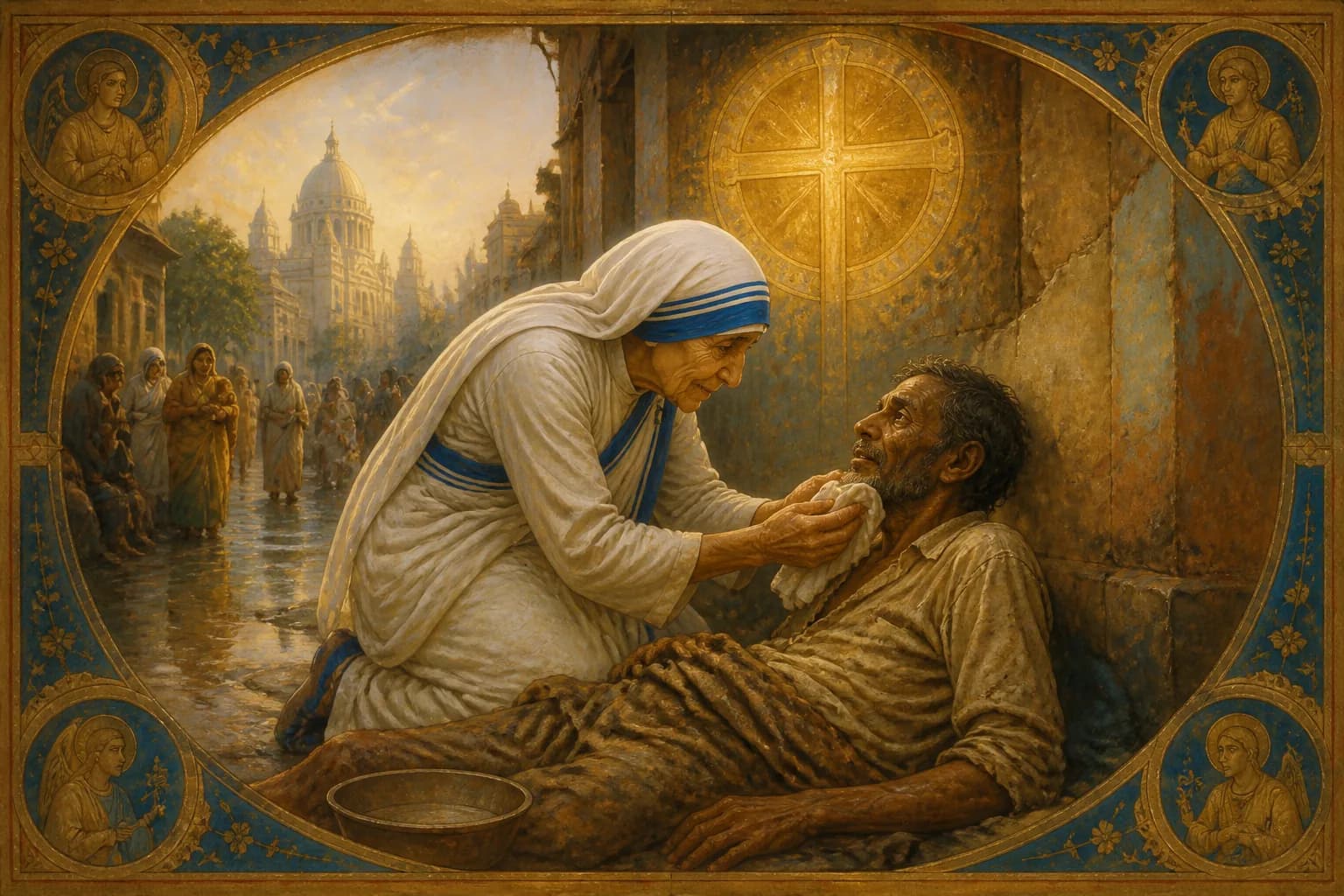
The world knew her as the small woman in the white-and-blue sari who knelt beside the dying in Calcutta and seemed to radiate the nearness of God. What the world did not know — what almost no one knew until after her death — was that for nearly fifty years she felt nothing of that nearness at all. Behind the steady smile was a soul that prayed for hours into what felt like silence, that reached for God and found only absence. She kept this hidden, kept working, kept serving. When her private letters were finally published in 2007, the most famous missionary of the twentieth century turned out to be one of its most surprising witnesses to faith.
The smile and the silence
Anjezë Gonxhe Bojaxhiu was born in 1910 in what is now North Macedonia. At eighteen she left home to become a nun, took the name Teresa, and spent years teaching at a convent school in Calcutta. By every account these were happy, settled years, lit by a real and felt sense of God's love.
Then, in 1946, came what she called "the call within the call" — an interior summons to leave the convent and serve "the poorest of the poor" in the slums. Out of that call grew the Missionaries of Charity, founded between 1948 and 1950. And almost exactly as her great work began, the consolation that had carried her for years simply went out, like a lamp.
The darkness arrives
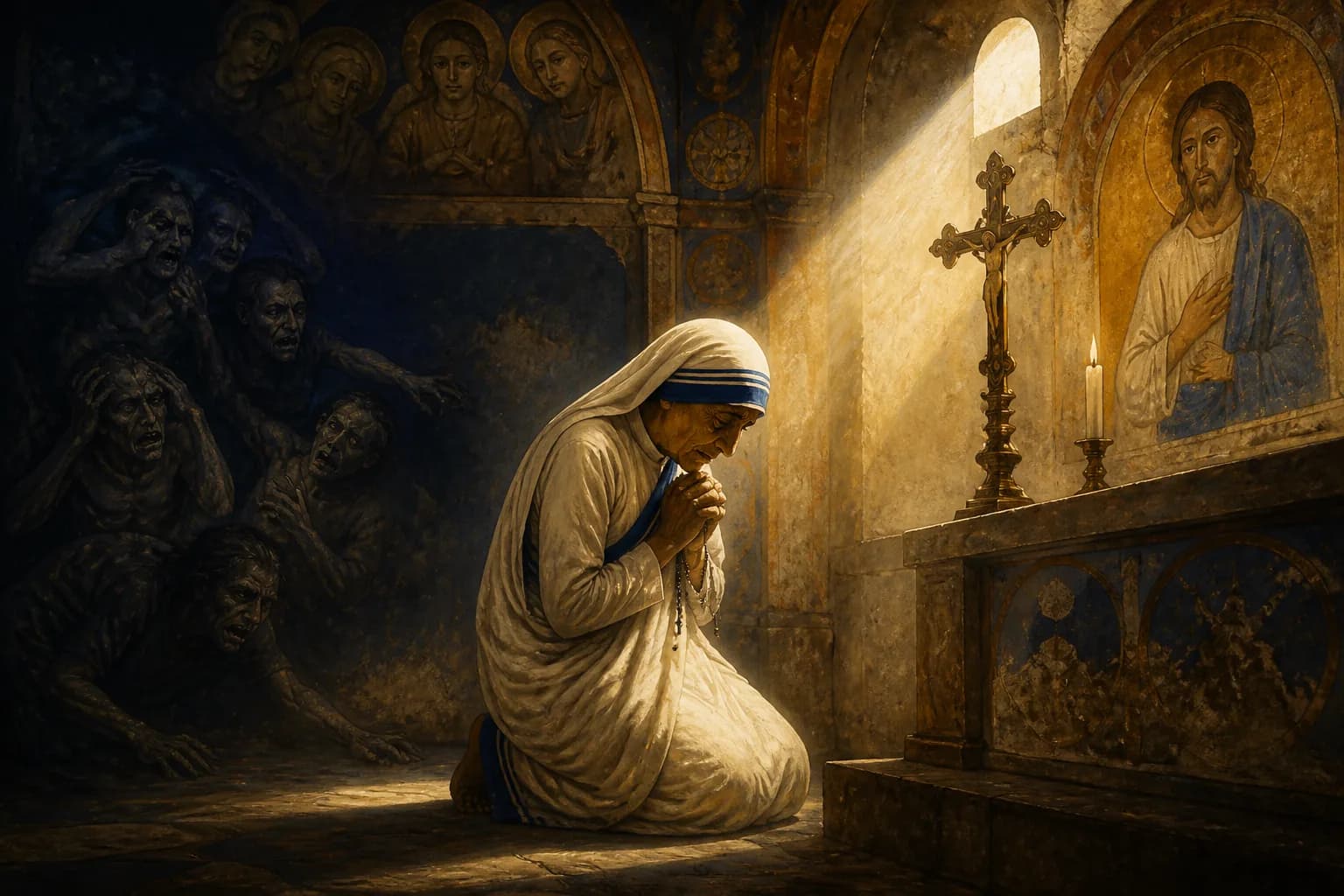
What replaced it she described, again and again, as darkness. Not depression in the clinical sense, and not a loss of belief in God's existence, but the felt absence of the One she had given her whole life to. She wrote of emptiness, of a coldness where there had been warmth, of speaking to God and hearing nothing in return. At times she confessed something even harder — a temptation to doubt that He was there at all.
The cruelty of it was sharp. The closer she drew to the suffering of the poor, the more her own interior life felt like a wasteland. The woman whose face the world read as proof of God's tenderness was, inside, walking in the dark.
What she did with it
Here is the part that turns the story from tragedy into heroism: she never stopped. She did not abandon the order. She did not abandon the poor. She did not abandon her hours of prayer — the same prayer that returned, day after day, what felt like silence.
For a long time the darkness frightened her, because she could not understand it. How could God ask everything of her and then seem to withdraw? She feared it meant she had failed Him, or that her faith was a fraud. She hid it so well that even those closest to her had no idea.
The turning point came through a spiritual director, Father Joseph Neuner, in the late 1950s. He helped her see the darkness not as God's rejection but as God's gift — a sharing in something. Christ on the cross had cried out, "My God, my God, why have you forsaken me?" The poor she served lived every day in a sense of being abandoned, unwanted, unloved. Her own interior abandonment, Neuner suggested, was a way of being joined to both — to the thirst of Christ and to the loneliness of the people she carried in her arms. Once she could read her darkness that way, she stopped fighting it. She even came to love it, as a strange and costly intimacy with the Lord she could no longer feel.
There was, by her own account, only one real respite: a brief lifting of the darkness around 1958 to 1959. After that it returned, and it stayed, with her almost to the end of her life in 1997.
The letters she wanted destroyed
We know all of this because of letters she wrote to her spiritual directors over the decades — the only place she ever let the secret out. She had asked that they be destroyed. She did not want her interior struggle to become public, or to distract from the work, or to be misread.
The Church kept them. After her death, and as part of the examination of her life for sainthood, they were studied and then gathered into the 2007 book Mother Teresa: Come Be My Light, edited by Father Brian Kolodiejchuk. The reaction was immediate and divided. Some readers were shaken: was this proof that even she had secretly lost her faith? Others saw something far greater — that here was a woman who served with total fidelity for half a century without the comfort that we usually imagine carries the saints along.
The dark night of the soul
What she lived has an old and honored name. Centuries earlier, the Spanish mystic St. John of the Cross described the dark night of the soul — a stage in which God withdraws all felt consolation, not to punish but to purify. The believer is stripped of every spiritual "reward," every warm feeling, so that what remains is faith in its purest form: trust held onto for its own sake, love offered with nothing given back.
Read through that lens, Mother Teresa's darkness is not a scandal. It is one of the most extreme and faithful examples of the dark night the Church has ever recorded — sustained not for weeks or years but for most of a lifetime, and carried in secret by a woman the world thought was overflowing.
Why this makes her closer, not farther
It would be easy to assume that the saints feel God constantly, that their joy is the engine of their goodness, and that the rest of us — who pray and feel nothing, who serve while doubting, who keep going on willpower and habit — are somehow second-rate believers. Mother Teresa's letters quietly demolish that idea.
Her life says that faith is not a feeling. It is fidelity. Consolation is a gift when it comes, but its absence is not the absence of God; sometimes it is the very place where the deepest love is tested and proven. She loved God by serving the poor when she felt nothing, and she did it for fifty years. That is not a lesser sanctity. It may be the hardest kind there is.
For anyone who has ever prayed into silence and wondered whether anyone was listening, Mother Teresa is not a distant ideal. She is a companion in the dark — one who kept walking, and who, we now believe, was never as alone as she felt.
Crucis Lux tells the life of Saint Teresa of Calcutta as a narrated, illustrated series — from a convent classroom to the slums of Calcutta and the long night of faith. The series is coming soon to the app.