Few beliefs are as comforting, or as easy to misunderstand, as the Catholic teaching on guardian angels. The picture many people carry is sentimental — a soft glow over a child's bed, a figure in a stained-glass window. The reality the Church proposes is both grander and simpler than that. Angels are not decoration. They are real creatures of God, and Catholic tradition holds that each one of us has an angel assigned to watch over us from the beginning of life to its end. Understanding what that does and does not mean is one of the quietest ways to grow in trust of God's providence.
What angels actually are
The Church teaches that angels are pure spirits — created beings without bodies, possessing intellect and will. They are not the souls of the dead, and they are not little gods. They were made by God, like everything else that exists, and they exist to serve him and to carry out his will. The word angel itself comes from a Greek word meaning "messenger," which describes their role rather than their nature: they are spirits whom God sends.
Because they are spirits, angels are not bound by bodies in the way we are. Scripture and tradition describe them as powerful, intelligent, and personal — each one a distinct individual. They surround the throne of God in worship, and they are sent into the world to accomplish his purposes. Among them, tradition names three archangels: Michael, Gabriel, and Raphael, each associated in Scripture with a particular mission.
It is worth saying plainly what angels are not. They are not equal to God, and they are not to be worshipped. Adoration belongs to God alone. Devotion to the angels — and especially to one's own guardian angel — is never worship of a creature; it is gratitude for a gift God has given, and trust in the care he provides through them.
The teaching on guardian angels
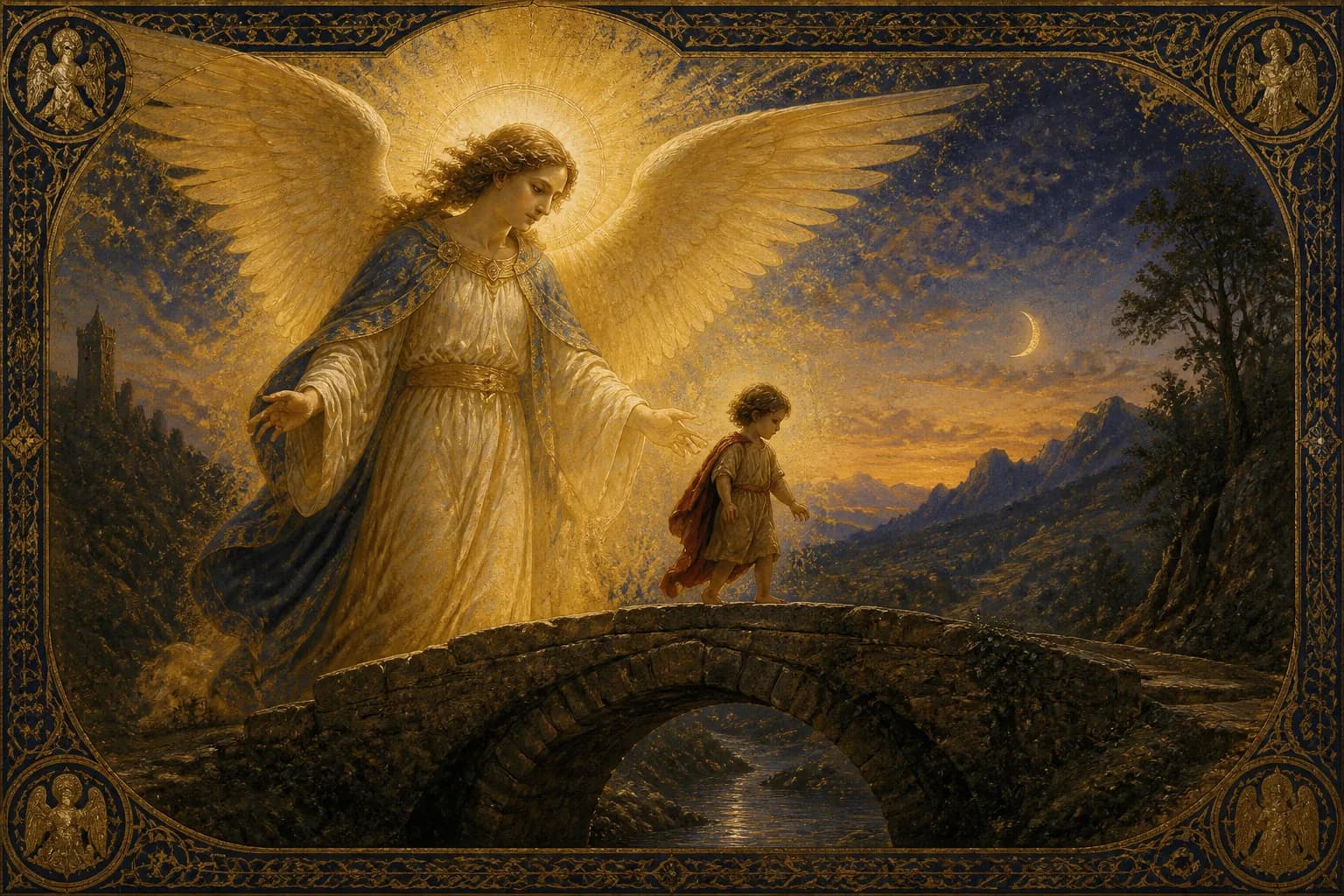
At the heart of this belief is a simple claim: God does not leave us to walk through life alone. Catholic tradition holds that each person has a guardian angel who watches over, guides, and intercedes for them before God. This is not a private opinion or a folk custom; it is part of the Church's settled teaching.
The Catechism of the Catholic Church puts it directly. In paragraph 336 it affirms that from infancy to death human life is surrounded by the watchful care and the intercession of angels. The protection is constant and personal — it does not depend on whether we are aware of it, and it does not wait until we are old enough to ask. From the first moment of a human life, that life is accompanied.
What does a guardian angel do? Tradition describes a role that is steady rather than spectacular. The angel guards us from spiritual and bodily harm, gently prompts us toward the good, and carries our needs before God as an intercessor. The angel does not override our freedom or make our decisions for us; it accompanies a free person, encouraging and protecting, while leaving us the dignity of our own choices.
The biblical basis
The teaching did not appear from nowhere. It grows out of Scripture, where the care of angels for individual people appears again and again.
The clearest single line comes from the Psalms. Psalm 91 promises of the one who trusts in God: "He will command his angels concerning you, to guard you in all your ways." The image is exactly that of a guardian — an angel given a charge over a particular person, for the whole of that person's path through life.
Jesus himself points to the angels of individuals. Speaking of children and of the vulnerable, he warns in the Gospel of Matthew not to despise "these little ones," for "their angels in heaven always behold the face of my Father." It is a striking phrase: each of these small ones has an angel, and that angel stands in the very presence of God.
The narrative books fill in the picture. In the Book of Tobit, the archangel Raphael travels alongside the young man Tobias, protecting him on a long and dangerous journey, guiding his choices, and bringing healing to his family — a vivid portrait of an angel accompanying one person step by step. In the Acts of the Apostles, when Peter is imprisoned and awaiting execution, an angel comes by night, wakes him, loosens his chains, and leads him past the guards to freedom. Across both Testaments, the consistent witness is of angels sent to guard, guide, and rescue real people in real need.
How to relate to your guardian angel
If God has truly given each of us a companion of this kind, the natural response is not anxiety but trust. Catholic devotion to the guardian angel has always been warm and unforced — closer to a quiet friendship than to a ritual.
The simplest practice is to remember that the angel is there. Many Catholics greet their guardian angel in the morning, ask its help before a difficult moment, and thank it at night. Others ask their angel to watch over those they love, or to assist someone in danger. None of this displaces prayer to God; all of it is woven into it, because the angel's whole purpose is to lead us closer to the God who sent it.
The Church marks this companionship on the calendar. The feast of the Guardian Angels is celebrated on October 2, a day set aside to thank God for their protection. A few days earlier, on September 29, the Church honors the archangels Michael, Gabriel, and Raphael together — the great messengers whose missions run through salvation history.
When this devotion is rightly understood, it always points beyond the angel. To trust your guardian angel is, in the end, to trust the providence of God — to believe that you are known, accompanied, and held, and that you were never meant to make the journey alone.
The Angel of God prayer
The most beloved expression of this trust is short enough for a child to learn and deep enough for a lifetime. It has been prayed by Catholics for centuries, morning and night:
Angel of God, my guardian dear, to whom God's love commits me here, ever this day be at my side, to light and guard, to rule and guide. Amen.
In four lines it says everything: that the angel is a gift of God's love, that its presence is constant, and that its work is to light, guard, rule, and guide — always toward the One who gave it.
Crucis Lux brings the lives of the saints and the great truths of the faith to life as narrated, illustrated series — discover them in the app.