The Chaplet of Divine Mercy is one of the most beloved prayers in the Catholic tradition, and one of the easiest to learn. You can pray it on the same Rosary beads you already own, it takes only about seven minutes, and it carries a message that has comforted millions of people: that God's mercy is greater than any sin. If you have never prayed it before, this guide will walk you through it slowly, bead by bead, with the full words of every prayer.
Where the Chaplet comes from
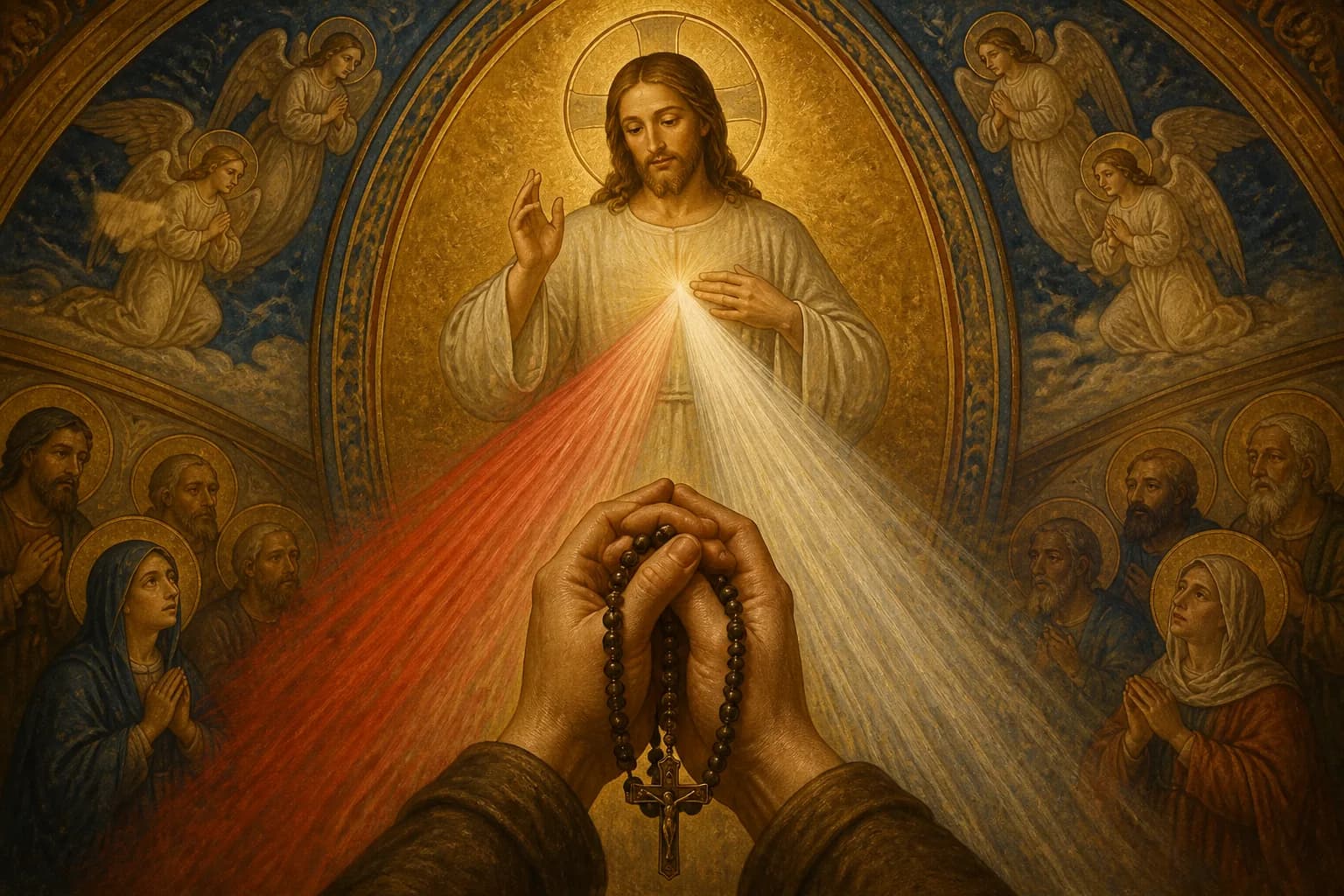
The devotion was revealed to St. Faustina Kowalska, a Polish nun who lived from 1905 to 1938. In the 1930s she recorded in her diary a series of encounters with Christ, who asked her to spread the message of His mercy. Out of those pages came the image of the Merciful Jesus, the Feast of Divine Mercy, and the Chaplet itself — a short, repetitive prayer offered for "us and the whole world."
Faustina died young and largely unknown, but her message did not stay hidden. In the year 2000, St. John Paul II canonized her — the first saint of the new millennium — and on that same day he instituted Divine Mercy Sunday, celebrated on the Sunday after Easter. A fellow Pole who had lived through the darkest years of the twentieth century, John Paul II understood instinctively why a suffering world needed to hear, again and again, that it is not beyond mercy.
What you need
You need nothing more than an ordinary set of Rosary beads — the same five decades you would use for the Rosary. There is no special chaplet to buy. If you do not have beads, you can simply count on your fingers. The whole prayer takes roughly seven minutes, which makes it easy to fit into a lunch break, a commute, or a quiet moment at the end of the day.
The bead-by-bead walk-through
Here is the complete order. Follow it slowly the first few times, and it will quickly become second nature.
1. Begin with the Sign of the Cross
Make the Sign of the Cross to open the prayer.
2. Optional opening prayers
Many people begin with two short prayers given to St. Faustina. They are optional but beautiful:
"You expired, Jesus, but the source of life gushed forth for souls, and the ocean of mercy opened up for the whole world. O Fount of Life, unfathomable Divine Mercy, envelop the whole world and empty Yourself out upon us."
"O Blood and Water, which gushed forth from the Heart of Jesus as a fountain of mercy for us, I trust in You."
3. Our Father, Hail Mary, and the Apostles' Creed
On the opening beads, pray one Our Father, one Hail Mary, and the Apostles' Creed.
4. On each large ("Our Father") bead
Before each decade, on the single large bead, pray:
"Eternal Father, I offer You the Body and Blood, Soul and Divinity of Your dearly beloved Son, Our Lord Jesus Christ, in atonement for our sins and those of the whole world."
5. On each of the ten small ("Hail Mary") beads
On each of the ten beads of the decade, pray:
"For the sake of His sorrowful Passion, have mercy on us and on the whole world."
6. Repeat for five decades
Then move to the next large bead, pray the "Eternal Father" prayer again, and pray "For the sake of His sorrowful Passion..." on the ten small beads. Do this for all five decades. The rhythm is simple: one "Eternal Father" prayer, then ten "have mercy" prayers, five times around.
7. Conclude with the closing prayer
After the fifth decade, conclude by praying three times:
"Holy God, Holy Mighty One, Holy Immortal One, have mercy on us and on the whole world."
Many people then close with the Sign of the Cross, and some add a short invocation such as "Jesus, I trust in You."
The Hour of Mercy
The Chaplet can be prayed at any time, but it is traditionally associated with 3:00 in the afternoon — the "Hour of Mercy," remembered as the hour of Christ's death on the cross. Pausing even briefly at three o'clock to recall the Passion, and to ask mercy for the world, is a small habit with deep roots. If your day allows it, three o'clock is a fitting moment to begin.
Why the words matter
Notice what the Chaplet actually asks for. It is not centered on the person praying it. Again and again it widens out — "on us and on the whole world." It offers the Father the very sacrifice of His Son, and then pleads, on the strength of that sacrifice, for mercy on everyone: the living and the dying, the faithful and the far-off, the people we love and the people we will never meet. That is the heart of St. Faustina's message. Mercy is not a private comfort to be hoarded; it is a flood meant to reach the whole world, and we are invited to help open the gates.
You do not need to feel anything in particular for the prayer to "work." Faustina herself wrote of dry, distracted days. What matters is the offering — turning up, beads in hand, and trusting. Over time, the repeated words sink in, and the simple refrain begins to shape the way you see other people: not as problems, but as souls in need of the same mercy you are asking for yourself.
A prayer for ordinary days
The Chaplet's great strength is its simplicity. It asks no special skill, no long study, no perfect mood — only a few quiet minutes and a willingness to ask. Pray it for a sick friend, for someone who has died, for a hardened heart, for peace, or simply for "the whole world" as the prayer says. Pray it once, and you will likely find you remember most of it the next day. That is by design. It was given to a humble nun precisely so that the most ordinary person, on the most ordinary day, could carry the message of mercy into the world.
Crucis Lux tells the lives of the saints — including St. Faustina Kowalska — as narrated, illustrated stories. The series is coming soon to the app.