
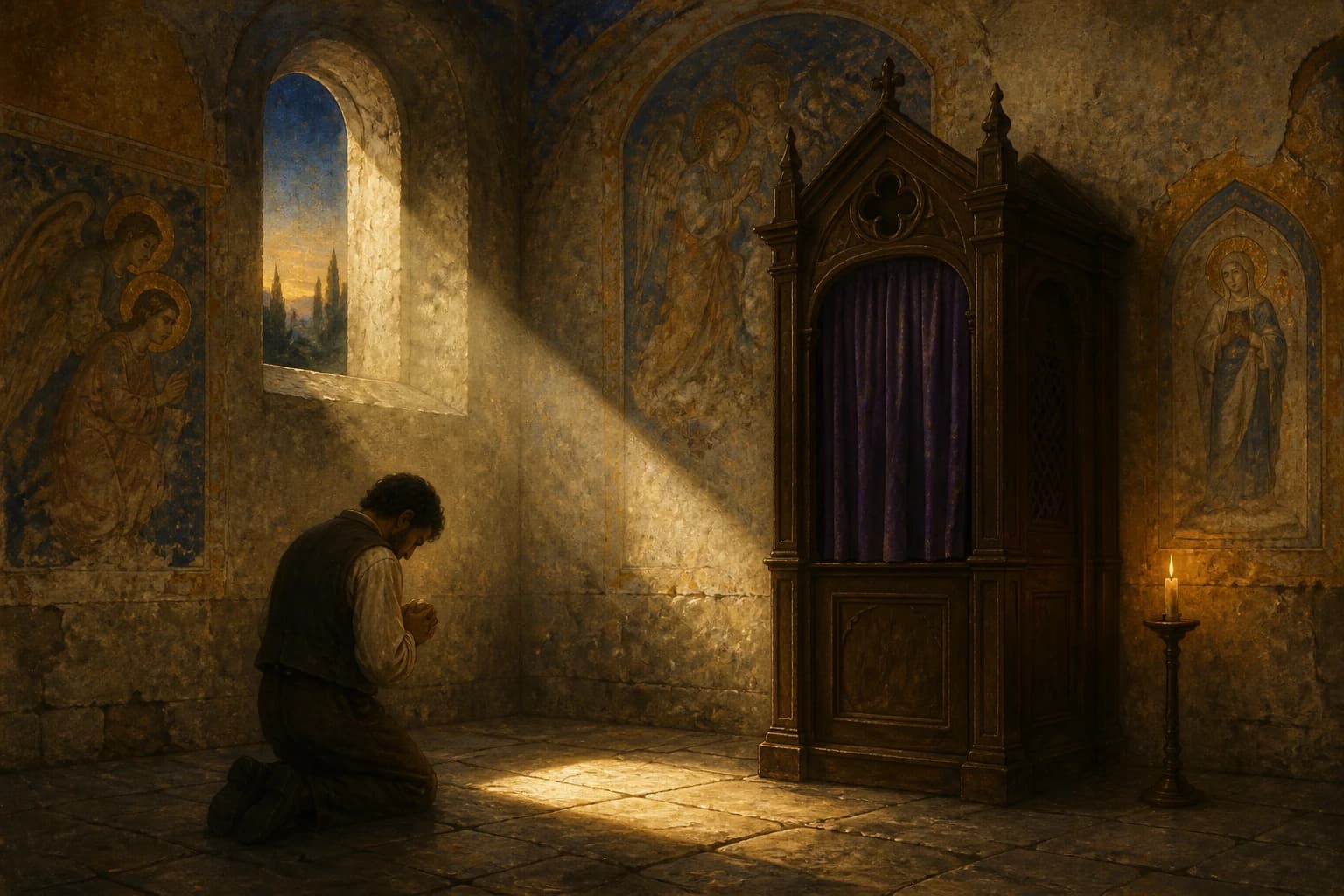
Almost nobody's first difficulty with confession is theological. It is practical: you are not sure what to say, you are afraid of getting the words wrong in front of a priest, and the whole thing feels like a ritual everyone else learned as a child. That fear keeps people away for years. The good news is that the sacrament is short, the words are few, and the priest on the other side of the screen has heard everything already and is not there to be shocked. This guide walks through the whole thing — what to do before you go, what happens inside, and what to say when your mind goes blank.
What confession actually is
The Sacrament of Reconciliation — confession, penance, whatever your parish calls it — rests on a simple claim: that Christ gave his apostles the authority to forgive sins in his name, and that this authority passed to the Church's priests. When the priest speaks the words of absolution, Catholic teaching holds that it is Christ who forgives through him. The priest is not evaluating your performance. He is a witness and an instrument.
That is why the encounter is confidential, unconditional, and, in practice, much gentler than people expect. What you bring is honesty about what you did. What you receive is the assurance that it has been forgiven.
Before you go: the examination of conscience
Take ten quiet minutes beforehand. An examination of conscience is not a search for reasons to feel terrible about yourself; it is an inventory. The traditional frame is the Ten Commandments, but many people find it easier to walk through the ordinary compartments of a life:
- God — Have I prayed? Have I treated faith as something I fit in when convenient? Have I used God's name carelessly?
- Family and home — Have I been harsh, absent, dismissive? Have I honoured my parents, my spouse, my children in how I actually speak to them?
- Work and money — Have I been honest? Have I taken what was not mine, including time and credit? Have I been indifferent to people who needed help I could have given?
- The body — Have I used other people, in person or on a screen, as objects rather than persons?
- Speech — Have I lied, gossiped, damaged someone's reputation, or nursed anger instead of letting it go?
Write nothing down that you would not want found. A short mental list of the things that actually weigh on you is enough.
The Church distinguishes between mortal sin — a grave matter, done with full knowledge and full consent — and venial sin, which weakens but does not sever the relationship. Mortal sins must be confessed. Venial sins need not be, but confessing them is one of the oldest ways Catholics have kept small things from becoming large ones.
Step by step, inside the confessional
Most parishes offer both a screen and a face-to-face option. Either is legitimate; take whichever lets you be honest.
- Enter and make the Sign of the Cross. The priest may greet you or say a short blessing.
- Say the opening line. "Bless me, Father, for I have sinned. It has been six months since my last confession." If it has been twenty years, say twenty years. If you have never been, say that — it changes nothing except that the priest will walk you through it.
- Confess your sins. Plainly, without a speech. "I lied to my wife about money." "I have been drinking too much and taking it out on my children." Kind and specific beats vague and elaborate. If a sin was grave, say roughly how often.
- Listen. The priest may ask a clarifying question, or offer a sentence or two of counsel. He may say nothing at all beyond the penance.
- Receive your penance. Usually a short prayer or a specific act. Do it as soon as you reasonably can — that day if possible.
- Pray the Act of Contrition. If you do not know it by heart, say so; every confessional has a card, and any honest expression of sorrow is valid.
- Receive absolution. The priest extends his hand and prays the formula of absolution, ending "I absolve you from your sins, in the name of the Father, and of the Son, and of the Holy Spirit." You answer, "Amen."
- Leave and do your penance. That is the whole sacrament.
What to say when your mind goes blank
Two sentences solve almost every case of confessional stage fright:
"Father, I haven't been in a long time and I'm not sure how to do this. Can you help me?"
Priests hear this constantly, and most will visibly relax when they do — it is a far easier confession to hear than a polished one. From there he will ask simple questions and you answer them.
The Act of Contrition
The classic form, worth learning by heart:
O my God, I am heartily sorry for having offended Thee, and I detest all my sins because of Thy just punishments, but most of all because they offend Thee, my God, who art all good and deserving of all my love. I firmly resolve, with the help of Thy grace, to sin no more and to avoid the near occasions of sin. Amen.
A shorter modern form is equally acceptable: "My God, I am sorry for my sins with all my heart. In choosing to do wrong and failing to do good, I have sinned against you, whom I should love above all things. I firmly intend, with your help, to do penance, to sin no more, and to avoid whatever leads me to sin. Amen."
The seal, and why you can be blunt
The seal of confession is absolute. A priest may not disclose what he hears, to anyone, for any reason — not to police, not to a bishop, not to you outside the confessional. Canon law treats a direct violation as one of the gravest offences a priest can commit. Practically, this means you can be entirely direct. You are not managing his opinion of you; there is no file, and there is no memory he is permitted to use.
If it has been years
The longer the gap, the heavier the door feels — and the lighter the room is once you are through it. A few things that help:
- Go to a parish where nobody knows you if that lowers the barrier. It is not cheating.
- Check the schedule online, or ask the parish office for an appointment. Confession by appointment is normal and unhurried.
- Don't rehearse a script. Bring the two or three things that genuinely weigh on you and let the priest do his job.
- Expect it to be short. Most confessions take under five minutes. The dread almost always outlasts the sacrament.
Saint Augustine, whose Confessions gave the word its literary afterlife, spent years circling the same admission before he made it — and described what followed not as humiliation but as relief. That pattern has not changed in sixteen centuries. If you want the long version of that story, we tell it in Augustine and the stolen pears. And if you are rebuilding a prayer habit alongside the sacrament, how to pray the Rosary is the usual place people start.