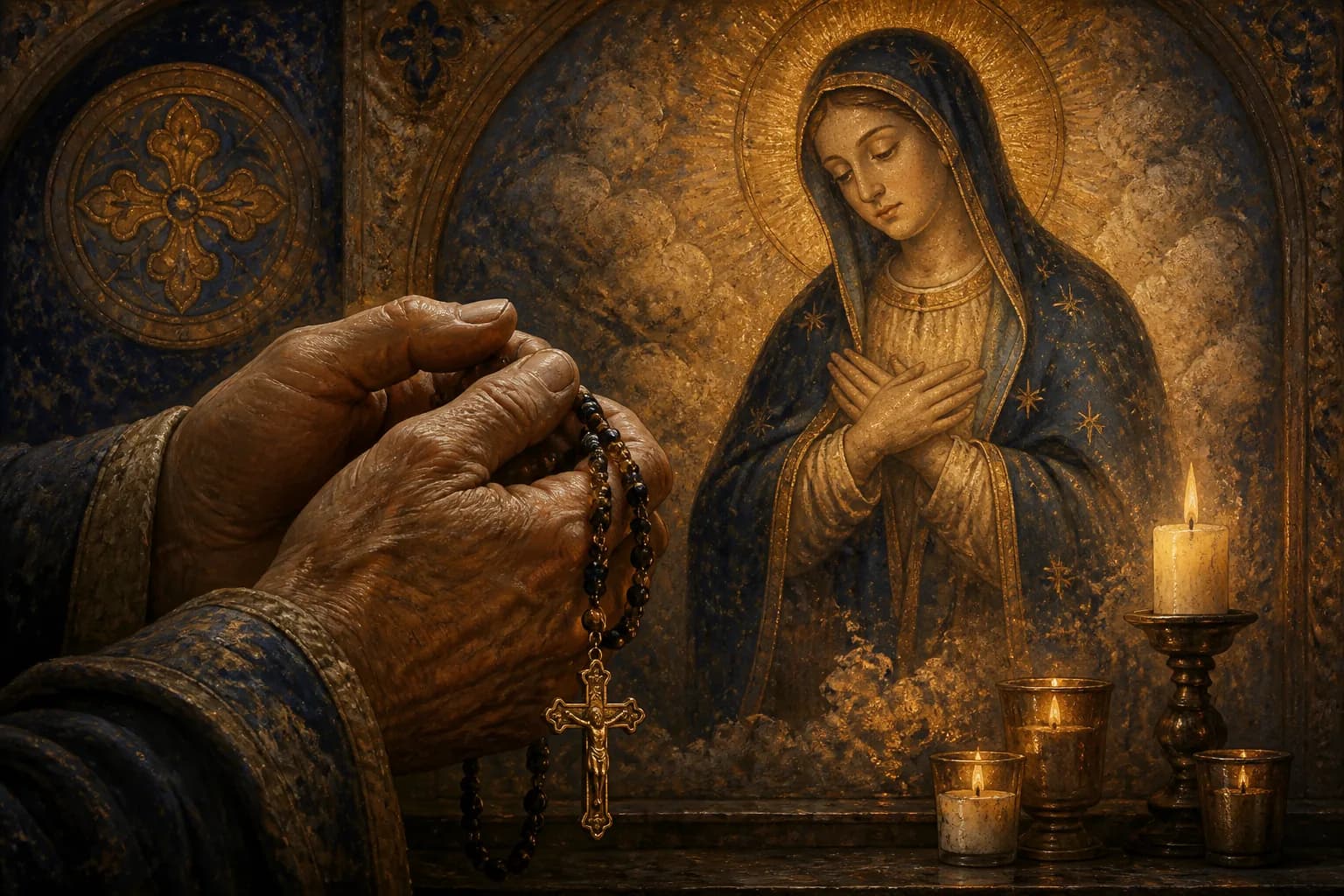
The Rosary can look complicated from the outside — a loop of beads, a string of repeated prayers, a vocabulary of "decades" and "mysteries." In practice it is one of the simplest and steadiest prayers a Catholic can learn, and you can be praying it well within an afternoon. At its heart the Rosary is two things happening at once: your lips say familiar vocal prayers while your mind quietly meditates on scenes from the lives of Jesus and Mary. The beads are not the point; they are just a way to keep your hands busy and your count honest so your heart is free to pray. This guide walks you through the whole thing, prayer by prayer.
What the Rosary actually is
The Rosary combines vocal prayer with meditation. While you repeat the Hail Mary again and again, you are not meant to focus on the words alone but to picture a particular event — a "mystery" — from the Gospel. The repetition is deliberate. Like a gentle, recurring rhythm, it settles the mind so that the meditation can sink in. Saint John Paul II called it a prayer in which "we contemplate the face of Christ" through the eyes of his mother.
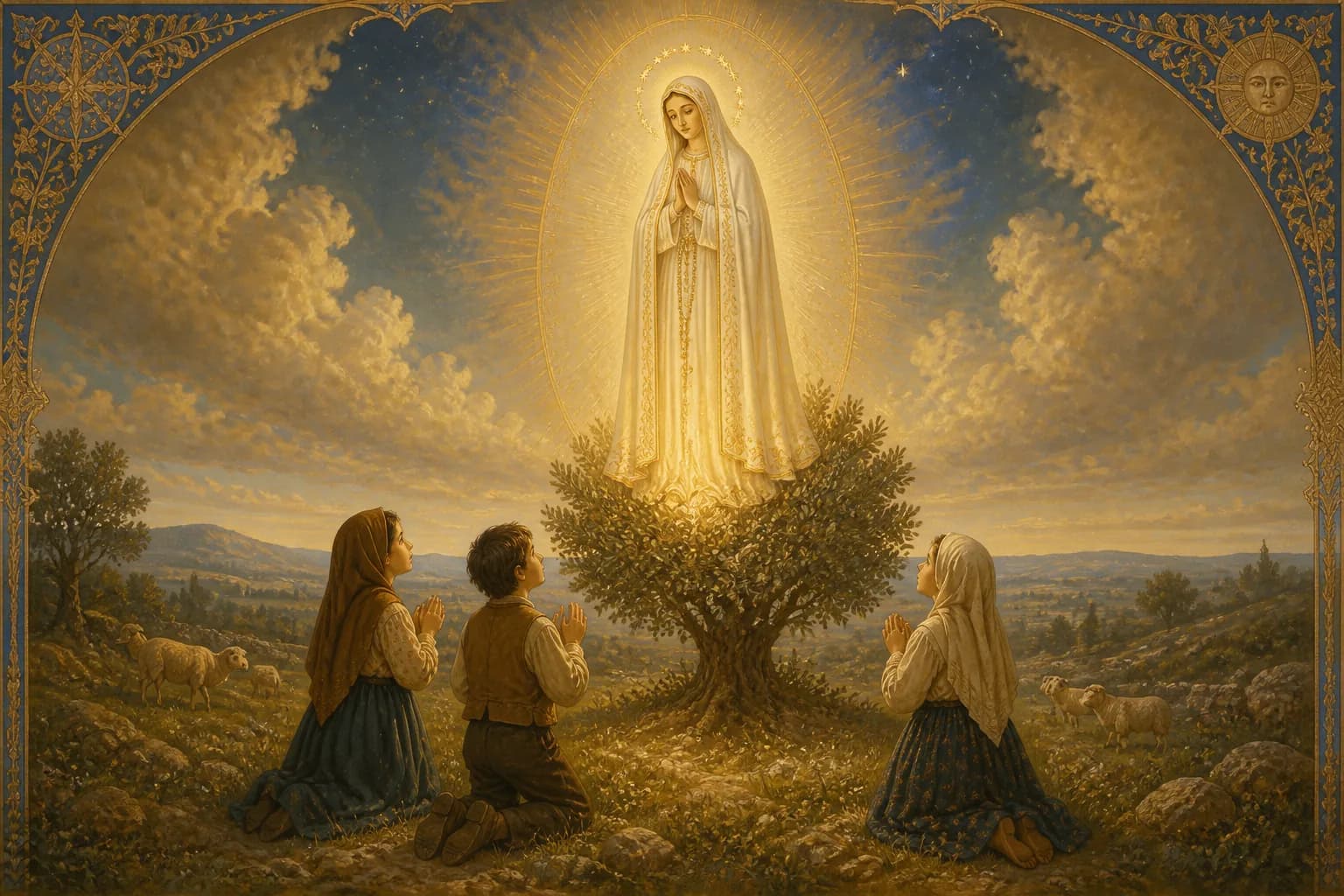
It also has a special place in modern Catholic devotion because of Fátima. In 1917, in a small Portuguese village, three shepherd children reported that Our Lady appeared to them and asked, again and again, for the daily Rosary, praying for peace and for the conversion of sinners. That request is one reason the daily Rosary became so central for so many Catholics in the last century.
Understanding the beads
Hold a Rosary and you will find a clear, repeating shape. Start at the crucifix. Just above it comes a single large bead, then a group of three small beads, then another single large bead — this short section is sometimes called the "tail." The tail joins a medal or centerpiece, and from there opens the main loop.
The loop is made of five "decades." Each decade is one large bead followed by ten small beads. So the pattern around the loop is: large bead, ten small beads, large bead, ten small beads, and so on, five times. The large beads mark where you pray an Our Father; the ten small beads are for the ten Hail Marys. Once you can feel that pattern under your fingers, you never really need to look down again.
The step-by-step sequence
Here is the full order, from the crucifix all the way around and back.
1. On the crucifix. Make the Sign of the Cross, then pray the Apostles' Creed.
2. On the first large bead. Pray one Our Father:
Our Father, who art in heaven, hallowed be thy name; thy kingdom come, thy will be done, on earth as it is in heaven. Give us this day our daily bread, and forgive us our trespasses, as we forgive those who trespass against us; and lead us not into temptation, but deliver us from evil. Amen.
3. On the three small beads. Pray three Hail Marys (traditionally for an increase of faith, hope, and love):
Hail Mary, full of grace, the Lord is with thee. Blessed art thou among women, and blessed is the fruit of thy womb, Jesus. Holy Mary, Mother of God, pray for us sinners, now and at the hour of our death. Amen.
4. After the three Hail Marys. Pray the Glory Be:
Glory be to the Father, and to the Son, and to the Holy Spirit; as it was in the beginning, is now, and ever shall be, world without end. Amen.
5. Now pray the five decades. For each decade, repeat these steps:
- Announce the mystery for that decade (for example, "The First Joyful Mystery — the Annunciation") and take a moment to picture it.
- On the large bead, pray one Our Father.
- On the ten small beads, pray ten Hail Marys while meditating on the mystery.
- Pray a Glory Be.
- Optionally add the Fátima Prayer, which the children of Fátima said Our Lady asked them to pray after each decade:
O my Jesus, forgive us our sins, save us from the fires of hell, and lead all souls to heaven, especially those in most need of thy mercy.
Then move to the next large bead and begin the following decade the same way, until all five are complete.
6. After the five decades. Pray the Hail Holy Queen (the Salve Regina):
Hail, Holy Queen, Mother of Mercy, our life, our sweetness, and our hope. To thee do we cry, poor banished children of Eve; to thee do we send up our sighs, mourning and weeping in this valley of tears. Turn then, most gracious advocate, thine eyes of mercy toward us, and after this our exile show unto us the blessed fruit of thy womb, Jesus. O clement, O loving, O sweet Virgin Mary.
Conclude with a closing prayer and a final Sign of the Cross. Many people end by praying for the intentions of the day or with a simple line asking that, meditating on these mysteries, they may imitate what they contain and obtain what they promise.
The four sets of Mysteries
The Rosary is meditation, so it needs something to meditate on. The mysteries are arranged in four sets of five, traditionally prayed on set days of the week.
The Joyful Mysteries (Monday and Saturday): the Annunciation, the Visitation, the Nativity of Jesus, the Presentation in the Temple, and the Finding of the child Jesus in the Temple.
The Sorrowful Mysteries (Tuesday and Friday): the Agony in the Garden, the Scourging at the Pillar, the Crowning with Thorns, the Carrying of the Cross, and the Crucifixion.
The Glorious Mysteries (Wednesday and Sunday): the Resurrection, the Ascension, the Descent of the Holy Spirit at Pentecost, the Assumption of Mary, and the Coronation of Mary as Queen of Heaven.
The Luminous Mysteries (Thursday): the Baptism of Jesus in the Jordan, the Wedding at Cana, the Proclamation of the Kingdom, the Transfiguration, and the Institution of the Eucharist. These five were added by Saint John Paul II in 2002 to fill in the years of Jesus' public ministry.
You do not have to pray all four sets in a day. Praying one set — five decades — is the ordinary daily Rosary, and the day of the week tells you which mysteries to use.
Starting small
If five decades feels like a lot at first, begin with one. The point is not speed or even completeness; it is presence. Let the words carry you while you keep company with the scenes of the Gospel. Over time the rhythm becomes second nature, and the prayer that once looked complicated becomes the easiest part of your day.
Crucis Lux brings the story of Fátima and the call to the daily Rosary to life as a narrated, illustrated series — explore it in the app.