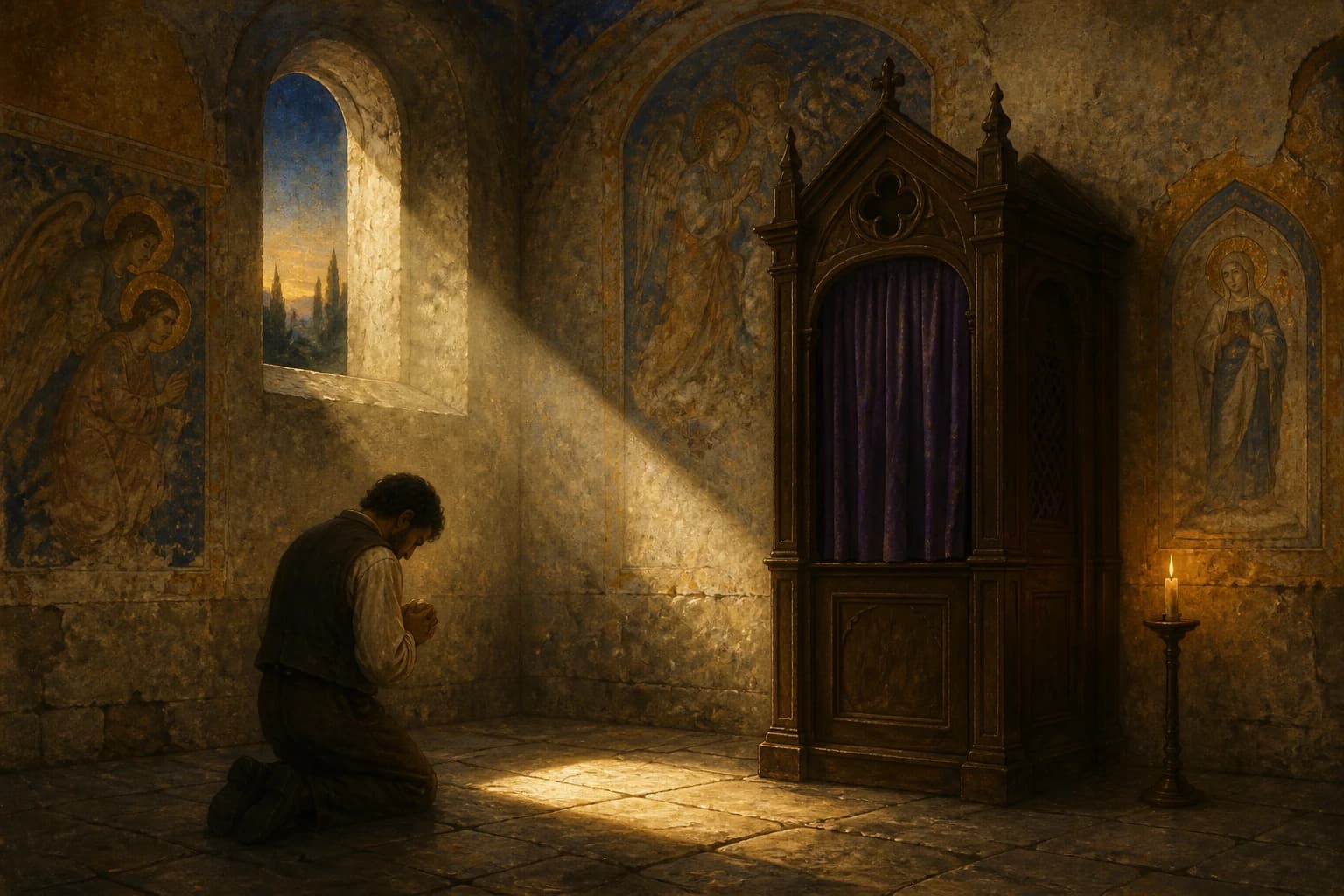
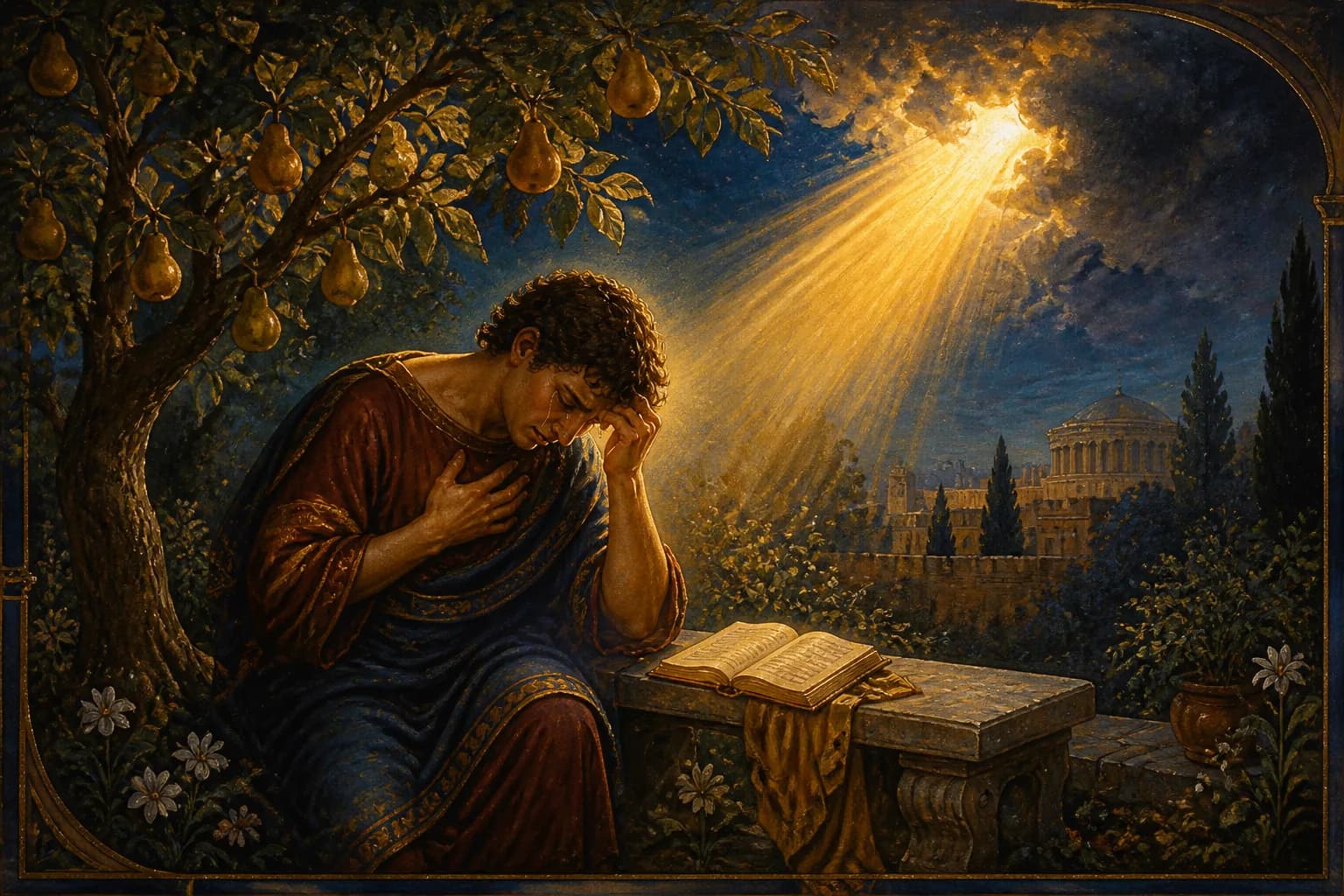
He was thirty-one years old, sitting in a garden in Milan, wracked with weeping, paralyzed between two lives. He had been a professor of rhetoric — the equivalent today of a chair in a major university — a Manichaean for nine years, then a Neoplatonist, then someone who had read enough Christian Scripture to know that what he had been chasing all his life was in it but who could not let go of his mistress, his career, or his philosophical pride. He heard a child's voice from a neighboring house, singing or chanting in Latin: tolle lege, tolle lege. Take and read. He picked up the book of Saint Paul's epistles he had set aside, opened at random, and read Romans 13:13–14. By the end of that page he was a different man. Within seven months he was baptized. Within a decade he was a bishop. Within seventeen centuries his Confessiones would still be the most read autobiography in Western literature.
The story of Augustine's conversion is the story of two scenes — one at sixteen and one at thirty-one — that he wrote about in the 390s in a book unlike anything that had been written before.
A North African Boyhood
Aurelius Augustinus was born November 13, 354, in Thagaste — modern Souk Ahras, Algeria — to Patricius, a pagan municipal official, and Monica, a devout Christian. The family was Berber, not Roman; Augustine wrote in Latin but his first language was likely Punic. He spent the first part of his life in the small towns of the North African interior and the latter part in the great cities of the Mediterranean — Carthage, Rome, Milan.
Monica is one of the most fully drawn characters in the Confessions. She wept over Augustine's behavior in his teenage years, followed him across the Mediterranean against his wishes, and outlived him only by months before her own death at Ostia, the port of Rome, in 387 — an episode Augustine renders in Book IX in some of the most tender prose he ever wrote.
The Pear Tree: An Adolescent Confession
The pear tree episode is in Book II of the Confessions and is famously disproportionate to its surface event. Augustine is sixteen. He and a gang of friends climb over a wall at night and steal a load of pears from a tree in a neighbor's orchard. The pears are not particularly good. They throw most of them to the pigs.
Augustine spends an entire book of the Confessions analyzing this theft. The point is not the value of what was stolen; the point is the structure of the will that did the stealing. We loved doing wrong because it was wrong, he writes (the Latin: non amabam aliud nisi furtum, non re alia inlecebrosus nisi quia non liceret). He sees, in retrospect, that he did not steal because he was hungry, or because the pears were good, or because he needed them. He stole because the act itself was forbidden and he wanted the company of those who were doing it.
The pear tree becomes Augustine's mature meditation on original sin. It is the first place in Western literature where someone systematically examines a small adolescent act for what it reveals about the disordered will. Read carefully, the passage is one of the foundational documents of moral psychology.
Carthage, Rhetoric, and the Concubine
Augustine moved to Carthage at seventeen to complete his rhetorical studies. He fell in with a stable, monogamous, common-law partner — a woman whose name he does not preserve in the Confessions — and they had a son together, Adeodatus, "given by God." Augustine lived with this woman faithfully for about fifteen years.
He also fell in with the Manichaeans, a dualist religious movement combining elements of Persian, Christian, and Gnostic thought, whose teaching that the body and material world were the work of an evil counter-deity offered him a sophisticated alternative to the simpler African Christianity of his mother. He remained a Manichaean hearer for nine years.
He moved to Rome in 383 to teach rhetoric, then to Milan in 384 as the city's official professor of rhetoric — a prestigious imperial appointment, since the imperial court was at Milan that year.
Ambrose of Milan
Milan changed everything. The bishop was Ambrose, one of the most intellectually formidable Christians of the fourth century — author, statesman, hymnographer, and the only man in the empire who had recently forced an emperor (Theodosius) to do public penance.
Augustine went to Ambrose's homilies at first to study his rhetoric. Within months he was attending to what Ambrose was actually saying about Scripture. Ambrose preached in an allegorical mode that allowed Augustine to read Genesis without the literalism that had made Manichaeism's critique of the Old Testament so appealing.
Ambrose was also Augustine's first model of a Christian intellectual whom Augustine could respect. By 385 Augustine had broken with the Manichaeans. He had become a catechumen. He had not yet been baptized. He could not, he confessed to himself, let go of two things: the woman he was living with and the philosophical autonomy of his career.
Monica intervened. She arranged, against Augustine's preferences, that the concubine should be sent back to Africa so that Augustine could be married to a more socially appropriate Christian girl who was, at the moment, too young to wed. The concubine, the Confessions records, returned to Africa vowing she would never know another man. Augustine, mortified by his own weakness, took a new mistress to wait out the engagement. He hated himself for it.
The Garden in Milan: August 386
The conversion comes in Book VIII of the Confessions, almost in the precise middle of the work.
A visitor named Ponticianus, a fellow North African, comes to the house Augustine is sharing with his friend Alypius. Ponticianus sees a Pauline manuscript on a table and is surprised. He tells them the story of Antony of the Desert, and of two imperial officials in Trier who had read Antony's life and immediately abandoned their careers to become monks.
Augustine, listening, is shattered. The story exposes everything he has been resisting. You stand naked in your own sight, he writes (the Latin: nudus ipse mihi conspectu meo). He is not, he sees, a man weighing two intellectual options. He is a man who has known what he should do for years and has been refusing to do it.
He flees out into the garden of the house. Alypius follows. Augustine throws himself down under a fig tree — a deliberate echo of the wandering Israelite under the vine and the fig tree — and weeps bitterly. He prays: How long, Lord, how long? Tomorrow and tomorrow? Why not now?
Then he hears the voice. A child's voice from a neighboring house — Augustine cannot tell whether boy or girl — chanting in a sing-song way: tolle lege, tolle lege. Take up and read.
He stops crying. He cannot recall any children's game that uses those words. He returns to the bench where Alypius is sitting. He picks up the codex of Paul's letters he had left there. He opens it at random — in whatever passage my eye should first fall on — and reads Romans 13:13–14:
Not in rioting and drunkenness, not in chambering and wantonness, not in strife and envying. But put ye on the Lord Jesus Christ, and make not provision for the flesh, in concupiscence.
He reads no further. He does not need to. The light, he says, of certainty flooded into his heart. Alypius asks to see the passage. He reads on a few lines and arrives at the verse him that is weak in the faith receive. He turns to Augustine and says: that is for me. He is converted too. The two men go inside to tell Monica.
Baptism, Ostia, and After
Augustine resigned his chair, retired with friends and his son to a country house at Cassiciacum, north of Milan, and prepared for baptism. On the Easter Vigil of 387 — the night of April 24–25 — Ambrose baptized Augustine and Adeodatus in the Milan baptistery. The remains of that baptistery are still visible beneath the Milan cathedral. Pilgrims can stand on the spot.
That summer Augustine, Monica, Adeodatus, and a small group set out to return to North Africa. They stopped at Ostia, the port of Rome, to wait for a ship. There, in the days before her death, Augustine and Monica had the famous conversation at a window overlooking a garden — the Vision at Ostia of Book IX — in which mother and son tasted together, briefly, what eternal life with God might be. Within days Monica was dead of fever. She was buried in Ostia. Augustine wept; for the first time in the Confessions he records that he allowed himself to grieve openly.
He returned to Africa, lost his son Adeodatus to fever in 389 at age sixteen, and gradually became drawn into Church ministry against his preferences. He was ordained priest in 391 and consecrated bishop of Hippo Regius — modern Annaba, Algeria — in 395. He held that see for the next thirty-five years.
What the Confessions Did
He wrote the Confessions around 397–400, in his early forties, looking back. The book is addressed throughout to God, not to a reader; the reader is overhearing a prayer. Nothing quite like it had been written before. Greco-Roman autobiography existed (Caesar's Commentarii, Marcus Aurelius's Meditations), but no one had written interior autobiography — a sustained examination of the development of a single soul from infancy to maturity in dialogue with God.
The book has been continuously in print since the invention of printing. It is read in philosophy departments, literature departments, theology departments, and on the bedside tables of ordinary Catholics. It is also the foundational document for everything Augustine wrote later — On the Trinity, The City of God, his sermons, his letters.
Why the Pear Tree and the Garden Matter Together
The two scenes are deliberately paired. The pear tree at sixteen is Augustine sinning for its own sake — joy in disobedience as such. The garden in Milan at thirty-one is the inverse — joy in obedience as such, in turning at last to the God he had been running from his entire conscious life.
Between them lies twenty-six years of intellectual searching, sexual restlessness, professional success, and a mother who never stopped praying. The conversion is sudden in execution and slow in preparation. Augustine himself names the pattern. Late have I loved you, beauty so ancient and so new, late have I loved you, he writes in Book X (Latin: sero te amavi, pulchritudo tam antiqua et tam nova, sero te amavi). The lateness is the point. The grace did not depend on the readiness.
For broader context on Catholic conversions across the centuries, see the conversion of Saint Paul on the road to Damascus and the restoration of Peter on the shore of Galilee. Augustine stands in this tradition: not the lightning of Damascus, not the slow grief of denial repaired, but a third pattern — the long intellectual climb of a brilliant man who finally surrenders.
Listen to Augustine on Crucis Lux
Crucis Lux tells the story of Augustine's conversion as a slow-paced, illustrated audio series — every scene narrated, every panel illustrated in the style of medieval frescoes, in five languages.