Augustine of Hippo
The long walk home
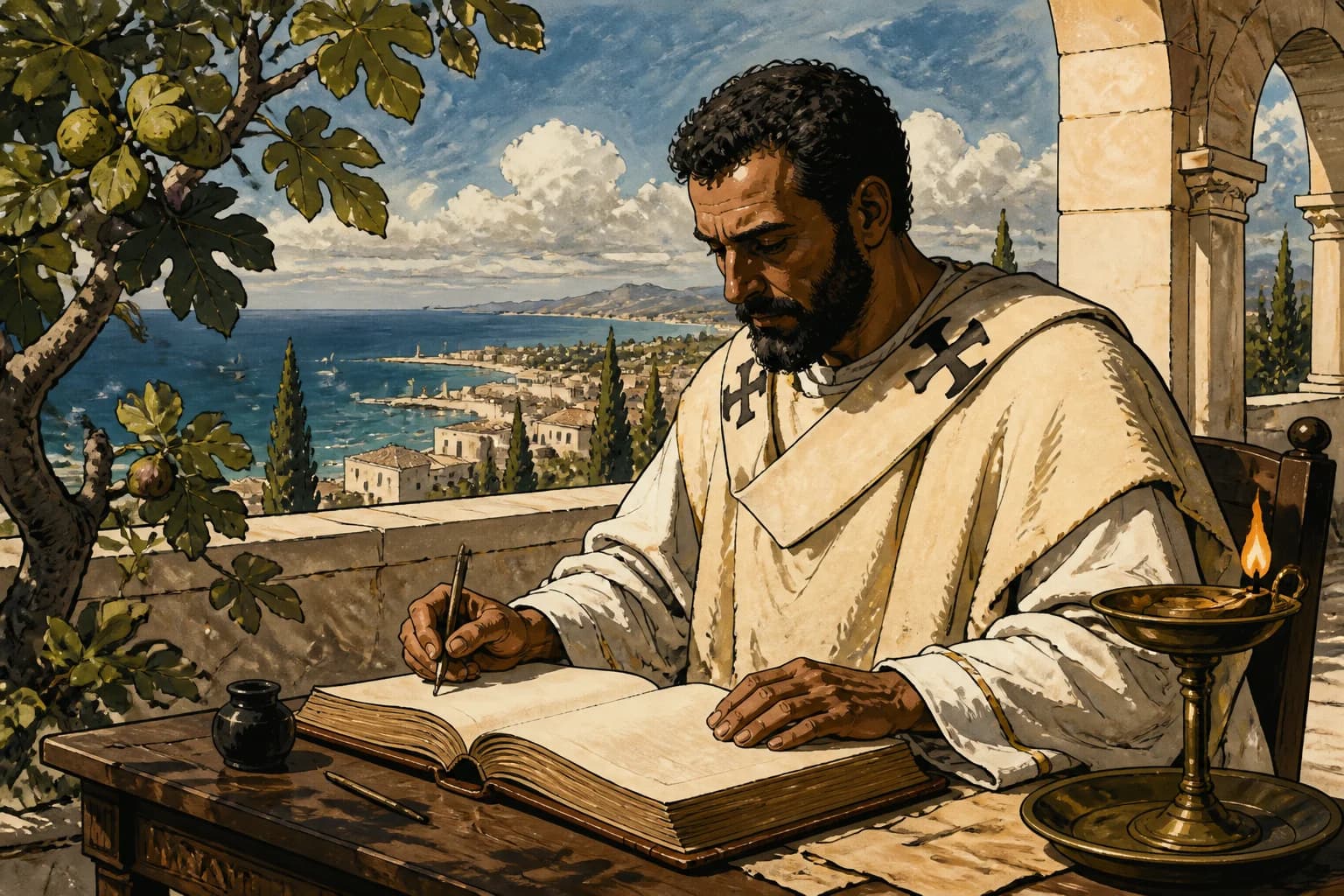
The saint who gives his name to Pope Leo XIV's order, the Augustinians. Eighteen episodes on a son of Roman Numidia, born in three hundred and fifty-four, who wrote the first interior memoir in Western literature. From the schools of Madauros to the gardens of Milan, from the unnamed concubine to the penitential Psalms tacked to the bedroom wall as the Vandals besieged Hippo.
18 episodes · Narrated in English, Portuguese, Spanish, French and German
Episode 1 is free
Episodes
- 01
The Son of Thagaste
Roman Numidia, the thirteenth of November in the year 354. A town in the interior of North Africa. A boy is born into a Latin-speaking Berber family.
- 02
The Pears
Thagaste, the summer of 369. A year without school. The year the boy becomes the Church's first problem.
- 03
Carthage
Carthage, province of Africa Proconsularis, autumn of 370. The second city of the Western Roman Empire. A cauldron.
- 04
The Woman Without a Name
Carthage, 370 to 383. Fourteen years with a woman whose name no one wrote down. Their son will die at sixteen.
- 05
Hortensius
Carthage, the library of the school of rhetoric, 373. A book by Cicero. A single afternoon. A life turns toward philosophy.
- 06
The Kingdom of Light
Carthage, 373 to 383. Nine years among the Manichaeans. The meeting with Faustus, and the end of a faith that was not his own.
- 07
The Flight to Rome
Carthage, autumn of 383. A night at the harbor. A mother praying in the chapel of Saint Cyprian. A son who leaves without saying goodbye.
- 08
The Imperial Chair
Milan, late 384. The imperial capital. A bishop who governed a province before he was ordained. A voice that changes everything.
- 09
His Mother Arrives
Milan, the first months of 386. Monica arranges a marriage. The concubine is sent away. A torn heart.
- 10
The Books of the Platonists
Milan, spring and summer of 386. Plotinus reaches Augustine's hands. The intellectual obstacle gives way. The obstacle of the will does not.
- 11
The Garden
Milan, late summer of 386. An August afternoon. Children's voices in the garden next door. A book opened at random.
- 12
The Vision at Ostia
Ostia, the port of Rome, autumn of 387. Mother and son at a window, speaking of what lies beyond words. Days later, she falls ill and dies.
- 13
The Losses of Thagaste
Thagaste and Hippo, Roman Africa, 388 to 391. The death of the son. Ordination by force.
- 14
The Bishop of Hippo
Hippo Regius, Africa Proconsularis, 395 to 410. The bishop's house. The courtrooms. The Donatists.
- 15
The Confessions
Hippo, 397 to 400. Thirteen books. The first inner memoir of Western literature.
- 16
The Fall of Rome
Rome, the twenty-fourth of August, 410. Alaric's Visigoths enter through the Salarian Gate. In Hippo, a bishop begins to write.
- 17
Pelagius
The Christian Mediterranean, 411 to 418. Two men who never meet wage the controversy that will shape Western Christianity.
- 18
The End of the World
Hippo Regius, spring and summer of 430. The Vandals besiege the city. A seventy-five-year-old bishop dies reading the Psalms.
How this series was researched
The narration and the place and date labels were broken down into factual claims and checked against sources: 479 claims in this series were checked against a cited source. Where the sources did not support a claim, the text was corrected or reduced to what the sources actually say.
A second, independent check then went through the whole series again.
The text was reviewed separately in each of the five languages it is narrated in.
Main sources
- Confessiones — Augustine of Hippo (c. 397–400)
- De civitate Dei — Augustine of Hippo (413–426)
- Vita Augustini — Possidius of Calama (5th century)
- General Audiences on Saint Augustine — Benedict XVI (2008)
- Augustine of Hippo: A Biography — Peter Brown (1967)
Tradition and debate
Where the sources are thin or disagree, the series says so. For example:
- That Augustine was baptized in the octagonal baptistery beside Milan's cathedral, whose remains lie beneath the Duomo square, rests on tradition.
- That Augustine's library escaped when Hippo was burned is told by tradition; almost all his writings have come down to us.
- The journey of Augustine's remains to Sardinia and then to Pavia, where they rest today, comes from a later tradition.
Read more on the Journal
How to Go to Confession — A Step-by-Step Guide
What to say, what happens inside the confessional, how to examine your conscience, and the Act of Contrition — a practical guide for a first confession or a return after many years.
Augustine's Confessions: The Pear Tree, the Garden, the Voice
Augustine's Confessions — the stolen pears at 16, the garden in Milan at 31, and the voice that said tolle lege. The story of the most famous conversion.