Three times a day, in countless towns across the world, a bell rings — and for centuries it called Christians to pause whatever they were doing and remember a single, astonishing moment: the day the angel Gabriel came to a young woman in Nazareth and the eternal Word of God became flesh. That brief pause has a name, the Angelus, and it is one of the simplest and most beautiful habits in the Catholic tradition. You can learn it in an afternoon and pray it for the rest of your life.
What the Angelus is
The Angelus is a short Marian prayer that commemorates the Incarnation — the announcement of the angel to Mary, which the Church calls the Annunciation. In that moment, recorded in the Gospel of Luke, Gabriel tells Mary she will conceive the Son of God, Mary gives her free consent, and the Word "is made flesh." The whole of Christian salvation turns on that yes.
The prayer takes its name from its opening Latin words, Angelus Domini — "The Angel of the Lord." For generations Catholics knew it simply as "the Angelus," and the bell that summoned it became known as the Angelus bell. It is not a long devotion. At its heart are three short lines from Scripture and tradition, each answered with a Hail Mary, followed by a closing prayer. The genius of it is in the repetition — woven into the rhythm of an ordinary day, it keeps the great mystery of God-made-man always near.
When to pray it
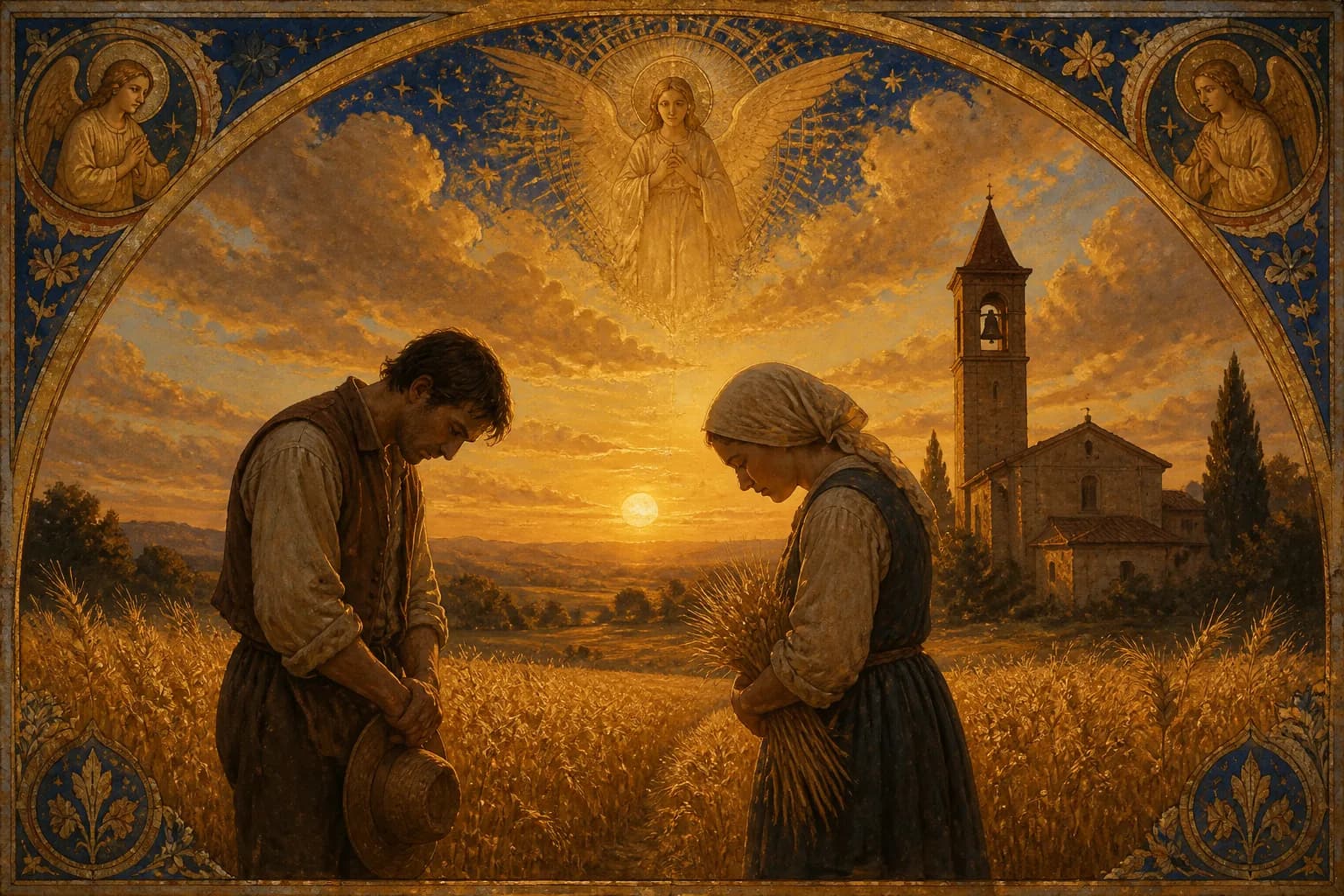
Traditionally the Angelus is prayed three times a day — at 6 a.m., at noon, and at 6 p.m. — at the ringing of the Angelus bell. The pattern is deliberate. It greets the morning, anchors the middle of the day, and closes the working hours, sanctifying the whole span of time and turning the clock itself into a quiet call to prayer.
You do not need a bell tower to keep the custom. Many people simply set a reminder on their phone for noon, or pause when they hear church bells nearby. If three times a day feels like a lot at first, begin with one — the noon Angelus is a natural place to start. On Sundays the Holy Father traditionally leads the Angelus at noon from Rome, praying it with crowds gathered in St. Peter's Square and with the wider Church watching from around the world.
The prayer, step by step
The Angelus is built from three versicle-and-response pairs. One person (or your own voice, if you pray alone) says the versicle, marked V., and the response, marked R., follows. After each pair you pray a Hail Mary.
First. V. The Angel of the Lord declared unto Mary, R. And she conceived of the Holy Spirit. Hail Mary, full of grace...
Second. V. Behold the handmaid of the Lord, R. Be it done unto me according to thy word. Hail Mary, full of grace...
Third. V. And the Word was made flesh, R. And dwelt among us. Hail Mary, full of grace...
Then comes the concluding exchange and prayer. V. Pray for us, O holy Mother of God, R. That we may be made worthy of the promises of Christ.
Let us pray. Pour forth, we beseech Thee, O Lord, Thy grace into our hearts, that we to whom the Incarnation of Christ, Thy Son, was made known by the message of an angel, may by His Passion and Cross be brought to the glory of His Resurrection. Through the same Christ our Lord. Amen.
Notice how the three lines tell the story in miniature. The first is the angel's announcement. The second is Mary's answer — her humble consent, be it done unto me. The third is the heart of the mystery itself — the Word was made flesh. In some places it is customary to bow or genuflect at that third line, the same gesture made during the Creed at Mass, as a sign of reverence before the Incarnation. The Hail Marys carry you gently from one truth to the next, and the closing prayer asks God for the grace to live what the words proclaim — to pass with Christ through His Cross to the glory of His Resurrection.
Prayed slowly, the whole thing takes only a minute or two. That is part of its wisdom. It is short enough to keep and deep enough to last a lifetime.
The Regina Caeli in Eastertide
During the Easter season the Angelus is set aside and replaced by a different Marian prayer of joy — the Regina Caeli, the "Queen of Heaven." The change fits the season. The Angelus dwells on the moment the Son of God took flesh in Mary's womb; in Eastertide the Church can no longer speak of that beginning without bursting into the song of His Resurrection.
The Regina Caeli greets Mary as the mother whose Son has risen, and asks her to rejoice and to pray for us. It is prayed at the same three hours — morning, noon, and evening — and the pope, too, leads it from Rome in place of the Angelus throughout the Easter weeks. When Pentecost closes the Easter season, the bells return to the Angelus, and the old daily rhythm begins again.
If you are new to the devotion, do not worry about getting every gesture or hour exactly right. The point is not perfection but presence — the daily decision to stop, even for a moment, and remember that God came among us. Begin with the noon Angelus tomorrow, or with the Regina Caeli if it is Eastertide, and let the prayer teach you the rest.
Crucis Lux brings the Marian apparitions and the lives of the saints to life as narrated, illustrated stories — meet the figures behind the prayers in the app.