When the cardinals elected Karol Wojtyła on October 16, 1978, they did something no conclave had done in 455 years: they chose a pope who was not Italian. They also chose a man who had spent his entire priesthood behind the Iron Curtain, in a Poland ruled by a communist government that treated the Church as a rival to be managed and, where possible, hollowed out. Within eleven years, that government — and the whole Soviet bloc around it — was gone. The pope did not topple it with armies. He did something the regimes feared more: he gave millions of people their courage back.
A pope from behind the Iron Curtain
To understand the impact, you have to understand the system. In postwar Poland the state controlled the press, the schools, the unions, and public life. Religion was tolerated but pressured: seminaries were watched, careers were closed to believers, and the official story said that history was moving inevitably toward a secular, socialist future. Wojtyła had lived inside that machine for decades — first as a worker and underground seminarian during the Nazi occupation, then as a priest and the archbishop of Kraków who quietly outmaneuvered the censors, built churches the authorities tried to forbid, and refused to be afraid.
So when "the Polish pope" was announced to the world, the news landed in Warsaw and Moscow very differently than it did in Rome. Here was a man who knew the regime from the inside, spoke its language, and could not be dismissed as a foreign critic.
The nine days that shook Poland
In June 1979, John Paul II returned home. The government could not stop the visit without admitting how much it feared him, so it let him come — and then watched, alarmed, as the country reorganized itself around him. Over nine days, an estimated one in three Poles saw him in person. They printed their own bulletins, marshaled their own crowds, kept their own order. For the first time in a generation, millions of people discovered that they were not alone and not powerless — that the "official" Poland on television was not the real one.
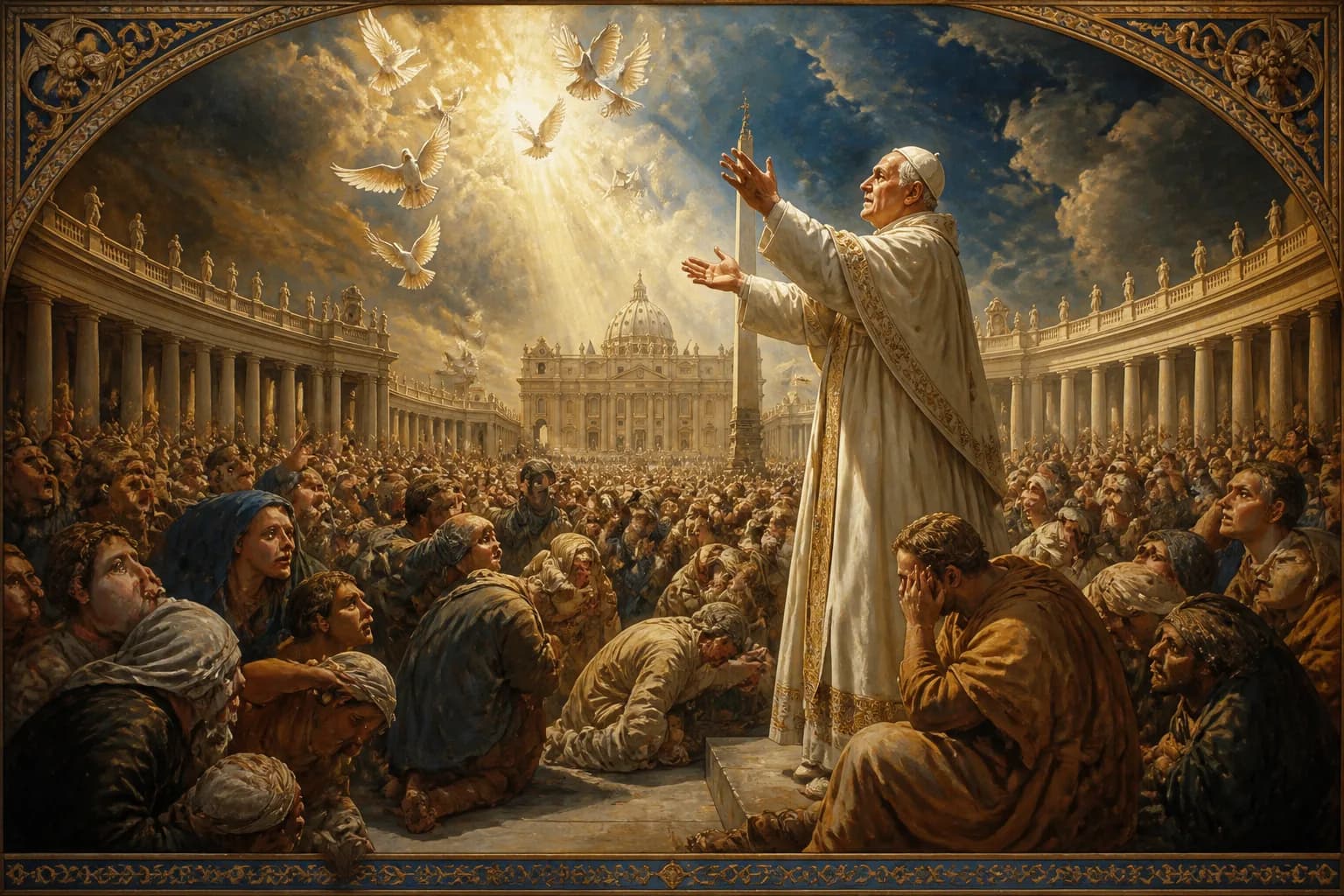
In Victory Square in Warsaw he preached on the Holy Spirit and then prayed, in words Poles never forgot: "Let your Spirit descend and renew the face of the earth — the face of this land." It was not a political speech. It did not have to be. The simple fact of a free, immense, peaceful, openly Catholic crowd was itself a refutation of everything the state claimed to be true.
Solidarity and the shipyard
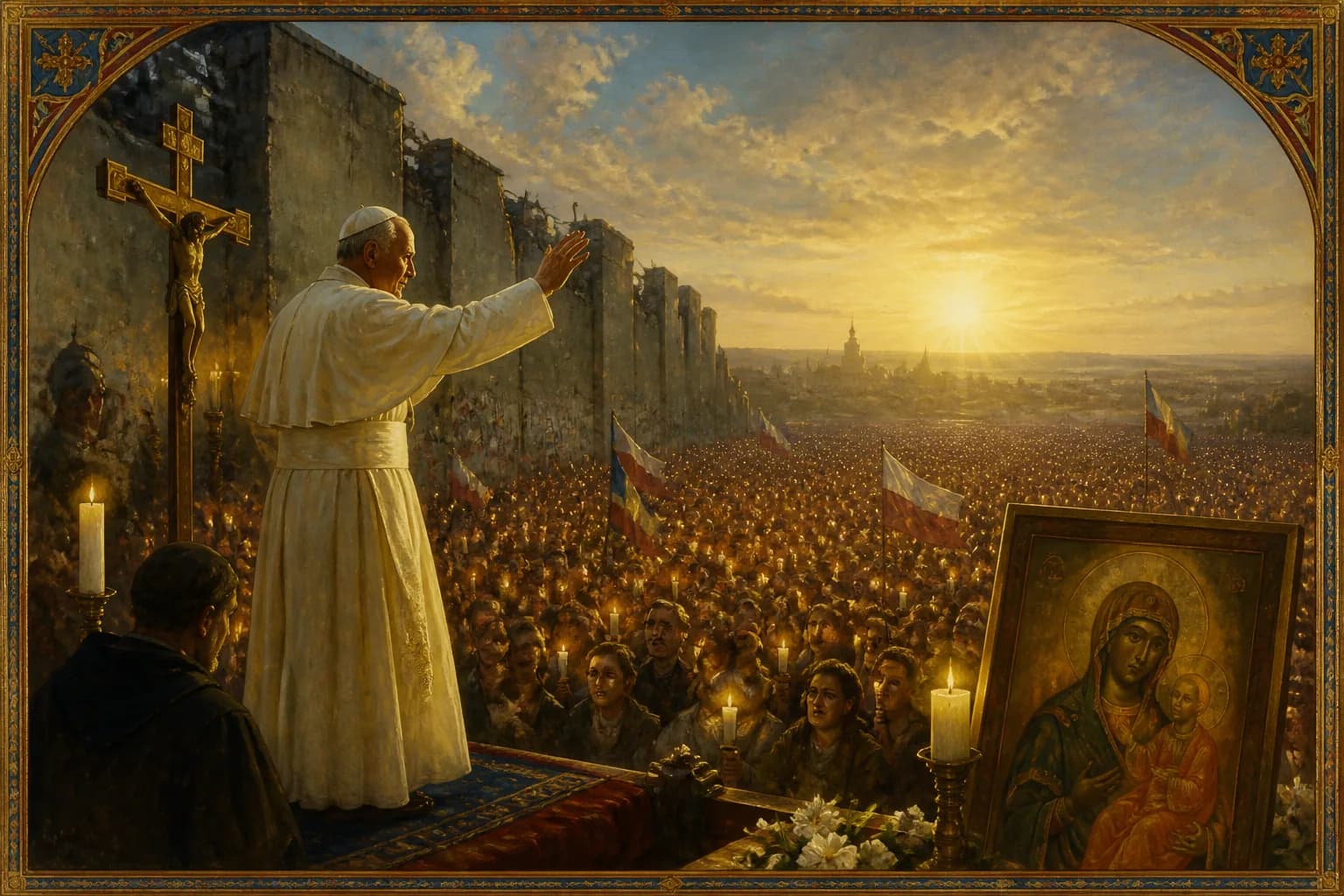
The change did not stay abstract. A little over a year later, in August 1980, workers at the Lenin Shipyard in Gdańsk went on strike. Out of that strike came Solidarność — Solidarity — the first independent trade union in the Soviet bloc, led by an electrician named Lech Wałęsa. At its height it counted some ten million members. Above the shipyard gate, alongside the strikers' demands, hung a portrait of the pope.
The connection was not a coincidence. Many of the people who built Solidarity were the same people who had stood in those 1979 crowds and learned that courage was contagious. The regime struck back: in December 1981 it imposed martial law, banned the union, and arrested its leaders. But the idea did not die. John Paul II kept Poland's cause on the world's front pages, met with Wałęsa, channeled quiet support to families of the imprisoned, and returned again in 1983 and 1987 to tell his people, in person, not to give up.
'Be not afraid': words as a weapon
The phrase that defined his whole pontificate was there from the first day. At his installation Mass in October 1978 he told the crowd, and the watching world: "Be not afraid." It sounds gentle. Under a regime that governed by fear, it was radical. Fear was the system's main tool — fear of losing a job, a place at university, a passport, one's freedom. A pope telling people to stop being afraid, week after week, year after year, was attacking the regime at its foundation without ever calling for violence.
That insistence on non-violence mattered enormously. John Paul II never blessed an uprising or an army. He offered something steadier: the conviction that human dignity comes from God and cannot be granted or revoked by a state, and that a people who refuse to lie and refuse to hate cannot, in the end, be ruled by force forever.
1989 and what it meant
In 1989 the dam broke — peacefully. Poland held partially free elections in June; Solidarity swept them. By the autumn the Berlin Wall was open, and one regime after another in Eastern Europe stepped aside, most of them without a shot fired. Historians still debate the exact weight of each cause — economic exhaustion, the policies of Mikhail Gorbachev, the steady pressure of the West. But almost no serious account leaves the pope out. Gorbachev himself later said that what happened in Eastern Europe would not have been possible without John Paul II.
The pope's own reading was characteristically modest and spiritual. He did not claim a victory for the Church over its enemies. He spoke instead of a recovery of truth — of people who had simply stopped pretending, and in doing so had discovered they were free. He also warned, almost immediately, that freedom is not the same as goodness, and that a society which throws off one set of lies can fall for another.
That is the John Paul II worth remembering: not a political operator, but a pastor who believed that fear is a prison and that the way out is to live as though the truth were true. His life ran straight through the darkest machinery of the twentieth century — and came out insisting, to the very end, be not afraid.
Crucis Lux tells the life of Saint John Paul II as a narrated, illustrated series — from wartime Kraków to the chair of Peter. The series is coming soon to the app.