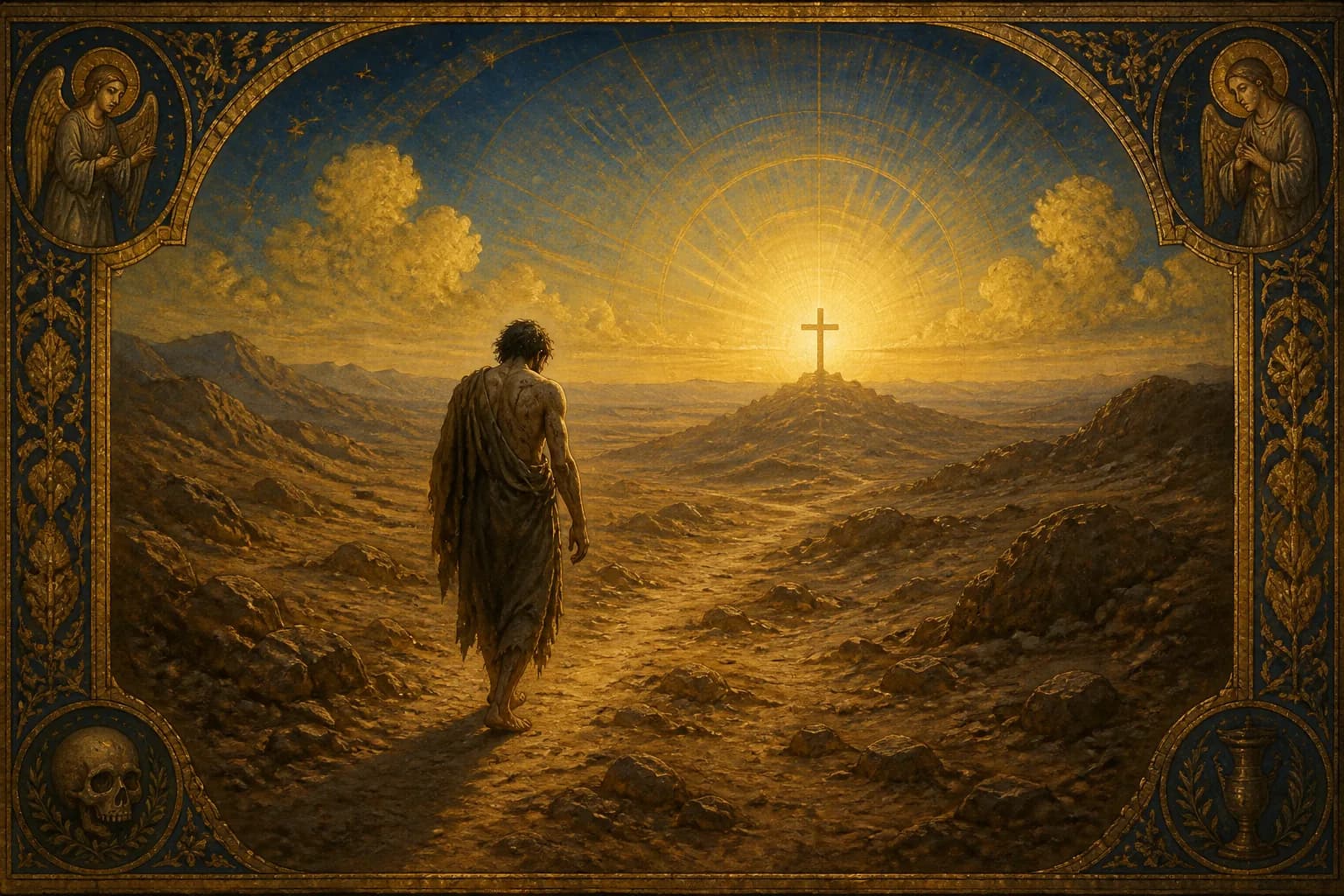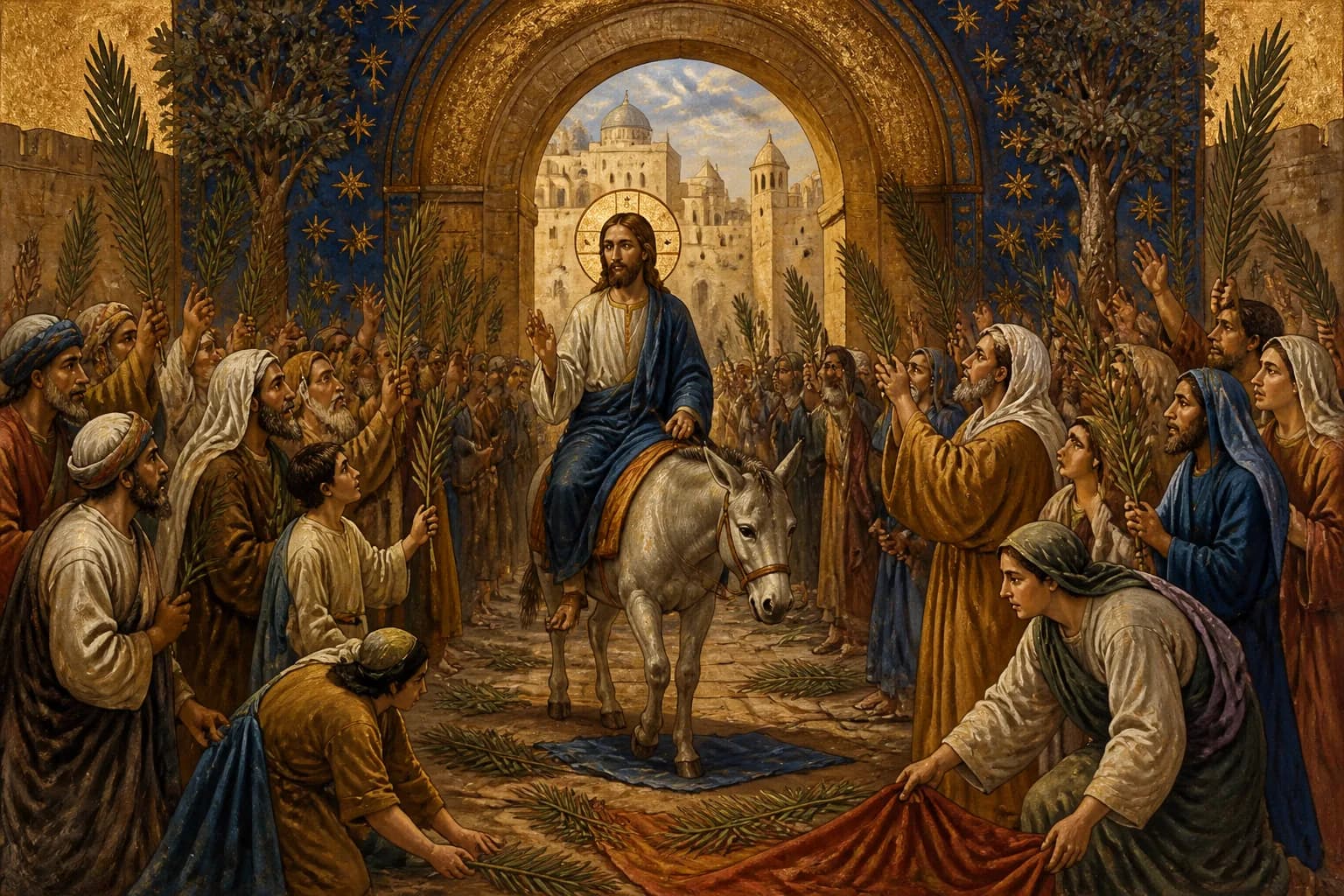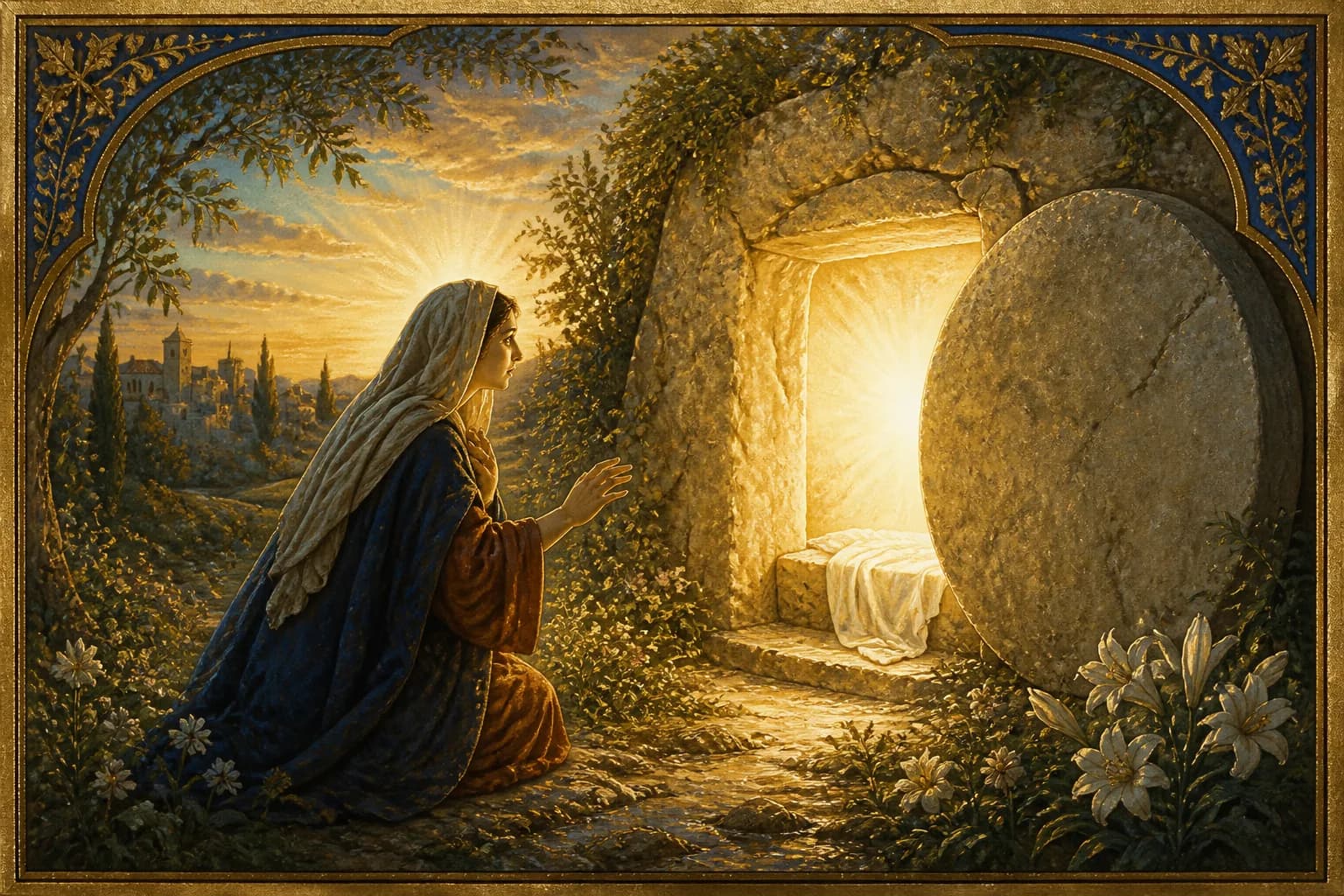
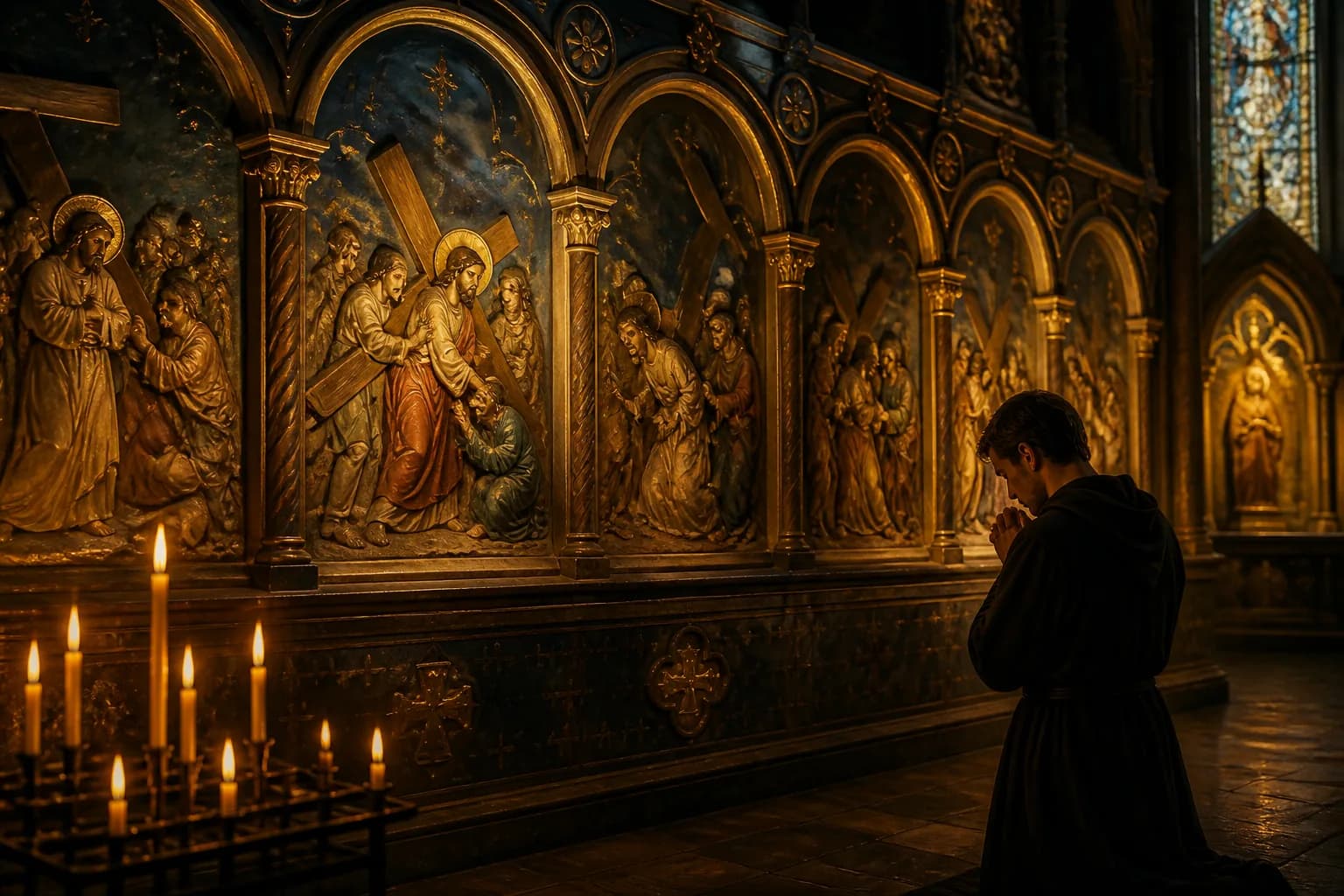
Few Catholic devotions are as physical, as visual, and as ancient as the Stations of the Cross. Walk into almost any Catholic church and you will find them around the walls: fourteen images, or sometimes simple numbered crosses, marking out the last hours of Jesus' life from His condemnation to His burial. The devotion — known in Latin as the Via Crucis, the "Way of the Cross," and after the road in Jerusalem as the Via Dolorosa, the "Way of Sorrows" — invites you to walk that road yourself, pausing at each station to look, to remember, and to pray. It is prayed all year, but it belongs especially to the Fridays of Lent and to Good Friday, when the whole Church turns its eyes to the Passion.
Where the devotion comes from
The roots of the Stations run all the way back to Jerusalem itself. From the earliest centuries, Christian pilgrims who reached the Holy City wanted to walk where Jesus had walked — to retrace, step by step, the path He took carrying His cross to Calvary. That path became known as the Via Dolorosa, and pilgrims would stop along it to pray at the places associated with the events of the Passion.
But most Christians could never make the long and dangerous journey to Jerusalem. So the devotion came home to them. The Franciscans, who from the Middle Ages were entrusted as custodians of the holy places in the Land where Jesus lived, did more than anyone to spread it. They built sets of stations in churches and along roads across Europe, so that a believer who would never see Jerusalem could still make the pilgrimage in spirit — moving from station to station, meditating on each scene of the Passion as though present there.
Over time the number of stations settled at fourteen, the form most Catholics know today. The Church gave the devotion its blessing and attached spiritual fruits to it, and it spread from Franciscan churches to nearly the whole Latin Church.
The 14 traditional stations
Each station marks a moment, real or by ancient tradition, on Jesus' road to the cross. The traditional list is:
- Jesus is condemned to death — Pilate hands Him over to be crucified.
- Jesus takes up His cross — He accepts the weight of the wood.
- Jesus falls the first time — exhausted and beaten, He falls under the cross.
- Jesus meets His Mother — He encounters Mary along the way.
- Simon of Cyrene helps carry the cross — a passerby is made to bear it for Him.
- Veronica wipes the face of Jesus — by ancient tradition, a woman wipes His face with a cloth.
- Jesus falls the second time — He falls again under the weight.
- Jesus meets the women of Jerusalem — He tells them to weep not for Him but for themselves.
- Jesus falls the third time — He falls a final time before Calvary.
- Jesus is stripped of His garments — His clothing is taken from Him.
- Jesus is nailed to the cross — His hands and feet are fastened to the wood.
- Jesus dies on the cross — He breathes His last.
- Jesus is taken down from the cross — His body is placed in His Mother's arms.
- Jesus is laid in the tomb — He is buried.
Some versions add a fifteenth station — the Resurrection — so that the Way of the Cross does not end at the grave but in the light of Easter. Several of the traditional stations (the three falls, Veronica, the meeting with Mary) come from long-standing devotional tradition rather than directly from the Gospel text. For that reason, in 1991 Saint John Paul II introduced a Scriptural Way of the Cross, a version in which every station is drawn directly from a scene recorded in the Gospels — for example, the agony in Gethsemane, Peter's denial, and the promise to the good thief. Both forms are loved and used widely today; the traditional fourteen remain the most common.
How to pray the Stations
Praying the Stations is simple, and that is part of its power. Traditionally you move from station to station — walking the inside of a church, or following the images in order — and pause at each one to meditate on what happened there.
At each station the classic pattern is the same. You begin with a genuflection or a sign of reverence and the ancient versicle and response:
We adore You, O Christ, and we bless You. Because by Your holy cross You have redeemed the world.
Then comes a short reading — a verse of Scripture or a brief meditation on the scene — followed by a moment of silent reflection and a prayer, often the Our Father, a Hail Mary, and a Glory Be. Many people also sing a verse of the Stabat Mater, the hymn that contemplates Mary standing by the cross, as they move to the next station. Then you proceed to the following station and repeat the pattern, all the way to the tomb.
You do not need a church to do it. The Stations can be prayed alone or with a family, from a booklet, an illustrated set of images, or simply from memory. What matters is not the setting but the movement of the heart: to walk slowly with Jesus through His suffering, to stop and look at each step of His love, and to let that road open into our own lives — our own falls, our own crosses, and the hope that, in Him, the tomb is never the end.
That is finally what the Stations are for. They are not a history lecture but a pilgrimage made in the soul. Whether you pray the traditional fourteen or the Scriptural form, whether on a quiet Friday in Lent or on the great silence of Good Friday, the devotion does the same gentle thing: it takes the most important journey ever walked and lets you walk it again, beside the One who walked it for you.
Crucis Lux brings the Passion to life as a narrated, illustrated series, station by station — coming soon to the app.