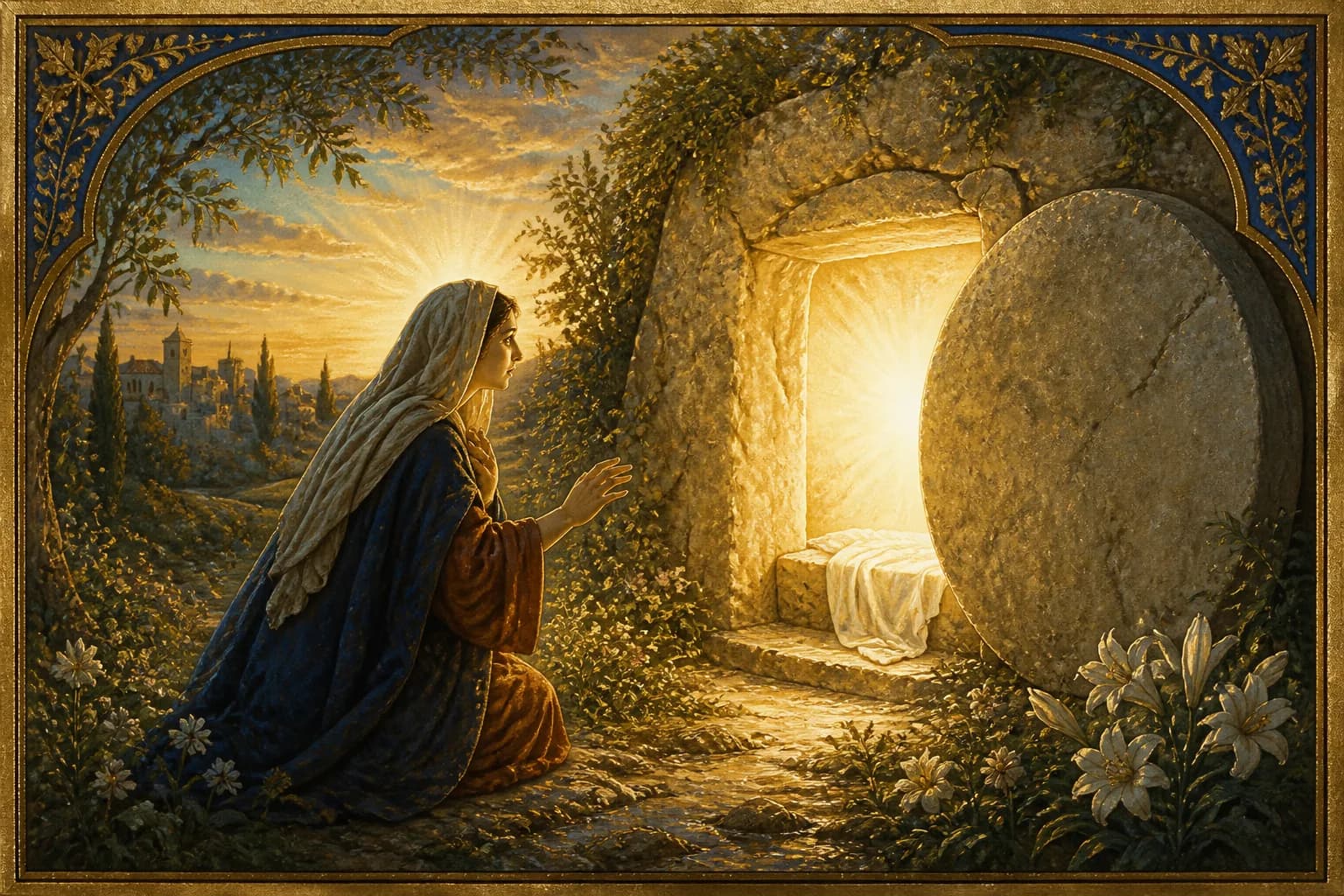
She arrived at the tomb before dawn on the first day of the week, carrying spices to anoint a body that should still have been there. She had been at the foot of the cross two days earlier when most of the men had run. She had watched Joseph of Arimathea wrap the body in linen and roll the stone across the entrance. She had come back as early as she could. The stone was rolled away. The body was gone. She ran to tell Peter and the beloved disciple, then returned alone, weeping, to a garden where she would mistake the risen Christ for the gardener — until he spoke her name. By the end of that morning she would be the first human being to bear the news of the Resurrection. The Catholic tradition has called her, for nearly seventeen centuries, the Apostle to the Apostles.
What the Gospels Say About Her
Mary of Magdala — Magdala was a small fishing town on the western shore of the Sea of Galilee, about five kilometers north of Tiberias — appears by name twelve times in the four Gospels. That is more than most of the named male disciples after the inner three.
Luke 8:1–3 introduces her: she is among the women who travel with Jesus and the Twelve in Galilee, supporting the ministry out of their own resources. Luke notes that she was a woman from whom seven demons had gone out. The detail is brief and not elaborated. The Catholic tradition has not generally read the seven demons as a moral category but as a description of severe and chronic affliction.
She is at the cross. All four Gospels place her there. Matthew 27:55–56, Mark 15:40, John 19:25 — explicit. Luke does not name the women individually but mentions a group of women who had followed him from Galilee watching from a distance.
She is at the tomb on Easter morning. All four Gospels place her there, again. Matthew 28:1, Mark 16:1, Luke 24:10, John 20:1.
She is the first to encounter the risen Christ. John 20 gives the most extended account; Mark 16:9 (the longer ending) confirms it briefly.
These are the data. They are robust across the four Gospels in a way that few other elements of the Passion narratives are.
The Garden: John 20
John 20 is the most fully developed account, told with the kind of detail that suggests eyewitness memory.
Mary comes alone before dawn — while it was still dark — sees the stone removed, and runs immediately to find Simon Peter and the disciple Jesus loved. She tells them: They have taken the Lord out of the tomb, and we do not know where they have laid him.
The men run to the tomb. The beloved disciple, younger, gets there first but stops at the entrance. Peter, characteristically, goes straight in. He sees the burial linens lying there, the head cloth folded separately. The other disciple follows him in, sees, and believes. They go home.
Mary stays. She is weeping outside the tomb. She stoops to look in. Two angels in white are seated where the body had been, one at the head and one at the feet. They ask: Woman, why are you weeping? She answers: They have taken away my Lord, and I do not know where they have laid him.
She turns. A man is standing behind her. She does not recognize him. She assumes he is the gardener — a small, true detail (cemeteries in first-century Jerusalem often had a gardener or caretaker). He repeats the angels' question with one addition: Woman, why are you weeping? Whom are you looking for? She answers: Sir, if you have carried him away, tell me where you have laid him, and I will take him away.
He says one word.
Mary.
She recognizes the voice and turns fully toward him. Rabbouni, she answers — my teacher, the Aramaic affectionate form. She moves to embrace him. He stops her: Do not hold on to me, for I have not yet ascended to the Father. But go to my brothers and tell them: I am ascending to my Father and your Father, to my God and your God.
She goes. She tells the disciples: I have seen the Lord.
Noli Me Tangere
The Latin Vulgate translation of Jesus's word to her — noli me tangere, do not touch me — has been one of the most painted subjects in Christian art. Giotto, Fra Angelico, Titian, Holbein, Rembrandt, Rubens — most of the major painters of the Western tradition produced at least one version.
The translation has also generated theological debate. The Greek of John 20:17 is mē mou haptou — literally do not cling to me or do not keep holding me on. The verb is in a tense suggesting an ongoing action, not the simple imperative of don't touch. The phrase is more accurately rendered: stop clinging to me.
The point, Catholic exegetes have held since the Greek Fathers, is not that the risen Christ is untouchable — Thomas will be told to touch his wounds within the same chapter — but that Mary cannot hold on to the resurrection encounter in the way she once held onto his earthly company. The relationship has shifted. He is going to the Father. She is to go to the brothers.
"Apostle to the Apostles"
The title Apostola Apostolorum — Apostle to the Apostles — for Mary Magdalene goes back at least to Hippolytus of Rome in the early third century. It is preserved in medieval Latin commentaries and was formally restored by Pope Francis in 2016, when he elevated her liturgical memorial to a feast day (July 22) and the Vatican's congregation for divine worship explained the change by reference to her role as apostle to the apostles. The decree of the Congregation for Divine Worship makes the point explicitly.
The title is theologically precise. An apostle, in the New Testament sense, is one sent with a message. Mary was sent by the risen Christ himself to bear the news of the Resurrection to the Eleven. She is the first to do it. The men do not believe her at first — Luke 24:11 says these words seemed to them an idle tale. They believe later, when they have seen for themselves.
The Western Confusion: Was She a Prostitute?
For most of the Western Catholic tradition, Mary Magdalene was conflated with two other Gospel women: Mary of Bethany (the sister of Martha and Lazarus) and the unnamed sinful woman of Luke 7 who anointed Jesus's feet at the house of Simon the Pharisee. The conflation was made explicit in a homily by Pope Gregory the Great in 591 and persisted in Western preaching and art for fourteen centuries.
The Eastern Orthodox tradition never made the conflation. The Eastern churches always treated Mary Magdalene, Mary of Bethany, and the sinful woman as three separate persons.
The Catholic Church corrected the Western tradition in the liturgical reforms of 1969, removing the implication of the conflation from the liturgical readings. Mary Magdalene is no longer presented as a former prostitute in official Catholic teaching. She is presented as she appears in the Gospels: a Galilean disciple, healed of severe affliction, financially supporting the ministry, present at the cross, first witness of the Resurrection.
The popular image of Magdalene as a repentant prostitute remains in circulation, especially through paintings and devotional literature from the medieval and early modern periods, but it is not the position of the contemporary Church.
The Gnostic Texts
Several non-canonical texts from the second to fourth centuries — the Gospel of Mary (Coptic, fourth-century manuscript of a likely second-century original), the Gospel of Philip, the Gospel of Thomas — give Mary Magdalene an expanded role and, in the case of the Gospel of Philip, describe her as the companion of Jesus whom he loved more than the other disciples. These texts have been used in popular fiction (most famously in The Da Vinci Code) to argue that Mary was Jesus's wife or that the early Church suppressed her role.
The Catholic position on the Gnostic texts is straightforward. They are interesting historical documents from groups that diverged from the apostolic tradition. They are not Scripture, were not accepted by the early Church as Scripture, and contain theological positions (a dualistic cosmology, a downgrading of the body, esoteric salvation by knowledge) that the early ecumenical councils rejected.
What Mary Magdalene needs no Gnostic text to establish is her role at the empty tomb. The four canonical Gospels do that on their own, and they were doing it in writing before the Gnostic texts were composed.
Mary in the Catholic Tradition
In the Catholic liturgical calendar Mary Magdalene's feast is July 22, ranked as a feast (the rank above an obligatory memorial) since Pope Francis's elevation in 2016. The proper preface for her Mass calls her the witness of divine mercy. The Gospel reading at her Mass is, of course, John 20:1–2 and 11–18 — the encounter in the garden.
She is the patroness of contemplatives, of converts, of perfumers, of repentant sinners, and of pharmacists (a medieval association with the spice jar she carried to the tomb). She is also, by extension of her role at the cross and the tomb, a model for those whose discipleship is faithful in the absence of visible reward — the quiet attendance that does not draw attention but does not leave.
The story of the empty tomb is the seed of the entire Christian message. Without the Resurrection, as Paul will write to Corinth, our preaching is in vain, and your faith is in vain. The first preaching of the Resurrection was done by a woman who was, on the testimony of Luke, a recipient of severe healing, and on the testimony of every Gospel, faithful at the cross.
For broader context on how the disciples encountered the risen Lord, see Peter's restoration on the shore of Galilee and Paul's encounter on the road to Damascus. Each is a Resurrection story; Mary Magdalene's is the first.
The Place Today
The traditional site of the empty tomb is preserved beneath the Church of the Holy Sepulchre in the Old City of Jerusalem — a complex jointly held by the Greek Orthodox, Latin (Roman Catholic), Armenian Apostolic, Coptic, Ethiopian, and Syriac Orthodox communities, in an arrangement of shared custody known as the Status Quo that has been in place since the eighteenth century. The Edicule, the small chapel containing the rock-cut burial slab, was restored in 2016 — the first such restoration in two centuries — by a team of Greek and international conservators. The rock surface beneath was exposed for the first time in modern history; a brief inspection confirmed the integrity of the first-century burial bench.
Pilgrims who reach the Edicule today can stand where the women stood on Easter morning. The site has been continuously venerated since at least the fourth century, when the Emperor Constantine cleared a Roman temple from the location and built the original Constantinian basilica.
Listen to Mary Magdalene on Crucis Lux
Crucis Lux tells the story of Mary Magdalene and the empty tomb as a slow-paced, illustrated audio series — every scene narrated, every panel illustrated in the style of medieval frescoes, in five languages.