
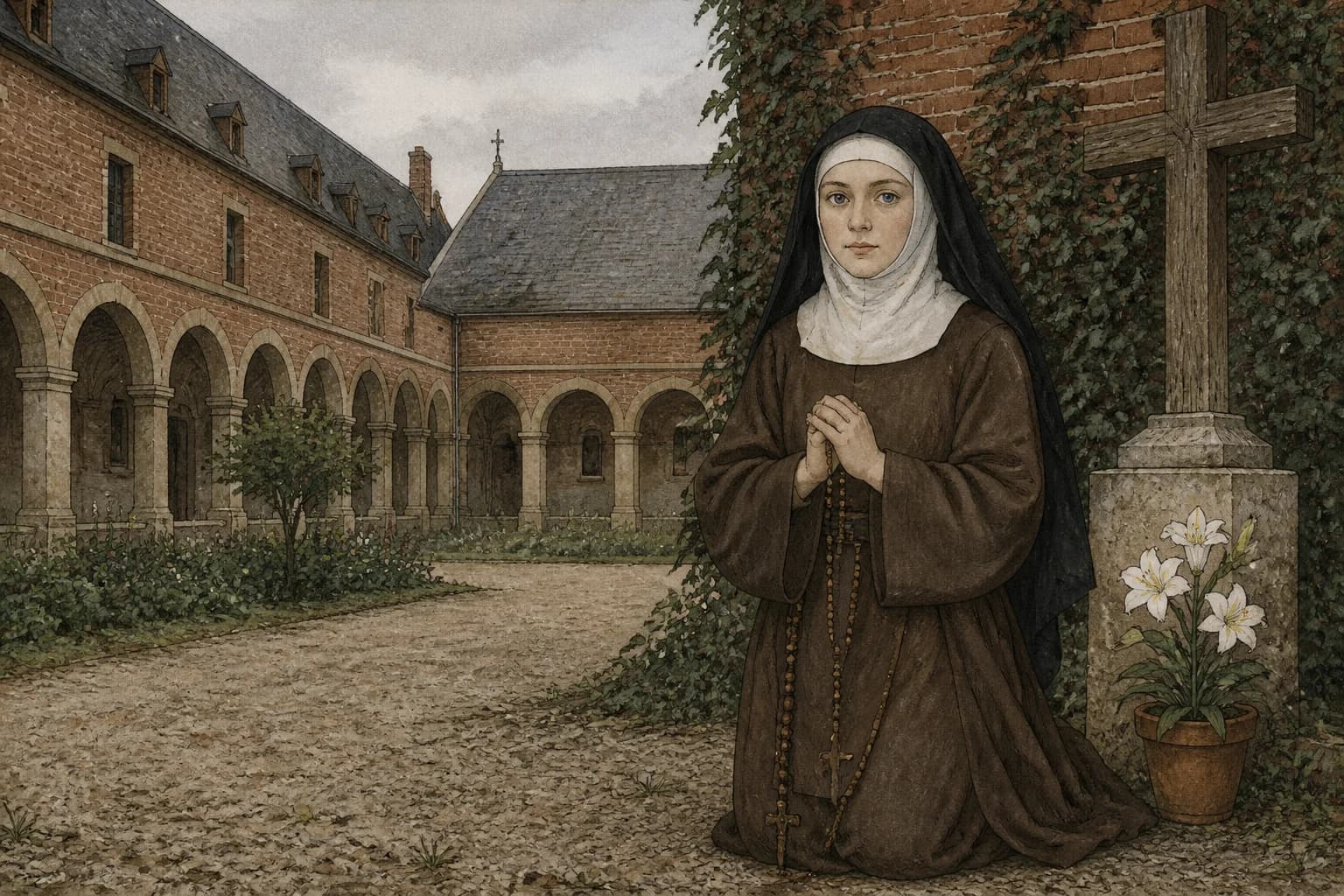
She lived in a provincial French convent for nine years, died at twenty-four, and left behind a few notebooks. A century later the Church named her a Doctor, a teacher for the whole Church. Saint Thérèse of Lisieux is easy to turn into a holy card: sweet, pink, harmless. The real woman was more interesting and more demanding. She asked a pope, at fifteen, to let her enter a convent, and she went through the last stretch of her life in a trial of faith that she wrote about without disguising it.
This article is a short guide: who she was, what the Little Way actually says, where Story of a Soul came from, and why the Church calls her a Doctor.
From Alençon to Lisieux
Marie-Françoise-Thérèse Martin was born in Alençon, Normandy, on 2 January 1873 and baptized two days later. Her parents were Louis Martin and Zélie Guérin. Her mother died on 28 August 1877, when Thérèse was four, and the family moved to Lisieux, where she grew up surrounded by her father and her sisters.
Several moments stand out in the Church's own account of her life. In 1883, on the day of Pentecost, she was healed of a serious illness, which she attributed to Our Lady. She made her First Communion on 8 May 1884. And on Christmas Day 1886 she had an experience she called her "complete conversion": it freed her from the emotional fragility that had followed her mother's death.
The girl who asked the Pope
Thérèse wanted to enter Carmel, where two of her sisters, Pauline and Marie, had already gone. She was told she was too young. During a pilgrimage to Italy she took her request to the highest authority available: at an audience for the faithful of the Diocese of Lisieux on 20 November 1887, she asked Pope Leo XIII to let her enter Carmel at fifteen.
On 9 April 1888 she entered the Carmel of Lisieux. She received the habit on 10 January 1889 and made her religious profession on 8 September 1890. She took the name Thérèse of the Child Jesus and the Holy Face. Her father, Louis Martin, was gravely ill and died on 29 July 1894; John Paul II wrote that, tried by his illness and illumined by the Word of God, she embarked on the way of holiness, insisting on the centrality of love.
What the Little Way is
The Carmel she joined followed the way of Teresa of Jesus (Teresa of Ávila), whose spiritual works shaped her vocation; John Paul II adds, citing her manuscripts, that Saint John of the Cross was her true spiritual master. Within that tradition she found something of her own. As a young Carmelite she discovered and passed on to the novices in her care what the Church calls the little way of spiritual childhood.
In 1997 John Paul II summarized it in one sentence: the little way is "nothing other than the Gospel way of holiness for all." Three ideas stand at its centre.
- Divine filiation. Spiritual childhood, John Paul II wrote, is the experience of being the Father's adopted children in Jesus, moved by the Holy Spirit.
- Trusting abandonment. Her last manuscript, he said, holds her most beautiful pages on trusting abandonment into God's hands.
- Love as the centre. On 9 June 1895, Trinity Sunday, she made an Act of Oblation to Merciful Love, offering herself to God's merciful love. The Carmelite sanctuary at Lisieux summarizes her path as holiness lived in the small acts that fill each day.
None of this is a shortcut. It does not claim that holiness is easy, only that it is open to people who are not heroes, who have no great works to offer, and who can only offer what is in front of them.
Story of a Soul
Thérèse's best-known book was never planned as a book. It was assembled from three manuscripts:
- Manuscript A, written at the request of her sister Agnes of Jesus, then prioress, and handed to her on 21 January 1896. It covers childhood and adolescence up to her entrance into Carmel and first profession.
- Manuscript B, written during her retreat in 1896 for her sister Marie of the Sacred Heart. John Paul II called it the source of some of her most beautiful and most quoted pages.
- Manuscript C, written in June and the first days of July 1897 for the prioress, Marie de Gonzague. She never finished it.
The 1898 first edition, Histoire d'une âme, was printed at the expense of her uncle, Isidore Guérin, in 2,000 copies. According to the Carmel of Lisieux, her sisters made a coherent book from the notebooks and letters: they merged three recipients into one, added chapters, corrected spelling, wrote some links between texts, skipped some passages, corrected the style and gave it a title. The book became a bestseller; by 1997 it had been translated, with her other writings, into about fifty languages.
The Carmel archives say that the question of the original text caused discussion for more than a century. After the Second World War, and with Pope Pius XII's backing, the Carmelites agreed to publish the authentic manuscripts after the death of Mother Agnes (28 July 1951). The facsimile and critical editions appeared in 1956.
The last year
On the night of Holy Thursday to Good Friday, 3 April 1896, she noticed the first symptoms of the illness that would kill her. She received it, John Paul II wrote, as a visitation of the divine Spouse. She was moved to the infirmary on 8 July 1897. The Carmel of Lisieux describes the cause of her death as tuberculosis.
During this time she also went through a trial of faith that lasted until her death. John Paul II does not soften it: he speaks of a "long and painful dark night," and of pages she wrote while trusting in God's merciful love. That should be said plainly because the sweet version leaves it out. Thérèse did not live her last months in easy consolation. The saint of the Little Way is also the saint of that dark night.
She died on the afternoon of 30 September 1897. Her last words, in the Apostolic Letter's account, were "My God, I love you." Earlier she had written to one of her spiritual brothers: "I am not dying; I am entering life."
Canonization and Doctor of the Church
The Church moved quickly. Pius XI proclaimed her blessed on 29 April 1923 and canonized her on 17 May 1925 in St Peter's Basilica, before an immense crowd. On 14 December 1927, at the request of many missionary bishops, he named her patron of the missions along with Saint Francis Xavier, a title that may surprise for a cloistered Carmelite. John Paul II points to her "apostolic and missionary vocation," and to her correspondence with missionary "brothers."
On 19 October 1997, World Mission Sunday, John Paul II proclaimed her a Doctor of the Universal Church in St Peter's Square, with the apostolic letter Divini Amoris Scientia ("The Science of Divine Love"). He noted that she had no particular theological training but that her doctrine shows "a special charism of wisdom," nourished by Scripture, the Imitation of Christ, Teresa of Jesus and John of the Cross. He also noted that she is "not only the youngest Doctor of the Church, but also the closest to us in time."
Learning from Thérèse
Her memorial is on 1 October. A few ways to take her seriously rather than sentimentally:
- Read her, not a summary. Start with Manuscript C, written a few months before her death: it contains her pages on trial and on trusting abandonment.
- Practise the small thing. The Little Way is not a method but a habit of offering what is in front of you, a conversation, a chore, a patience, with love.
- Pray for missionaries. She is their patron. It is a fitting intention for a cloistered Carmelite.
- Be honest about dark nights. If faith feels empty, her pages on the trial of faith show a saint who did not hide it.
Listen to Thérèse on Crucis Lux
Crucis Lux has published a new sixteen-episode series on her life, from Alençon to the Carmel of Lisieux and her canonization, narrated and illustrated, in five languages. It tells the real story, including the trial of faith and the editing of her manuscripts, without the sugar.