Purgatory is one of the most misunderstood pieces of Catholic teaching, and much of the confusion comes from the fact that the popular picture — a waiting room, a sentence, a place where you serve time — is a good deal more elaborate than what the Church actually says. The official teaching is remarkably brief. What has grown up around it, in art, in preaching and in folklore, is not.
What the Church actually teaches
The Catechism gives the doctrine in three paragraphs, 1030 to 1032. The core of it:
"All who die in God's grace and friendship, but still imperfectly purified, are indeed assured of their eternal salvation; but after death they undergo purification, so as to achieve the holiness necessary to enter the joy of heaven." (CCC 1030)
Every clause matters.
"Die in God's grace and friendship" — everyone undergoing this is already saved. Purgatory is not a middle destination between heaven and hell, populated by those whose case is still open. The case is closed, favourably.
"Still imperfectly purified" — the premise is that a person can be genuinely forgiven and still be attached to what they were forgiven for. The habit outlives the guilt.
"Undergo purification" — the Church calls it a purification, not a punishment in the retributive sense, and deliberately avoids describing a mechanism.
"Necessary to enter the joy of heaven" — the purpose is preparation for something, not payment for something.
The doctrine was defined at the Councils of Florence (1439) and Trent (1563), both of which were notably restrained: they affirmed that a purification after death exists and that the prayers of the living help those undergoing it, and Trent explicitly warned preachers away from speculative and sensational descriptions.
Where it comes from in Scripture
The word "purgatory" is not in the Bible. Neither are "Trinity" or "incarnation"; the question is whether the reality is attested.
2 Maccabees 12:46 — after a battle, Judas Maccabeus takes up a collection and sends it to Jerusalem for a sacrifice for the fallen, "that they might be delivered from their sin." The verse is the oldest explicit witness to praying for the dead in the biblical tradition, and the practice only makes sense if the dead can still be helped.
1 Corinthians 3:11–15 — Paul describes each person's work tested by fire: "If the work is burned up, he will suffer loss, though he himself will be saved, but only as through fire." Saved, but through fire, and with loss — the closest thing in the New Testament to the shape of the doctrine.
Matthew 12:32 — a sin that will not be forgiven "either in this age or in the age to come", which Augustine and Gregory the Great both read as implying that some things can be forgiven in the age to come.
The practice, in any case, is older than the arguments. Inscriptions in the Roman catacombs ask for prayers for the dead, and the early liturgies name them.
What the fire means
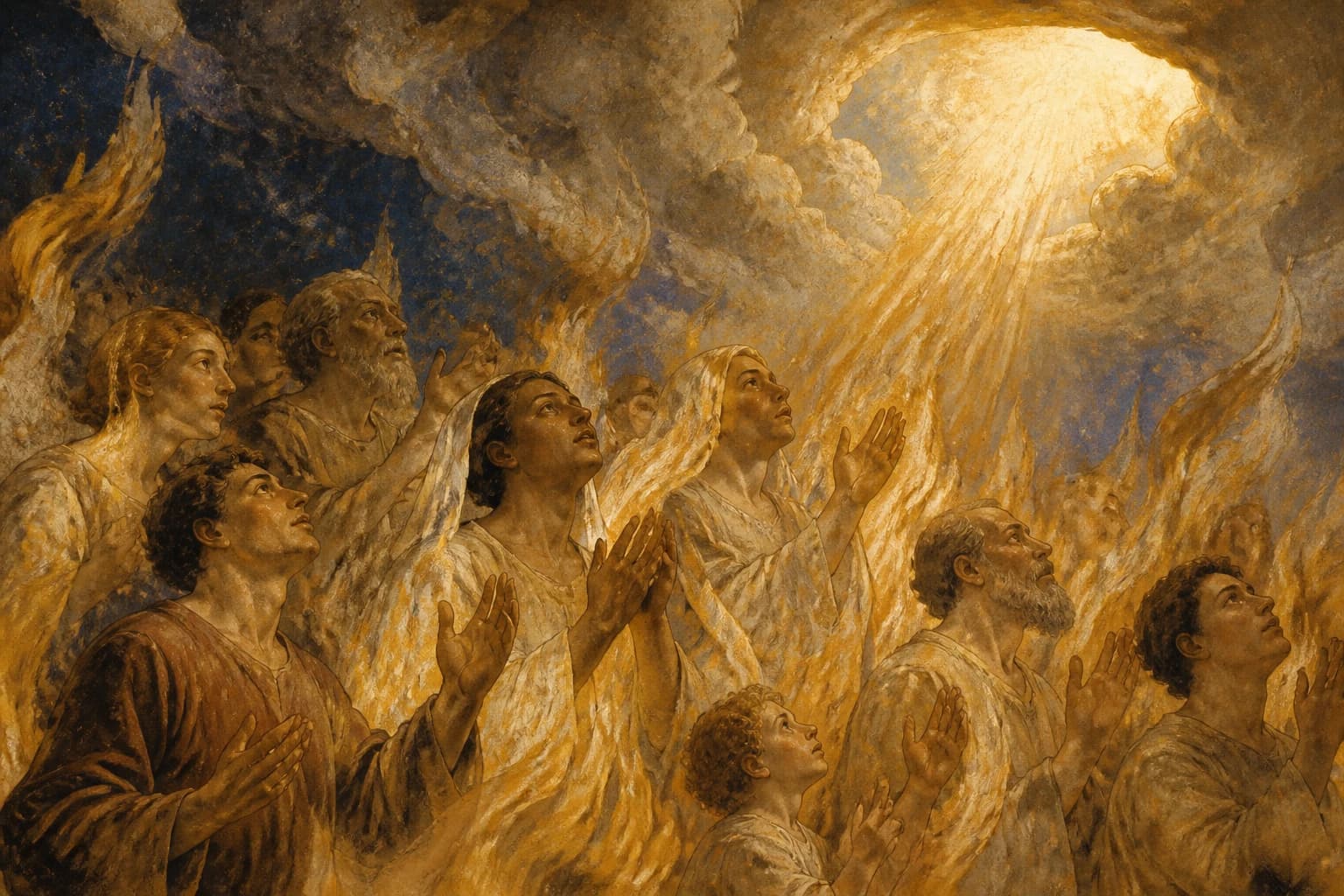
The imagery of fire is scriptural and ancient, and it has done enormous work in Western art — often to the doctrine's detriment, since the paintings inevitably look like hell with better lighting.
The Church has never defined the fire as physical. Recent theology has tended to read it as an image of encounter: the purification of coming face to face with perfect love while still carrying everything in you that resisted it. Benedict XVI, in Spe Salvi, described the encounter with Christ himself as the fire — a burning that transforms rather than destroys.
That reading takes nothing away. It relocates the pain from an external punishment to an internal reckoning, which is both harder and easier to bear than a furnace.
What it is not
- Not a second chance. No one is deciding anything in purgatory.
- Not the same as hell, briefly. The Church teaches hell as definitive separation; purgatory is the opposite condition, characterised by certainty of heaven.
- Not a system of buying one's way out. The sale of indulgences was a real scandal, and it was one of Luther's most effective charges precisely because the abuse was real. It was abolished; the sale of an indulgence is now itself a grave offence in canon law.
- Not measured in days. Indulgences once carried terms like "forty days", which referred to the ancient penances of that length once assigned on earth. That vocabulary was removed from the Church's official grants in 1967 for exactly this reason.
Praying for the dead
This is where the doctrine touches ordinary life, and it is the part almost every Catholic practises whether or not they can explain the theology. Having a Mass offered for someone who has died, keeping a name in the November book of the dead, praying a Rosary for a parent on their anniversary — these are all the same act.
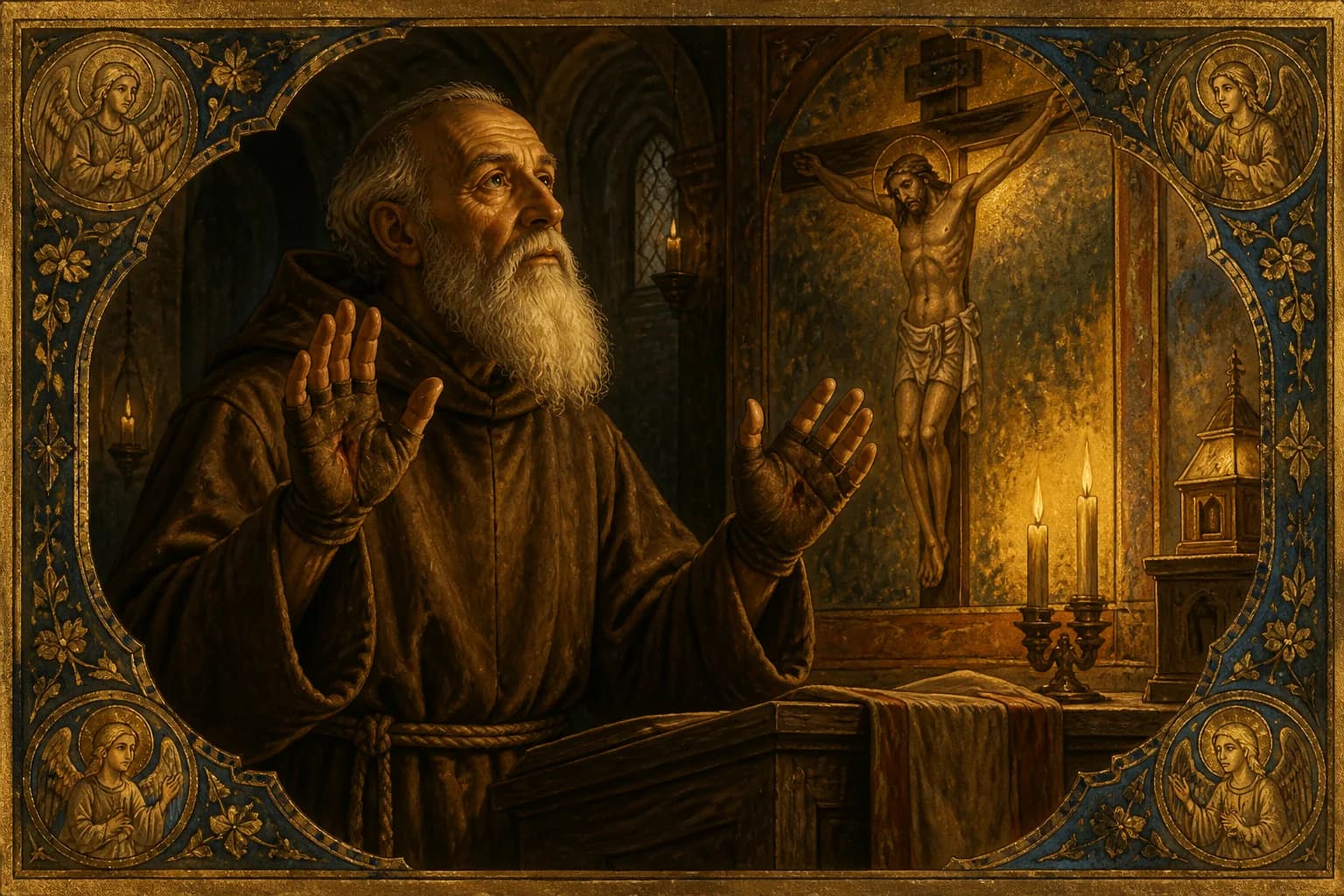
Accounts of Padre Pio's life describe a man who took this with unusual seriousness, offering prayers and Masses for the dead as a daily obligation rather than an occasional courtesy. We tell his story, including the parts that were medically examined at the time, in Padre Pio and the stigmata.
The logic underneath is simple, and it is the reason the doctrine has survived every attempt to make it embarrassing: the dead are not out of reach. Something can still be done for someone you have lost, and it is not nothing, and it is not merely therapeutic. For most people that is the whole of purgatory that matters — not the mechanics, but the fact that love still has somewhere to go.