On the morning of September 20, 1918, a young Capuchin friar in southern Italy walked from the choir loft of his small monastery church to the sacristy. Blood was leaking through his habit at the hands, the feet, and the side. He was bleeding from five wounds that looked like puncture marks from a crucifixion. He was thirty-one years old. The wounds did not heal, did not become infected, and did not close until the last week of his life. He carried them for fifty years and two days.
This is what the medical record actually says about Padre Pio's stigmata. Not the legend, not the hagiography, not the conspiracy literature — what doctors with names and credentials wrote on official letterhead after examining the wounds, often under the orders of a Vatican that was deeply skeptical and at one point banned him from public ministry for a decade.
The Friar from Pietrelcina
Francesco Forgione was born May 25, 1887, in Pietrelcina, a hill village in the province of Benevento. He entered the Capuchin novitiate at fifteen, took the religious name Pio, was ordained priest in 1910, and was assigned in September 1916 to the friary of San Giovanni Rotondo in the Gargano peninsula of Apulia. He would live there for the next fifty-two years.
By 1916, Pio had already shown the pattern that would mark his life: long hours in the confessional, intense Eucharistic devotion, severe physical sufferings he attributed to spiritual combat, and reports — initially from his confessor, later from friars in the house — of invisible stigmata, pains in his hands and feet that left no marks. The visible wounds appeared on August 5–7, 1918 (a wound in his side first, called the transverberation) and then more fully on September 20.
September 20, 1918
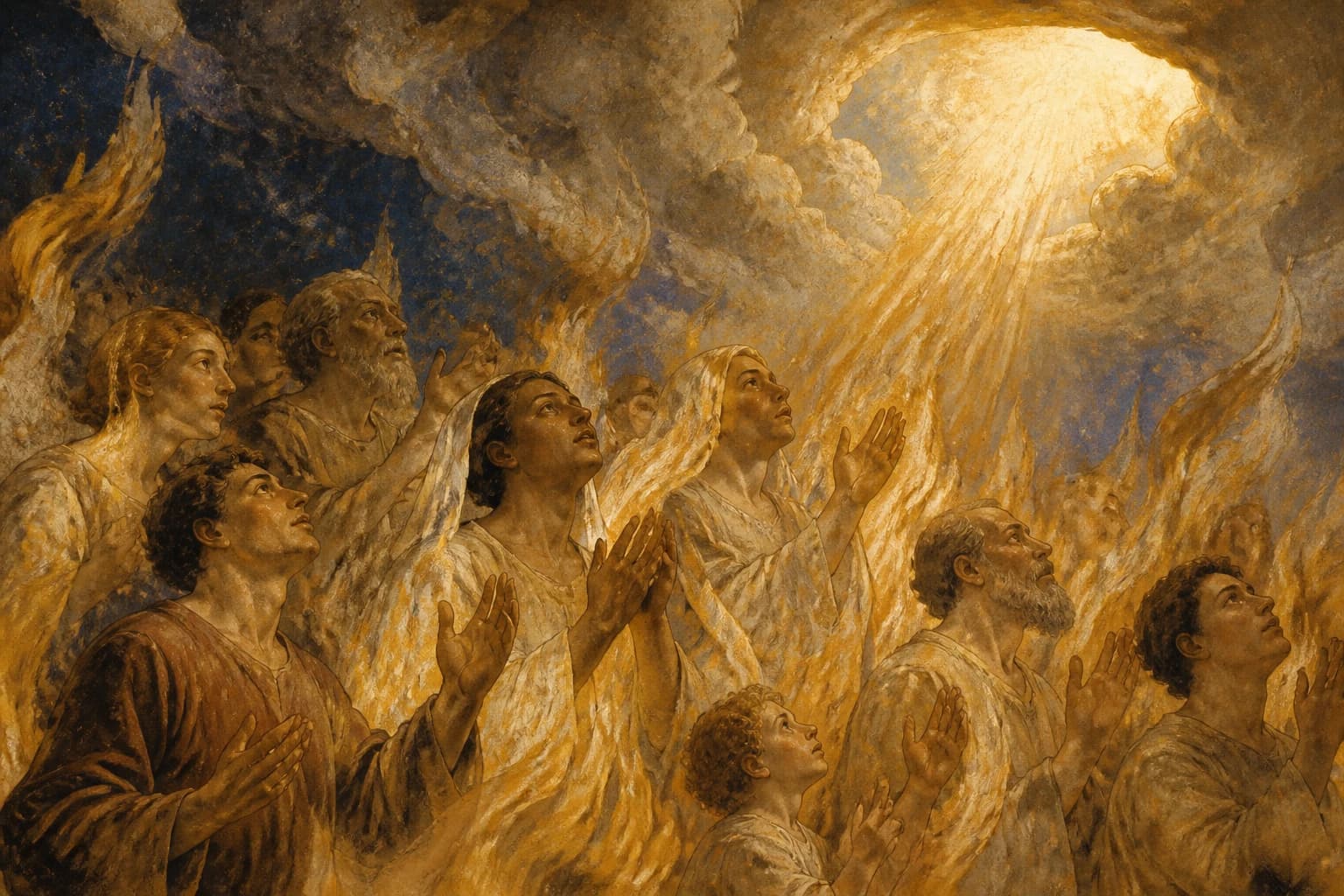
The September 20 account comes from Padre Pio himself, written under obedience to his spiritual director, Padre Benedetto. He had been alone in the choir loft after Mass. He saw what he described as a heavenly being whose hands, feet, and side were dripping blood. The vision terrified him. When it ended, he was on the floor and bleeding from the same five places. The other friars found him there and helped him to his cell.
The wounds were:
- A wound on each palm of the hand, going through to the back, about an inch in diameter
- A wound on the top of each foot, also passing through
- A diagonal wound in the left side, about three inches long, beneath the heart
They bled constantly — about a cup of blood a day, according to multiple medical examinations — but they did not become infected, did not produce the inflammatory signs around the edges that any open wound of that size would normally show, and did not show necrosis.
The First Medical Examinations
The Holy Office (now the Congregation for the Doctrine of the Faith) commissioned medical examinations almost immediately, because the case was so unusual and the crowds gathering at San Giovanni Rotondo were already growing.
Luigi Romanelli, 1919
Dr. Luigi Romanelli, chief of the civil hospital of Barletta, examined Padre Pio for eight days in May 1919. His report, sent to the Holy Office, described the wounds in detail: through-and-through perforations of the hands and feet with no callus, no scar tissue, no granulation, no infection. He could not produce a medical explanation. Romanelli returned for additional examinations in 1920, 1925, and 1934 — the wounds were unchanged.
Amico Bignami, 1919
Dr. Amico Bignami, a professor of pathology at the University of Rome, was sent by the Holy Office in July 1919, specifically because his medical reputation was strong and his personal disposition skeptical. He examined Padre Pio thoroughly. His report acknowledged that the wounds were genuine and inexplicable in their persistence, but he proposed they might have been initiated by autosuggestion and then kept open by iodine application — a hypothesis that did not survive scrutiny. He tried sealing the wounds for several days under bandages he himself signed; they continued to bleed and did not heal. Bignami left without producing a coherent natural explanation.
Giorgio Festa, 1920
Dr. Giorgio Festa examined Padre Pio in October 1919 and again in 1920 and 1925. He documented the wounds with photographs, made detailed drawings, and wrote a book-length account, Mysteries of Science and Light of Faith (1933). Festa noted that the wounds in the hands were not centered in the palm in the manner of popular crucifixion iconography but were anatomically odd in a particular way: open through-and-through perforations whose edges showed no scarring after years.
The medical consensus across the early examiners was: the wounds were real, persistent, and not explainable by ordinary medical categories.
The Vatican's Skepticism
It is worth emphasizing that the Holy See spent decades skeptical of Padre Pio, not credulous toward him. In 1923 the Holy Office issued a declaration that the events at San Giovanni Rotondo could not be confirmed as supernatural in origin. In 1931, after years of friction with local clergy and bishops, the Vatican banned Padre Pio from celebrating Mass publicly and from hearing confessions. The ban lasted two years.
A second wave of restrictions came in 1960 under John XXIII, including the tapping of the friary's telephones and stricter limits on Padre Pio's correspondence and contact with laypeople. Some of these measures were lifted only after Paul VI's accession in 1963.
Padre Pio submitted in obedience throughout. He never appealed publicly, never spoke against the Holy See, and continued to live the regular life of a Capuchin friar under whatever restrictions were imposed.
What the Faithful Saw
For fifty years, an average of two hundred pilgrims a day — and sometimes thousands — came to San Giovanni Rotondo to attend Padre Pio's Mass, to confess to him, or to write to him. He celebrated Mass at length, sometimes for two or three hours, in evident physical pain. He heard confessions for ten or twelve hours a day. Witnesses described him refusing absolution to penitents who were not contrite, sometimes seeing into matters they had not told him.
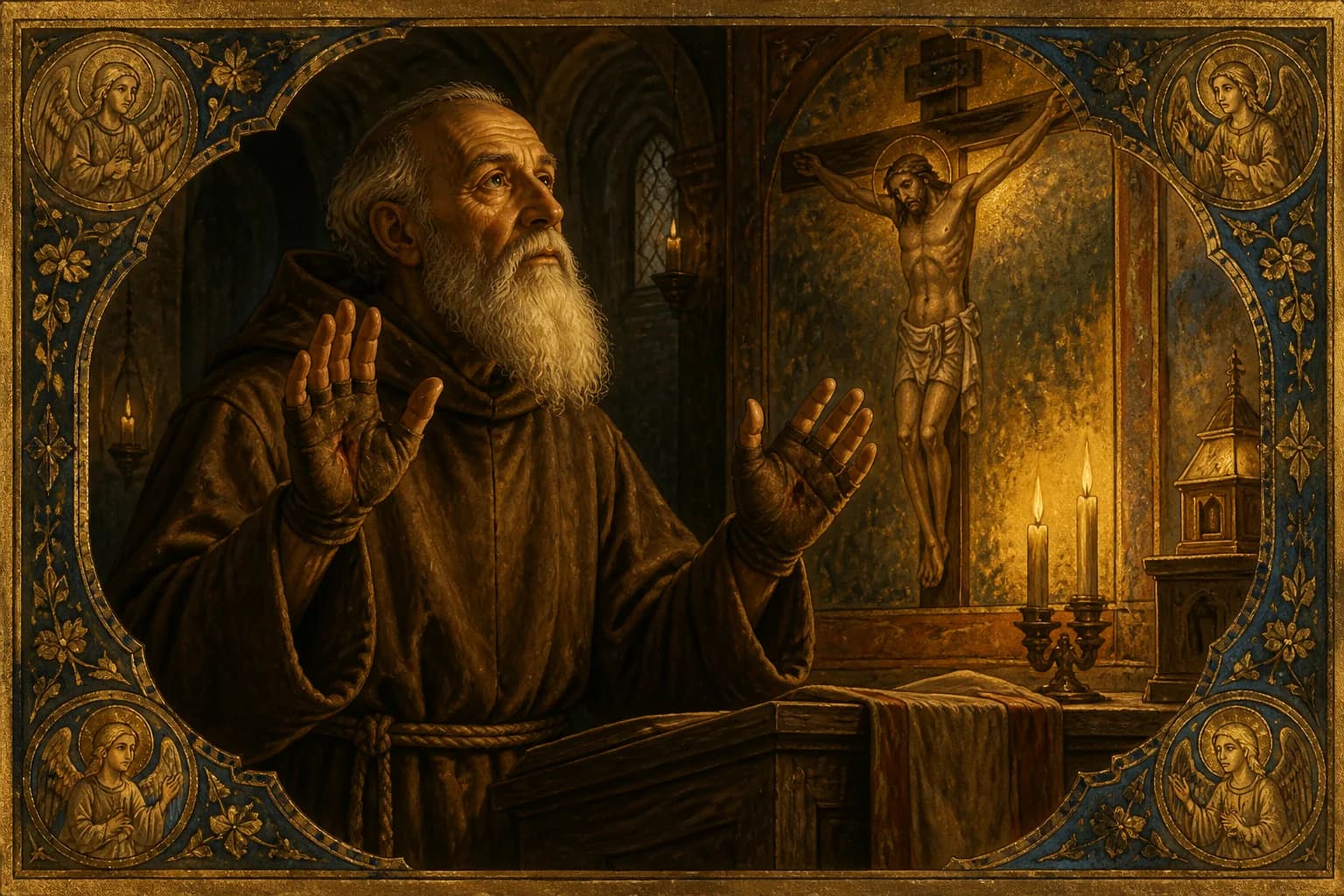
He always wore half-gloves on his hands, with the palms covered, and tried to hide the wounds. He found their attention humiliating.
Bilocation, Healings, and the Skeptical View
Padre Pio is also associated with reports of bilocation — being seen, by named witnesses, in places he could not have traveled to — and of miraculous healings. The Catholic Church investigates these claims as part of the canonization process. Two miracles — the cure of Consiglia De Martino in 1995 from a ruptured thoracic duct, and the cure of Matteo Pio Colella in 2000 from acute meningitis — were medically and canonically certified as inexplicable and used in the beatification (1999) and canonization (2002) of Padre Pio.
Bilocation is harder. The Church does not require Catholics to believe in any specific reported instance. The phenomenon is reported in the lives of other saints and is treated as part of the broader category of charismatic phenomena that may attend genuine sanctity.
The skeptical view of Padre Pio — that the wounds were maintained by carbolic acid, that some of the reports were fraud, that the friar was a manipulator — has been argued, most prominently in Sergio Luzzatto's 2007 book Padre Pio: Miracles and Politics in a Secular Age. Luzzatto cites archival material including an account from a pharmacist who said he sold Padre Pio carbolic acid. Defenders of Padre Pio note that the carbolic acid was used in the friary as a general antiseptic and that the wounds existed before and after any such purchases.
What no critical historian has produced is a medical mechanism that accounts for fifty years of stable, non-infected, non-healing through-and-through perforations of the hands, feet, and side.
The Disappearance of the Wounds
This is the part of the story least appreciated outside Catholic circles.
In the last week of his life, Padre Pio's stigmata began to disappear. He celebrated his last Mass on the morning of September 22, 1968 — the day before he died — and was visibly weak. That evening, the friars who helped him to bed noticed that the wounds were already closing. By the time he died at 2:30 a.m. on September 23, the wounds were gone entirely. The skin of his palms and the tops of his feet was smooth, unmarked, without scar tissue. The wound in his side had closed.
The undertakers and the friars who prepared his body documented this. Photographs of the hands taken after death show clean, unmarked skin. Whatever had caused the wounds had taken them with it.
He had told a fellow friar years earlier that the wounds would disappear before his death. The prophecy is preserved in the testimony given during the canonization process.
Canonization and Legacy
Padre Pio was beatified by John Paul II on May 2, 1999, and canonized on June 16, 2002, as Saint Pio of Pietrelcina. His feast is September 23, the day of his death. His body is enshrined at the Sanctuary of San Pio of Pietrelcina in San Giovanni Rotondo, one of the most visited Catholic shrines in Italy.
The Casa Sollievo della Sofferenza ("Home for the Relief of Suffering"), the modern hospital Padre Pio founded in San Giovanni Rotondo and inaugurated in 1956, is now one of the major hospitals in southern Italy. It is widely considered his most lasting visible work.
For broader context on what Catholic tradition makes of bodily charisms in the lives of the saints — wounds, ecstasies, mystical experiences — see the stigmata of Saint Francis at La Verna in 1224 and the transverberation of Saint Teresa of Avila.
What the Wounds Were For
Padre Pio was clear, when pressed, about how he understood the stigmata: they were a participation in the suffering of Christ on behalf of souls. He used the language of victim soul — a soul that offers itself to share in Christ's redemptive suffering. He prayed and suffered for sinners; he offered his Masses for the holy souls in purgatory; he received hundreds of letters a day asking for prayer and answered as many as he could.
A man bleeding for fifty years with no medical explanation, who carried five wounds and a stack of letters and the silence of a Vatican that did not trust him, kept his obedience and his ordinary religious life. That is the harder thing to imitate than the wounds themselves.
Listen to Padre Pio on Crucis Lux
Crucis Lux tells the story of Padre Pio as a slow-paced, illustrated audio series — every scene narrated, every panel illustrated in the style of medieval frescoes, in five languages.