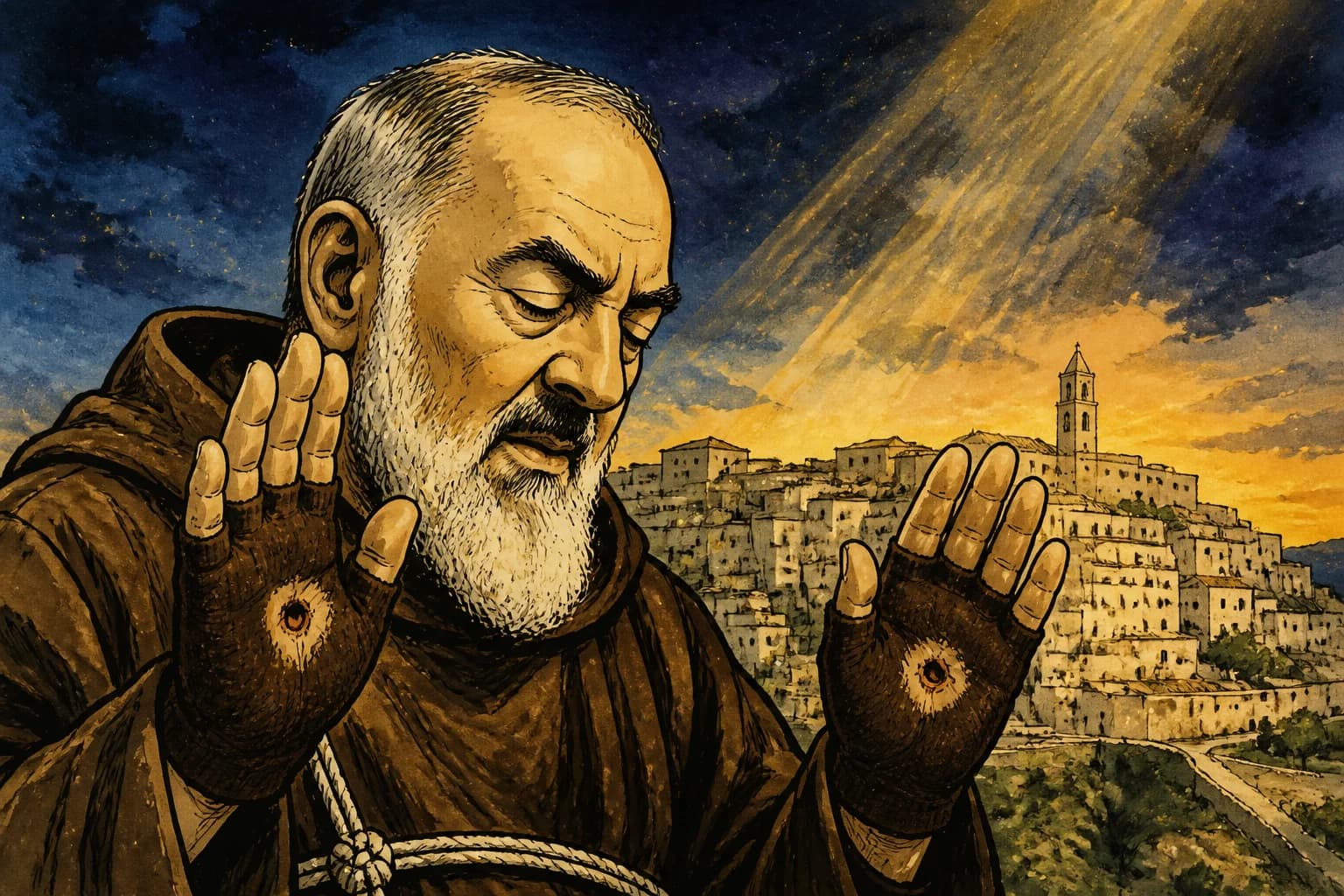
Padre Pio — The Five Wounds
The Italian friar who bore the stigmata for fifty years
Fifteen episodes on Francesco Forgione, the peasants' son from Pietrelcina who became the first stigmatized priest in the history of the Church. From the 1887 village to the convent of San Giovanni Rotondo, from the Holy Office suspensions to the improbable friendship with Karol Wojtyla, from the hospital he founded for the poor to the funeral that drew a hundred thousand people. The life of the saint told in historical detail and reverent silence.
15 episodes · Narrated in English, Portuguese, Spanish, French and German
Episode 1 is free
Episodes
- 01
The Forgione Boy
Pietrelcina, 1887. A peasant village in Campania. A boy who, by his own later account, consecrates himself to God at the age of five.
- 02
Brother Pio's Novitiate
1903. At fifteen, Francesco enters the friary. He takes the habit, receives a new name, and begins to learn silence.
- 03
The Years of Suffering
1910 to 1916. A priest, but a sick one. At home, in temporary friaries, in the military hospital. Six years of letters and silence.
- 04
The Mountain of Gargano
1916. Padre Pio arrives in San Giovanni Rotondo. An isolated friary on the mountain. The quiet years before the storm.
- 05
The Transverberation
August 1918. Padre Pio describes a vision, a blade of fire, and a wound in the soul that does not close.
- 06
The Twentieth of September
1918. Friday morning, in the friary choir. According to his own account, the five wounds appear on Padre Pio.
- 07
The Doctors and the Wounds
1919 to 1920. Romanelli, Bignami and Festa examine the wounds. They do not reach the same conclusion. None of them closes the case.
- 08
The First Shadow
1921 to 1923. The Vatican investigates. The archbishop of Manfredonia sends denunciations to Rome. The Holy Office decides.
- 09
Two Years of Silence
1931 to 1933. A decree of the Holy Office strips Padre Pio of all ministry except Mass, celebrated privately in an inner chapel. No congregation, no confessions.
- 10
The Friar in the Clouds
1939 to 1945. The world war reaches Italy. A legend is born of airmen who are said to have seen a friar in the sky above San Giovanni Rotondo.
- 11
Casa Sollievo della Sofferenza
1940 to 1956. Padre Pio founds a hospital for the sick of Monte Gargano. Sixteen years of fundraising. The dream of a lifetime.
- 12
The Spiritual Children
The 1940s and 1950s. Padre Pio's network of spiritual children grows around the world. A young Polish priest visits him. According to one account, Pio tells him of a hidden wound.
- 13
The Last Investigation
1960 to 1964. John the Twenty-Third approves a new apostolic visitation. Monsignor Carlo Maccari examines every detail. The result will be bitter.
- 14
The Letter from Bishop Wojtyla and the Last Mass
1962 to 1968. Wojtyla writes asking for prayers for an ailing mother and, days later, writes that she has been healed. And the night when Padre Pio dies, the stigmata already gone.
- 15
From the Earth to the Altar
1968 to 2010. A vast crowd at the funeral. Thirty-four years until canonization. A boy's healing, recognized as a miracle. A Polish Pope who canonizes him. A body exhumed and taken to the gilded crypt.
How this series was researched
The narration and the place and date labels were broken down into factual claims and checked against sources: 243 claims in this series were checked against a cited source. Where the sources did not support a claim, the text was corrected or reduced to what the sources actually say.
A second, independent check then went through the whole series again.
The text was reviewed separately in each of the five languages it is narrated in.
Main sources
- Epistolario di Padre Pio da Pietrelcina (4 vols.) — Padre Pio da Pietrelcina (1901–1968)
- Padre Pio da Pietrelcina (1887–1968) — biography — Holy See
- Homily for the canonization of Padre Pio — John Paul II (2002)
- Padre Pio Under Investigation: The Secret Vatican Files — Francesco Castelli (2011)
- Padre Pio. Miracoli e politica nell'Italia del Novecento — Sergio Luzzatto (2007)
Tradition and debate
Where the sources are thin or disagree, the series says so. For example:
- The story of a friar in the sky over San Giovanni Rotondo turning bombers back circulates in many versions, all from later accounts; no document from the time confirms it.
- The saying “Pray, hope, and don't worry” is attributed to Padre Pio by tradition; its exact written origin could not be traced in the sources consulted.
- Sources disagree on the year the young priest Karol Wojtyła visited San Giovanni Rotondo: 1947 or 1948.
Read more on the Journal
The Padre Pio Novena to the Sacred Heart — Text and How to Pray It
The novena to the Sacred Heart associated with Padre Pio: the full text as it is commonly printed, what can honestly be said about its attribution, the other prayers that carry his name, and how to pray the nine days.
What Is Purgatory? What the Church Actually Teaches
Purgatory in Catholic teaching — what the Catechism says and does not say, the scriptural basis, why it is not a second chance, what the 'fire' means, and how praying for the dead fits in.
Padre Pio's Stigmata: The Medical Examinations and Record
Padre Pio's stigmata and the medical record: the doctors who examined him in 1919 and 1920, wounds that never healed or infected, and their end.