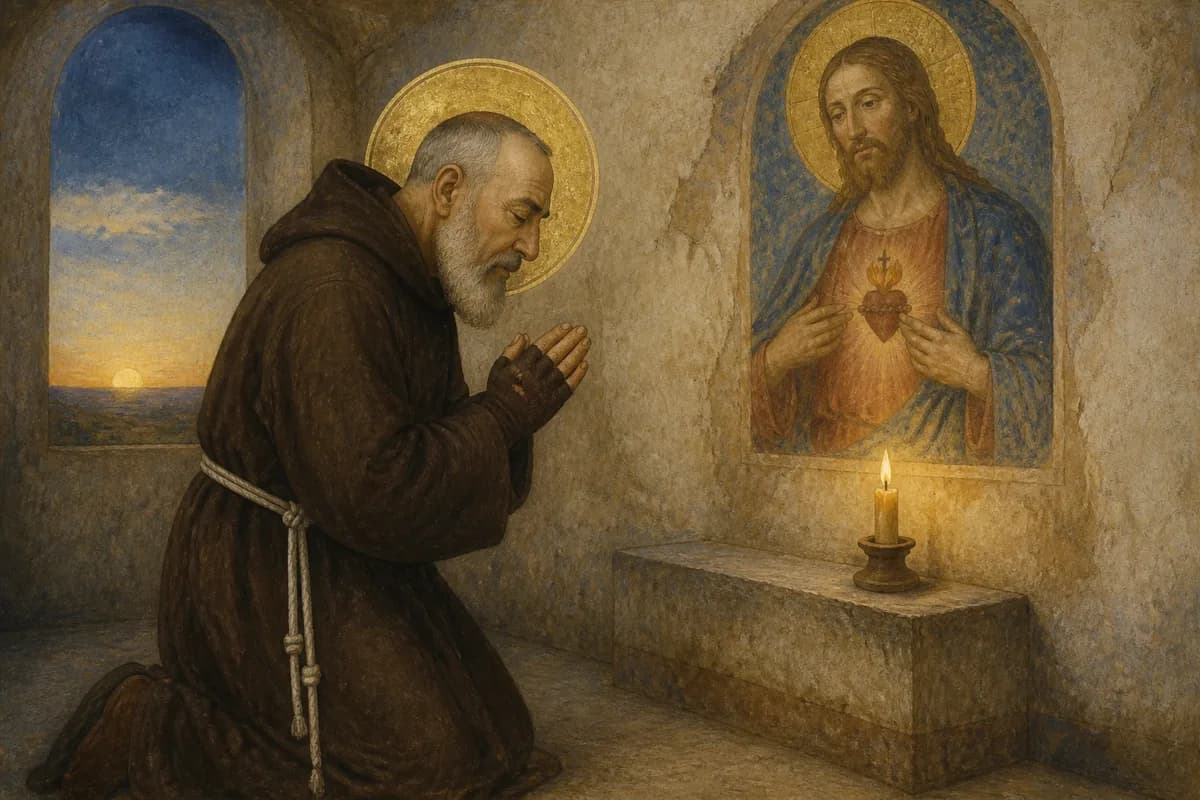
Padre Pio spent fifty years answering letters. They arrived at San Giovanni Rotondo by the sackful — sick children, failing marriages, men who had stopped believing, women asking him to pray for a son at war. He could not answer them all individually, and he did not pretend to. What he did, according to the friars who lived with him and the accounts gathered at his friary, was carry those intentions into a prayer he made every day: a novena to the Sacred Heart of Jesus.
That novena still circulates under his name. It is short, it is entirely built out of words Christ speaks in the Gospels, and it can be prayed in about five minutes. Here is what it actually says, what is honestly known about how it came to be attached to him, and what the other prayers associated with Padre Pio are.
Two different things are called "the Padre Pio novena"
It is worth separating them at the start, because devotional websites mix them constantly.
The first is the novena Padre Pio prayed — the one described in this article. It is addressed to the Sacred Heart of Jesus. Padre Pio is not its object; he is, so to speak, a fellow petitioner.
The second is a novena to Padre Pio, in which he is asked to intercede. Those texts were written after his beatification in 1999 and his canonization by John Paul II in 2002, and they are perfectly legitimate — Catholics ask saints to pray with them and for them, which is what intercession means. But they are not the same prayer, and they are not the one he is said to have prayed himself.
If you are new to the form altogether, our explainer on what a novena is covers the nine-day structure and its roots in the Upper Room between the Ascension and Pentecost.
The structure
The novena has an unusual shape. Most novenas are a composed prayer repeated for nine days. This one is three Gospel sentences, each turned back to Christ as a request, each followed by the three prayers every Catholic already knows.
Day by day, the same sequence is prayed:
- A sentence of Christ, quoted back to him, followed by the intention.
- Our Father, Hail Mary, Glory Be.
- The invocation: Sacred Heart of Jesus, I place all my trust in you.
That happens three times, once for each sentence. Then the novena closes with a single prayer to the Sacred Heart.
The text, as it is commonly printed
First:
O my Jesus, you have said: "Truly I say to you, ask and you will receive, seek and you will find, knock and it will be opened to you." Behold, I knock, I seek, and I ask for the grace of… (name your intention)
Our Father. Hail Mary. Glory Be. Sacred Heart of Jesus, I place all my trust in you.
Second:
O my Jesus, you have said: "Truly I say to you, if you ask anything of the Father in my name, he will give it to you." Behold, in your name, I ask the Father for the grace of… (name your intention)
Our Father. Hail Mary. Glory Be. Sacred Heart of Jesus, I place all my trust in you.
Third:
O my Jesus, you have said: "Truly I say to you, heaven and earth will pass away, but my words will not pass away." Encouraged by your infallible words, I now ask for the grace of… (name your intention)
Our Father. Hail Mary. Glory Be. Sacred Heart of Jesus, I place all my trust in you.
Closing prayer:
O Sacred Heart of Jesus, for whom it is impossible not to have compassion on the afflicted, have pity on us miserable sinners and grant us the grace which we ask of you, through the Sorrowful and Immaculate Heart of Mary, your tender Mother and ours.
The three sentences come from Matthew 7:7, John 16:23, and Matthew 24:35 (repeated at Mark 13:31 and Luke 21:33). Wordings differ slightly from one printed card to the next, because translations differ; none of the variants changes the sense.
What can honestly be said about the attribution
This part deserves care, because devotional publishing is careless with it.
There is no evidence that Padre Pio composed this novena. Its raw material is Scripture, and the concluding prayer to the Sacred Heart belongs to a devotional tradition that long predates him — the Sacred Heart devotion spread through the Church after the seventeenth-century revelations to Saint Margaret Mary Alacoque at Paray-le-Monial, and prayers of this kind were in wide circulation by the nineteenth century.
What is consistently reported, by his friary and by the many collections of his counsels, is that Padre Pio prayed this novena every day, for all those who had recommended themselves to his prayers. That is why it carries his name: not authorship, but habit. It is the prayer he is said to have used to carry other people's needs.
How much weight that bears is a fair question. The reports are devotional rather than archival: you will not find a dated notebook page settling when he began. Compared with, say, the stigmata — where there are named physicians and signed reports, which we go through in the medical record of Padre Pio's wounds — the documentation here is thinner. The honest summary is the modest one: widely and consistently attributed to him, not composed by him, and not verifiable to a particular date. Nothing about the prayer's worth depends on settling that, and inflating the claim only invites the scepticism the prayer does not need.
The other prayers that carry his name
"Stay with me, Lord." A long prayer of thanksgiving after Communion — Stay with me, Lord, for it is necessary to have you present so that I do not forget you — is printed almost everywhere under Padre Pio's name. It expresses exactly the Eucharistic devotion his life was built around. Its textual pedigree, however, is traditional rather than documented, and it is best prayed as a prayer of his tradition rather than as a text you can trace to his hand.
"Pray, hope, and don't worry." Prega, spera e non ti agitare is the line most often repeated by those who knew him and the one that appears throughout collections of his counsels. It is advice, not a formula — and it is a fair summary of how he told anxious people to handle an intention they had already placed before God.
The Rosary. Padre Pio's attachment to the Rosary is attested by everyone who lived with him; he called it a weapon and was rarely seen without beads in his hands. Accounts of how many he prayed each day vary wildly and none of the figures is reliable, so treat the numbers you see as folklore and the habit as fact.
Confession and the Mass. The two practices that actually consumed his days were hearing confessions — for ten or twelve hours at a stretch — and offering Mass at length. Any devotion to him that skips those two is missing the centre of gravity.
How to pray the nine days
Choose one clear intention and keep it the same for all nine days; the blanks in the text are meant to be filled with something specific. Set a time you can actually hold — early morning and the end of the day are the usual choices — and pray the three sentences, the three sets of prayers, and the closing prayer. It takes five minutes.
If you miss a day, continue rather than restart. The discipline is meant to form the one praying, not to be an unbroken sequence that a lapse voids.
Many people finish the novena on September 23, the feast of Saint Pio of Pietrelcina — the day he died in 1968, having borne the stigmata since 1918 — which means beginning on September 15. Others time it to the feast of the Sacred Heart, on the Friday after the octave of Corpus Christi. Neither is required. Any nine consecutive days will do.
More on his life, in narrated and illustrated form, is in the Padre Pio series.
What the novena does not promise
It is not a mechanism. Nine days do not oblige God, and the Church has never taught that they do. The three Gospel sentences are promises that the Father hears what is asked in Christ's name — which is not the same as a guarantee that the specific thing you name will arrive in the shape you imagined. Anyone who tells you otherwise is selling something.
What the nine days do is keep a need in front of you long enough to change how you hold it. That is the whole logic of a novena, and it is why Padre Pio, who had more requests than any man could carry, answered them by praying the same short thing every day for fifty years.