Every year, weeks before the lights and the carols and the gifts, the Church begins again. Not on January 1, but on a quiet Sunday in late November or early December, with violet vestments and a single candle. This is Advent — the season the Christian world has used for centuries to get ready for Christmas. It is older and stranger than the shopping countdown that has grown up around it, and far richer. Understanding it changes how the whole month feels.
What Advent is
The word comes from the Latin adventus, meaning "coming" or "arrival." Advent is the liturgical season of preparation for Christmas, and it is also where the Church's entire liturgical year begins. So while the rest of the calendar is winding down toward December 31, the Church is starting fresh: the First Sunday of Advent is, in a real sense, the Church's New Year's Day.
Advent begins on the First Sunday of Advent — the fourth Sunday before Christmas — and runs for about four weeks, until Christmas Eve. Because Christmas falls on a different day of the week each year, the exact length varies slightly, but the shape is always the same: four Sundays of expectation leading up to the Nativity.
It is, importantly, a season of preparation rather than celebration. The feasting belongs to Christmas itself and the days that follow. Advent is the getting-ready: a quieter, more reflective stretch that the Church marks with the color violet, the same color used in Lent, signaling penance and waiting.
The twofold meaning
Here is the part many people miss. Advent is not only about looking back to Bethlehem. It has a double horizon.
On one hand, Advent prepares us to celebrate Christ's first coming — the Nativity, God entering history as a child two thousand years ago. That is the obvious meaning, the one the manger scenes and the carols make vivid.
On the other hand, Advent also turns the believer's eyes forward, to await Christ's second coming in glory at the end of time. The earliest weeks of Advent, in fact, lean heavily on this theme: the readings speak of watchfulness, of staying awake, of a world straining toward its fulfillment. Only as Christmas draws near does the focus shift fully to the birth at Bethlehem.
That is why Advent has a distinctive emotional tone — not the somber penance of Lent, but a hopeful, joyful kind of waiting. It is a season of patience and longing, of preparing the heart, lit from within by expectation. The Church waits the way someone waits for a much-loved guest: with work to do, and with joy.
The Advent wreath
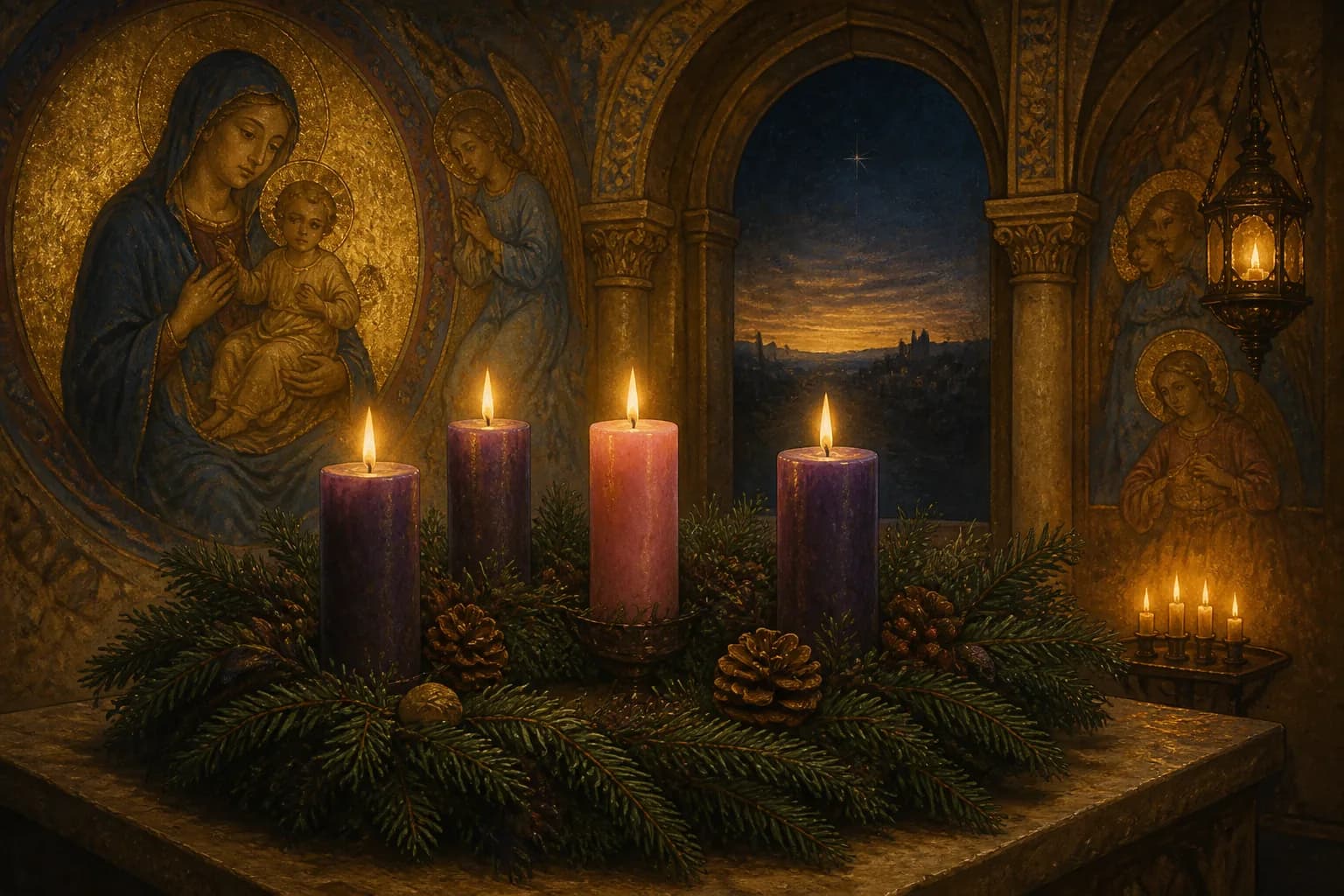
No custom captures the season better than the Advent wreath. It is a circle of evergreen branches holding four candles — three violet and one rose. One candle is lit on the First Sunday of Advent, two on the second, three on the third, and all four on the fourth, so that the light grows steadily as Christmas approaches. The circle of greenery, never-ending and always alive, is itself a sign of God and of eternal life.
The four candles are commonly associated with four themes, one for each week: hope, peace, joy, and love. The rose candle is lit on the Third Sunday — known as Gaudete Sunday, from the Latin word for "rejoice." At the season's midpoint, the Church pauses to celebrate that the waiting is more than half over and the joy of Christmas is near. The lighter rose color, breaking the violet, is the visible sign of that gladness.
Lighting the wreath is something families can do at home, week by week, often with a short prayer or a reading. Watching the light increase from one flame to four is a simple, powerful way to feel the season actually moving toward its goal rather than letting December blur past in a rush.
Other Advent customs
The wreath is the most familiar tradition, but it is far from the only one.
The O Antiphons are among the oldest. From December 17 to 23, in the days just before Christmas, the Church prays a series of short, ancient invocations that each address Christ by one of his scriptural titles — O Wisdom, O Root of Jesse, O Dayspring, O King of Nations, and so on. They are a poetic, escalating cry for the Savior to come, and the famous hymn "O Come, O Come, Emmanuel" is woven from them.
The Advent calendar is the custom most children know — a calendar with a small door or window to open on each day of December leading up to Christmas, building anticipation one day at a time. In its better forms it carries a Scripture verse or image behind each door, keeping the countdown tied to its meaning.
The Jesse Tree is a quieter, catechetical custom. Named for Jesse, the father of King David, it traces the family tree and the whole story of salvation that leads up to Christ. Each day an ornament representing a person or event from Scripture is added — from creation, through the patriarchs and prophets, down to Mary and Joseph — so that by Christmas the tree tells the entire story of how the world was prepared for the Savior.
How to live Advent well
The genius of Advent is that it resists the rush. The wider culture treats December as one long, frantic sprint to Christmas Day, and then drops everything the moment the wrapping paper is cleared away. The Church does the opposite: it spends four unhurried weeks preparing, and then celebrates Christmas as a season that begins, not ends, on December 25.
To enter into Advent is to reclaim that rhythm. It can be as simple as lighting the wreath each Sunday, keeping a few minutes of quiet, reading the day's Scripture, or following the Jesse Tree with children. The point is not to add more activity to an already crowded month but to give the waiting itself a shape — to let anticipation, hope, and a little holy patience do their work before the feast arrives.
Done that way, Christmas lands differently. It comes not as a deadline finally met but as the answer to a longing the whole season has been gently building. The light on the wreath has grown to four flames; the long expectation is fulfilled; the Guest has arrived.
Crucis Lux tells the life of Christ and the saints as narrated, illustrated stories — a gentle companion for Advent and the whole year.