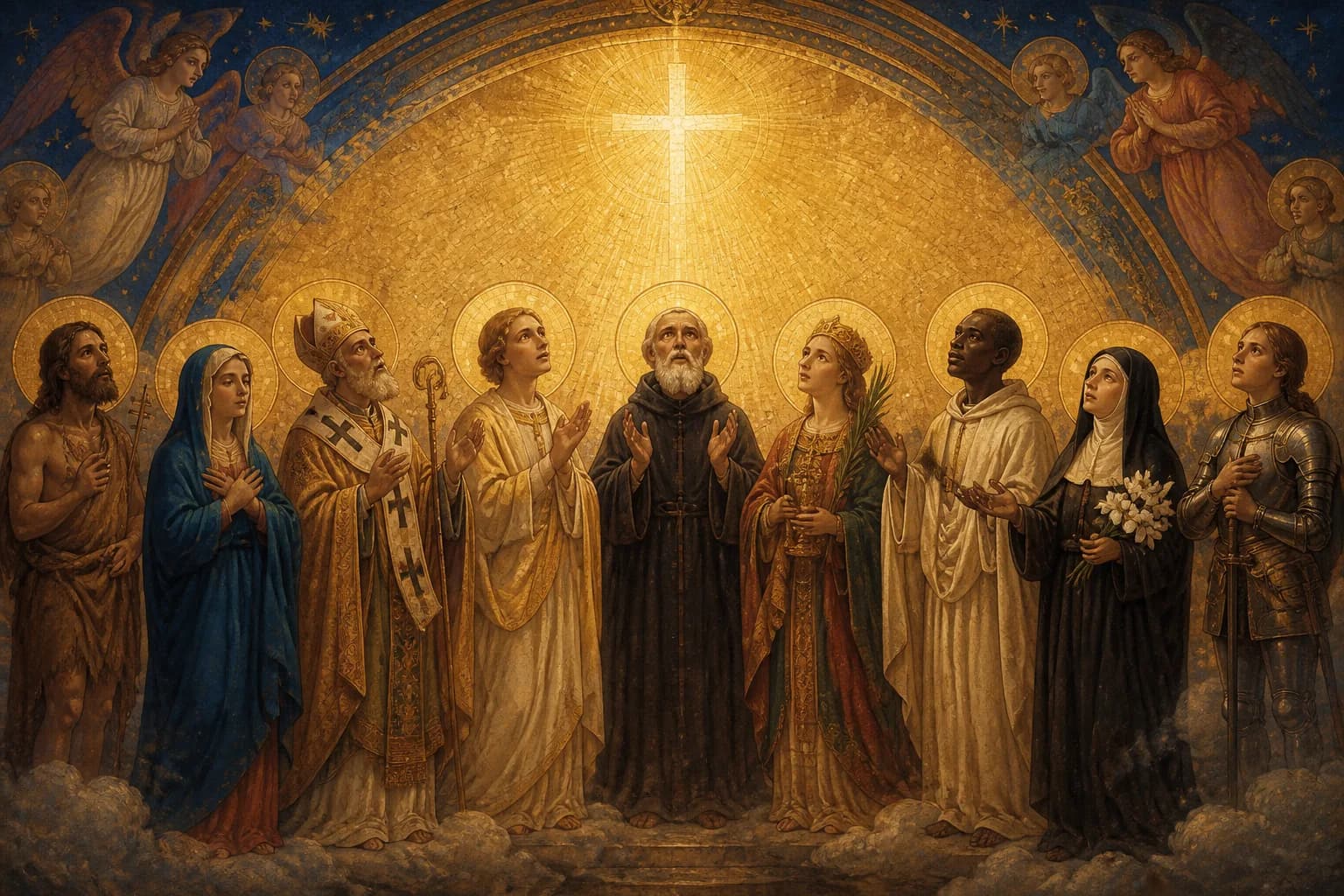
Walk into almost any Catholic parish and you will find them: a statue of a saint holding a child, a stained-glass figure with a sword, a small card tucked into a prayer book. Behind each of these is a person who once lived, struggled, prayed, and died — and who is now believed to stand in God's presence, paying special attention to a particular group of people, place, or need. These are the patron saints. The idea is older than most countries and gentler than it sometimes looks, and once you understand it, the whole crowded calendar of saints starts to make sense.
What a patron saint is
A patron saint is a holy person in heaven who is recognized as a special intercessor and protector for a particular person, place, profession, activity, or cause. The word patron comes from the Latin idea of a protector or advocate — someone who looks out for you and speaks on your behalf.
Catholics do not believe that a patron saint has powers of his or her own to grant. The conviction is simpler and more relational: the saints are fully alive in God, they love the people still on earth, and they pray for them. To have a patron saint, then, is to have a particular friend in heaven — one who is thought to take a special interest in your work, your town, your struggle, or your name.
A single saint can have many patronages, and a single need can have several saints associated with it. The system is not a tidy chart handed down from above; it grew over centuries, out of real lives and real devotion.
How patronages happen
Patronages arise in several recognizable ways.
The most common is the life or death of the saint. A patronage often mirrors something the saint actually did. Saint Luke is honored as the patron of physicians because early tradition held that he was a doctor. Saint Cecilia is the patron of musicians because of the music associated with her story. The link usually points back to something real in the saint's biography or martyrdom.
A second path is long-standing popular devotion. Sometimes ordinary believers simply turned to a particular saint in a particular need for so long that the association became permanent. No committee decided it; the people did, by praying.
A third path is papal or official designation. The Church can formally name a saint as the patron of a country, a diocese, a religious order, or even a modern profession or technology. When a new need arises that the ancient saints could not have imagined, the Church sometimes assigns a fitting patron whose life suggests a natural connection.
And finally there is place and tradition: a saint buried in a city, or one who evangelized a region, often becomes its patron almost naturally over time.
Some well-known examples
A few patron saints are famous far beyond the Church, and they make the idea concrete.
- Saint Joseph — the foster father of Jesus — is patron of workers and of fathers, of the universal Church, and of a happy death. His quiet, faithful, hidden labor made him the natural patron of anyone who works with their hands and of households trying to do right.
- Saint Anthony of Padua is invoked for lost things, a custom so widespread that even people far from the faith have heard the prayer to find a missing object.
- Saint Jude Thaddeus, one of the Twelve Apostles, is the patron of desperate or hopeless cases — the saint people turn to when every other door seems closed.
- Saint Francis of Assisi, who preached to birds and treated all creatures as kin, is patron of animals and of ecology.
- Saint Cecilia is patron of musicians; Saint Christopher, remembered for carrying the Christ Child across a river, is patron of travelers; and Saint Michael the Archangel is patron of soldiers and police, the protector against evil.
- For the missions, the Church names two very different figures: Saint Francis Xavier, who carried the faith across Asia, and Saint Thérèse of Lisieux, a cloistered nun who never left her convent yet is co-patron of all missions for the love that fueled her prayers.
- Saint Luke, the evangelist, is patron of physicians and of artists.
Countries and cities have patrons too. Across the world, nations and towns place themselves under the protection of a saint, often celebrated with a yearly feast that shapes the local calendar.
How to choose a patron saint
You do not have to engineer this; in many ways a patron saint is given as much as chosen. Still, there are natural ways to find yours.
The first is your name. Many Catholics carry the name of a saint from baptism, and at confirmation many choose a new saint's name deliberately — picking a holy person whose life they admire and want to imitate.
The second is your work or state in life. A nurse may turn to Saint Luke, a teacher to a patron of teachers, a parent to Saint Joseph. Letting your daily life suggest a companion is an old and sensible instinct.
The third is a particular need. People facing a hopeless situation pray to Saint Jude; travelers ask Saint Christopher; those who have lost something call on Saint Anthony. The need finds the saint.
And the fourth, quietest path is simply attraction. Sometimes you read a saint's life and feel drawn to that person — their courage, their humor, their way of loving God. That pull is itself a kind of introduction. You can adopt a patron saint the way you make a friend: by spending time with their story and talking to them in prayer.
The theology, gently stated
It is worth being clear about what this devotion does and does not mean, because it is easy to misunderstand.
Catholics ask the saints to pray with them and for them. Asking a saint to intercede is not worship and does not replace God. It is, very simply, like asking a friend to pray for you — except that this friend is already in God's presence, fully alive, and free of every distraction. The grace, the help, the answer all come from God alone; the saint joins your prayer to his, the way one believer on earth might pray alongside another.
Behind it stands an old conviction: that the Church is one family, and that death does not break the bonds of love within it. Those who have gone before are not gone from the family. To have a patron saint, then, is not to add a middleman between yourself and God. It is to remember that you are not praying alone — that heaven is crowded with people who already love you and are glad to pray you home.
Crucis Lux tells the lives of the saints as narrated, illustrated stories — so the friends in heaven become real to you. Meet them in the app.