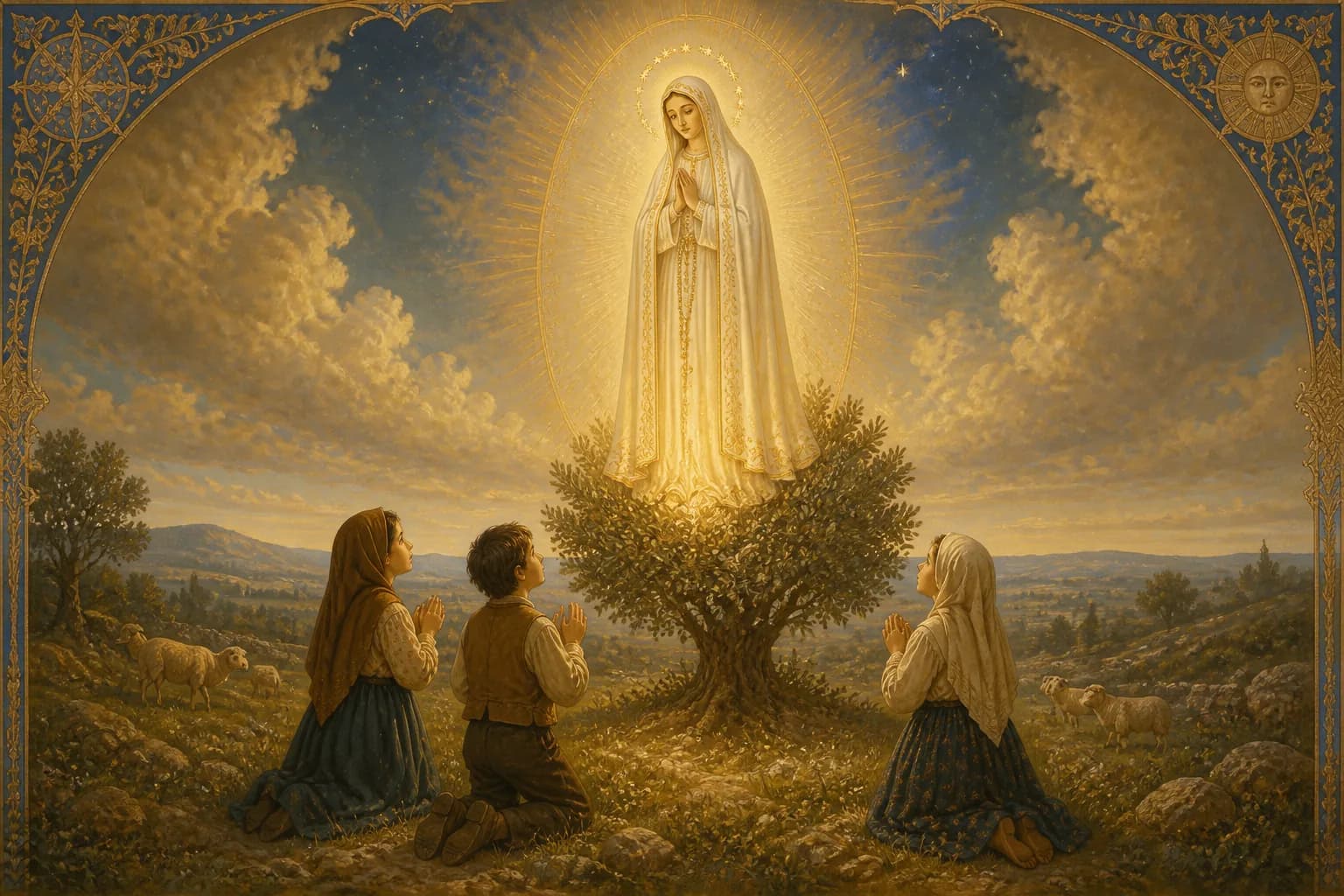
In the spring of 1917, with the First World War grinding through its third terrible year, a lady of light appeared above a small holm oak in a field called the Cova da Iria, near the Portuguese village of Fátima. She came not to scholars or kings but to three children who were watching their families' sheep. Over six months she returned again and again, always on the thirteenth day, and what she asked of them was simple enough for a child to understand and demanding enough to change the world: pray, do penance, and turn your hearts back to God. More than a century later, the message of Fátima has lost none of its urgency.
The apparitions and the children
The three who saw her were Lúcia dos Santos, who was ten years old, and her younger cousins Francisco and Jacinta Marto, who were nine and seven. They were ordinary shepherd children, unlettered and poor, the kind of witnesses no one would have chosen for a message meant for the whole Church.
Our Lady appeared to them six times, once a month from May to October of 1917. At the first apparition, on May 13, she told the children not to be afraid and asked them to come back to the same place on the thirteenth of each month. From the start she asked them to pray the Rosary every day for peace and for the end of the war that was tearing Europe apart. The children kept the appointment month after month, even as crowds grew, even as local officials mocked and threatened them, and even after one civil administrator detained the three and tried to frighten them into recanting. They did not recant.
What Our Lady asked
The heart of the Fátima message is not a prophecy or a spectacle. It is a call — the same call the Gospel makes — to conversion. Our Lady asked the world to stop offending God, who was already so deeply offended, and to amend its life.
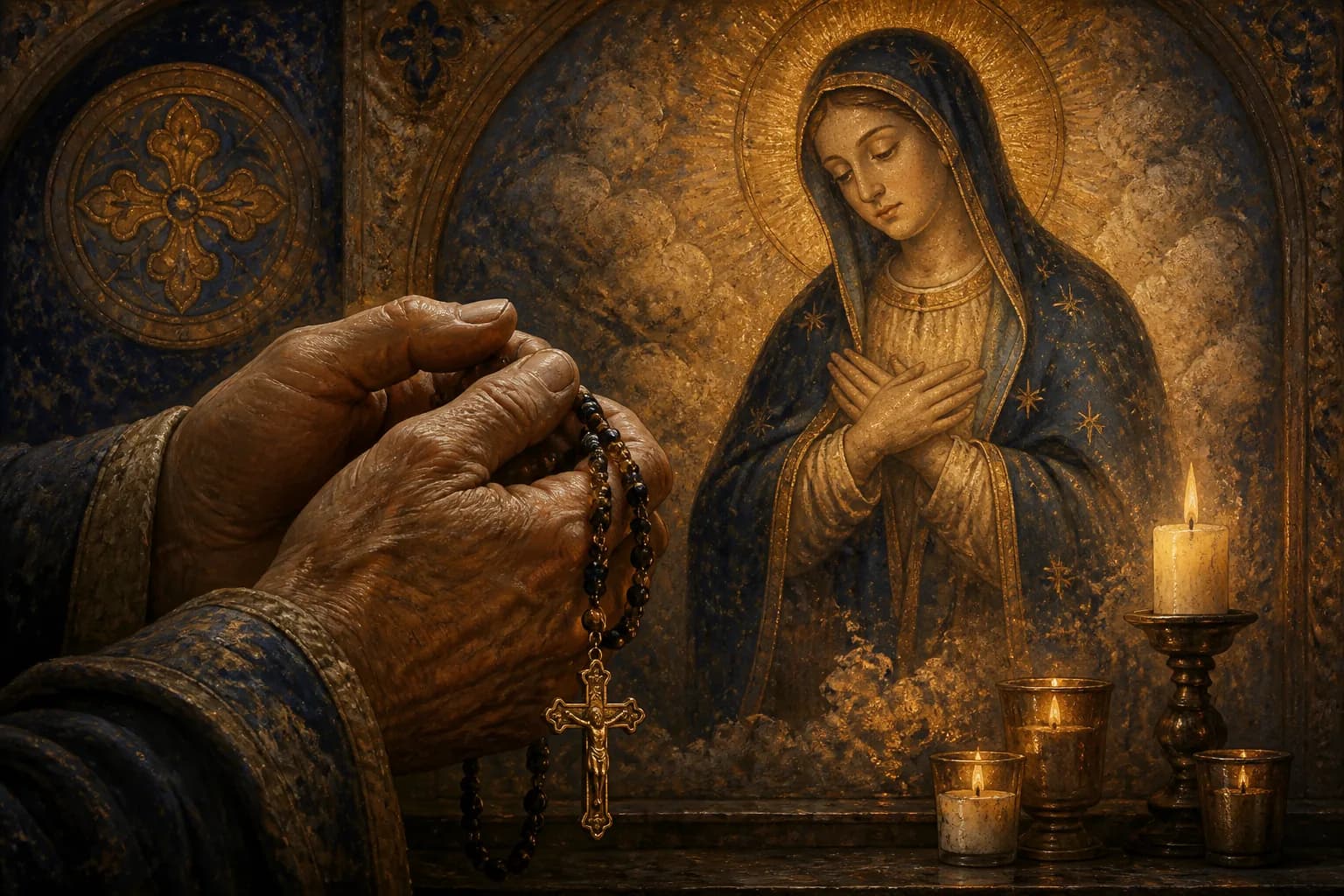
Around that central plea she gave a few clear, repeatable requests. She asked for the daily praying of the Rosary, naming it directly as the means to obtain peace and the end of the war. She asked for prayer and sacrifice offered for the conversion of sinners, telling the children that many souls are lost because no one prays and sacrifices for them. And she invited the children, and through them everyone, to accept the small sufferings of daily life and offer them to God in reparation. None of this required wealth, learning, or power. It required only a heart willing to turn around.
The most famous of the six apparitions came last. On October 13, 1917, a vast crowd — often described as tens of thousands — gathered in the rain at the Cova da Iria, drawn by the children's promise that Our Lady would give a sign. What they witnessed has come to be called the Miracle of the Sun, when the sun appeared to dance, spin, and plunge toward the earth before returning to its place, and the rain-soaked ground and clothing were found dry. That extraordinary day deserves its own telling, and the companion article in this series is devoted to it.
The Immaculate Heart of Mary
Running through the whole message is one tender and central theme: devotion to the Immaculate Heart of Mary. Our Lady told the children that God wished to establish in the world this devotion, and she pointed to her own heart as a refuge and a sure path to God.
This was never about exalting Mary in place of her Son. The Immaculate Heart is, in Catholic understanding, the most perfect human heart ever turned wholly toward God — a heart that received Christ first and held nothing back. To take refuge in it is to learn how to love God as she did. Fátima's call to honor the Immaculate Heart is, at bottom, an invitation to let Mary lead us to Jesus, and to trust her maternal care in a violent and frightened age.
The secrets in brief
In July 1917 Our Lady confided to the children what later became known as the three secrets of Fátima. They should be approached carefully and without sensationalism, for their purpose was always to call souls to prayer, not to feed curiosity.
The first was a vision of hell, shown to the children so that they would understand what is at stake for souls and would pray and sacrifice to save them. The second was the request that devotion to the Immaculate Heart of Mary be spread, together with a warning that grave suffering and further war would follow if humanity did not turn back to God. The third secret was not revealed until the year 2000; it described a vision of a bishop dressed in white who passes through a ruined city and is struck down. The Vatican has understood this vision in connection with the persecution the Church endured across the twentieth century, and especially with the 1981 attempt on the life of Pope John Paul II, who himself credited Our Lady of Fátima with saving him. The secrets are explored more fully in the companion article in this series.
Lives shaped by the message
The children themselves became the first to live what they had heard. Francisco and Jacinta Marto did not live long; both died young during the influenza years of 1918 to 1920, having spent their final months in prayer and quiet offering. The Church recognized the holiness of their short lives, beatified them, and canonized them as saints in 2017 — among the youngest non-martyrs ever raised to the altars.
Lúcia dos Santos lived a very different but no less faithful life. She entered religious life, became a Carmelite nun, and carried the Fátima message for decades, recording the apparitions and the requests she had received. She died in 2005, at the age of ninety-seven, the last living witness of the Cova da Iria.
The message today
It would be easy to file Fátima away as an event of 1917, bound to a war that ended long ago. But the message was never about a single year. Its core — conversion, prayer, penance, and trust in the Immaculate Heart of Mary — speaks to every age, because every age has its wars, its fears, and its temptation to live as though God were absent.
Fátima answers that temptation not with panic but with peace. Take up the Rosary. Offer the ordinary hardships of the day for those who have no one to pray for them. Turn the heart, again and again, back to God. The lady of light did not ask the children for anything heroic or strange — only for the steady, humble faith that any believer can practice. That is why the message endures, and why it still feels addressed to us.
Crucis Lux tells the story of Fátima as a narrated, illustrated series — the children, the apparitions, and the message that still calls. Explore it in the app.