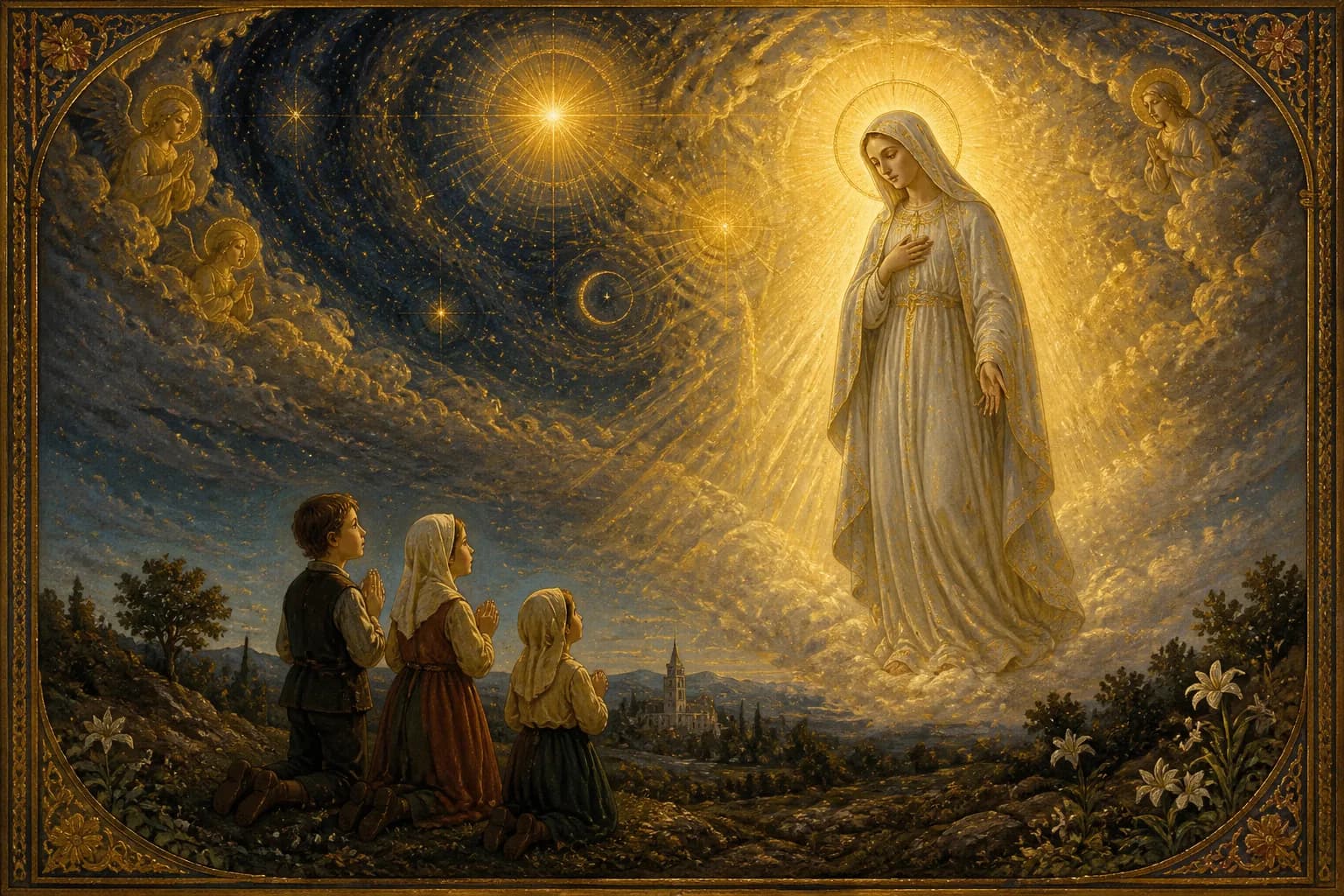
On July 13, 1917 — the third of six monthly apparitions to three shepherd children in the hills of central Portugal — the Lady showed Lúcia, Francisco, and Jacinta something so terrifying that Lúcia said in her memoirs they would have died of fright if Mary had not promised them heaven. That single vision contained three parts. Catholic tradition calls them the Three Secrets of Fátima. They have generated more speculation, conspiracy theory, and devotional reflection than any other private revelation in modern Catholic history.
The full text of all three secrets is now public. The Vatican released the last one in 2000. What they actually say is more sober and more demanding than the conspiracy literature claimed.
How the Secrets Came to Be Written
Lúcia dos Santos was the only one of the three seers who lived past childhood. Her cousins Francisco and Jacinta died in the influenza pandemic of 1919–1920. Lúcia became a Dorothean sister and later a Discalced Carmelite, and lived until 2005.
The bishop of Leiria, José Alves Correia da Silva, instructed Lúcia in the 1930s and 1940s to write down what she had seen. She produced four memoirs between 1935 and 1941. The first and second secrets appear in the third memoir, dated August 1941. The third secret was not yet written at that point.
In 1944, gravely ill and uncertain she would survive, Lúcia wrote the third secret on a single sheet, sealed it in an envelope, and gave it to the bishop with instructions that it should be opened in 1960 — or upon her death, whichever came first. The envelope went into the bishop's safe, then to Rome, then to the personal archive of successive popes.
The First Secret: The Vision of Hell
The first secret is the most graphic Marian vision in Church history. Lúcia describes the Lady opening her hands and showing them, in an instant, a vision of hell:
A great sea of fire, demons and the souls of the damned moving inside the flames, raised up and falling back like coals — Lúcia's prose in the third memoir is restrained but unmistakable. The point of the vision, Lúcia said, was not to terrify three children but to make plain to them, and through them to the Church, the reality of the human destiny at stake.
What is striking, theologically, is that the vision of hell is first. The Catholic doctrine of hell, formally taught from the Fourth Lateran Council and earlier, holds that hell is the eternal self-exclusion of those who definitively refuse God's love. The Lady showed the children the doctrine in image. The implication of the rest of the secrets follows from this: the rosary, the consecration of Russia, the Five First Saturdays — they exist because what the children saw is what some souls choose.
The Second Secret: World War and the Consecration of Russia
The second secret has two parts.
The first part is a prophecy: the First World War was about to end, but if humanity did not stop offending God, a worse war would come during the pontificate of Pius XI. The pontificate of Pius XI ran from 1922 to 1939. The Second World War formally began with the German invasion of Poland in September 1939, six months after his death. There is debate about whether the timing precisely matches; the "strange light" Lúcia identifies in her account as the sign of the coming war is generally identified with the great aurora borealis of January 25–26, 1938, which was visible across western and southern Europe and frightened many who saw it.
The second part is the request: the consecration of Russia to the Immaculate Heart of Mary by the Pope and all the bishops of the world, in union, on the same day. The Lady also requested the devotion of the Five First Saturdays — confession, communion, rosary, and fifteen minutes of meditation on the mysteries on five consecutive first Saturdays — in reparation for the offenses against her Immaculate Heart.
The consecration was not done in the precise form Mary requested until John Paul II, on March 25, 1984, in union with the bishops of the world (though some did not formally participate), consecrated the world — with Russia implicit in the formula — to the Immaculate Heart of Mary in Saint Peter's Square. Sister Lúcia herself was asked, in writing, whether this consecration fulfilled the Lady's request, and she confirmed in 1989 that it did. Some traditionalist Catholic voices have continued to dispute this; the Holy See has reaffirmed Lúcia's own confirmation more than once.
The Third Secret: The Bishop in White
The third secret is the part that generated the longest speculation. Held back until 1960, then held back again, it was finally released by the Holy See on June 26, 2000, in a document signed by Cardinal Joseph Ratzinger, then Prefect of the Congregation for the Doctrine of the Faith and later Pope Benedict XVI.
In Lúcia's own handwritten account, the vision shows an angel with a flaming sword crying out "Penance, Penance, Penance," and then a Bishop dressed in white — the Holy Father — climbing a steep mountain with great difficulty. At the top is a large cross. Around the cross lie the bodies of bishops, priests, men and women religious, and lay people of various ranks. The Bishop in white prays for the souls of the corpses he encounters. At the top of the mountain, beneath the cross, he is killed by a group of soldiers who fire bullets and arrows at him. Other clergy fall around him. Two angels collect the blood of the martyrs in a crystal aspersorium and sprinkle it on the souls making their way to God.
The Vatican's official interpretation, attached to the 2000 release, reads the vision as referring principally to the persecutions and martyrdoms of the twentieth century — the long catalogue of priests and religious killed by Soviet and Nazi regimes — and culminating in the assassination attempt on Pope John Paul II on May 13, 1981, the anniversary of the first Fátima apparition. The pope was shot in Saint Peter's Square by Mehmet Ali Ağca and nearly died. He attributed his survival to Our Lady of Fátima and placed the bullet from his abdomen in the crown of the statue at the sanctuary, where it remains.
Was the Third Secret Released in Full?
A small but persistent strand of Catholic opinion, particularly among traditionalist circles, has argued that what the Vatican published in 2000 is not the complete third secret. The argument cites: the secret's brevity (four handwritten pages), comments by Cardinal Ottaviani and others in the 1960s suggesting the secret contained a prediction about a crisis in the Church, and the strict secrecy maintained for forty years.
The Vatican has rejected this view repeatedly. In 2007 Cardinal Tarcisio Bertone, who interviewed Sister Lúcia about the secret before her death, published a book-length response, The Last Visionary of Fátima, in which Lúcia confirmed that the document released was the complete text of what she wrote in 1944. Pope Benedict XVI, who as Cardinal Ratzinger had signed the 2000 release, restated the same position during his visit to Fátima in May 2010.
A Catholic in good standing can hold private opinions about the matter, but the magisterial position is settled.
What the Secrets Mean Together
The three parts of the single July 13, 1917 vision form a sequence the Catholic tradition has read consistently:
- The reality of hell as the destiny human freedom can choose against God.
- The political consequences when humanity refuses God in the public sphere — war, the rise of atheistic regimes, the suffering of nations.
- The persecution of the Church as the long martyrdom of the twentieth century, ending in the figure of a Pope who falls but is preserved by Mary.
Each secret is heavier than the one before. Together they amount to an argument that history is not neutral: the choices nations and individuals make have eternal weight, and the Mother of God offers an intercession — the rosary, the Five First Saturdays, the consecration of Russia — that can change what would otherwise happen.
This is the same message running through the Miracle of the Sun and through the lives of the other great Marian apparitions. It is also why the canonization of Francisco and Jacinta in 2017 — the two children who saw all three secrets and died young — matters. They are the youngest non-martyr saints in Church history, and Catholic tradition reads their early deaths and their visible holiness as confirmation that the Lady's promises were kept.
Why It Still Matters
The Fátima message is sometimes presented as a code to be cracked — the conspiracy version. It is more useful to read it as a sustained Marian commentary on the twentieth century and on the human condition. The rosary is at the center. The Immaculate Heart is at the center. Reparation is at the center.
A century after the secrets were given to three shepherd children at the Cova da Iria, the Catholic tradition continues to draw from them. The Five First Saturdays devotion is alive. The world consecration of 1984 stands. The bullet in the crown of the statue at Fátima is still there. Sister Lúcia is dead, and her cause for canonization is open.
For broader context on how Mary speaks to Catholic spirituality across centuries — from Tepeyac to Massabielle to the Cova da Iria — see the related articles in this series.
Listen to Fátima on Crucis Lux
Crucis Lux tells the story of Fátima and the three secrets as a slow-paced, illustrated audio series — every apparition narrated, every panel illustrated in the style of medieval frescoes, in five languages.