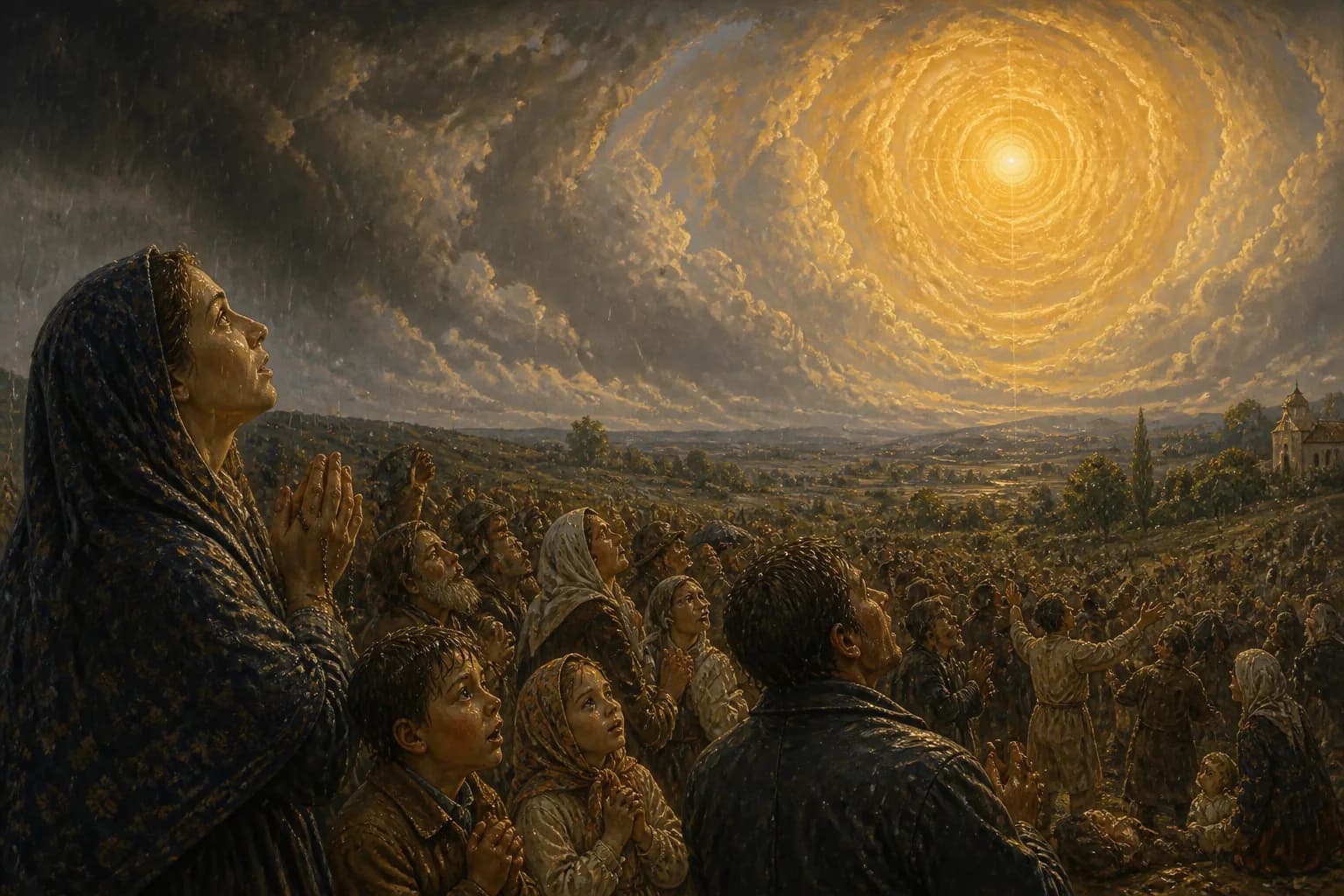
On the morning of October 13, 1917, it had been raining in central Portugal for hours. Roads were mud. Pilgrims walked through the night from as far as Lisbon and Porto, soaked to the skin. By midday, somewhere between fifty thousand and seventy thousand people stood packed into a natural amphitheater called the Cova da Iria, outside the village of Fátima, waiting for a miracle that three illiterate shepherd children had announced three months in advance.
What happened next was reported by Catholic newspapers, anticlerical newspapers, scientists, schoolteachers, atheists, and farmers. The accounts differ on detail but agree on the core: the rain stopped, the clouds opened, and the sun did something that no one in the crowd could explain.
The Three Children and the Promised Sign
Lúcia dos Santos was ten years old in the summer of 1917. Her cousins Francisco and Jacinta Marto were nine and seven. They were the children of small farmers in the parish of Fátima, north of Lisbon. From May 13 onward, they reported visits from a luminous woman who identified herself in October as the Lady of the Rosary.
By July 13, the Lady had told Lúcia that on October 13 she would perform a miracle "so that all may believe." The promise was specific and dated, which is unusual in the history of Marian apparitions. The children were interrogated, separated, and on August 13 actually arrested by the local administrator, Artur de Oliveira Santos, an anticlerical Freemason who threatened to boil them in oil. They did not recant. They were released and the apparitions continued.
Word spread. Newspapers picked it up — O Século, the largest secular paper in Portugal, ran multiple skeptical articles. By October 13, the crowd at the Cova da Iria was so large it had become a national event.
The Morning of October 13
It rained all morning. Witnesses describe being soaked through, mud to the knees, umbrellas useless. The journalist Avelino de Almeida of O Século — an anticlerical Mason on assignment partly to debunk the affair — was there, taking notes. The Marto family had eaten breakfast in the dark and walked through the storm.
Around solar noon, in a small clearing at the base of a holm oak, the three children fell to their knees. Lúcia called out, "Look at the sun." Witnesses said the rain stopped almost instantly. The clouds parted.
What the Witnesses Saw
Accounts converge on three phases.
The Disc
The sun appeared as a disc the human eye could look at directly — described by many as a silver disc or a pearl. People stared at it without pain. This in itself is anomalous; staring at the noon sun under normal conditions causes immediate damage.
The Dance
The disc began to spin on its axis, throwing off colored light — described as red, green, violet, blue, yellow — that bathed the landscape, the faces of the crowd, and the clouds. Witnesses described entire hillsides turning colors. The phenomenon repeated, by most accounts, three times.
The Plunge
Then the sun seemed to detach from the sky and zigzag downward toward the earth. The crowd panicked. People fell to their knees, made acts of contrition, screamed. Then the sun returned to its place. The whole event lasted about ten minutes.
When it was over, the crowd realized something else: the ground, their clothes, the rain-soaked mud — everything was dry. People who had been standing in water minutes earlier were dry to the skin.
The Secular Press Report
Avelino de Almeida, the anticlerical O Século journalist, wrote the next day:
The headline of his piece — printed in Lisbon on October 15, 1917 — was "How the sun danced at noon in Fátima." He described the disc, the colors, the panic of the crowd, and admitted that he had no scientific explanation. He did not claim a miracle; he reported what he had seen and what fifty thousand other people had seen with him. The article cost him professionally. The piece survives in archives and is widely reproduced.
Other secular dailies — Diário de Notícias in Lisbon, O Dia — published similar accounts. The Portuguese Republic of 1917 was aggressively anticlerical; there was no incentive for these papers to confirm a Catholic miracle.
The Witnesses at a Distance
Some of the strongest evidence comes from people who were not in the Cova da Iria but reported seeing the sun behave strangely from up to forty kilometers away. The poet Afonso Lopes Vieira saw it from his estate near Leiria. Schoolchildren in Alburitel, eighteen kilometers from Fátima, watched the sun spin from their schoolyard with their teacher. The phenomenon was not confined to the autosuggestion of one crowd. People who did not know the apparition was happening saw the sky behave anomalously and asked their neighbors what was going on.
What the Church Ruled
The local bishop of Leiria, José Alves Correia da Silva, opened a canonical investigation in 1922. After nearly eight years of inquiry — interviewing witnesses, reading the press accounts, examining the children's testimony — he issued a pastoral letter on October 13, 1930, formally declaring the apparitions of Fátima "worthy of belief." This is the strongest level of approval the Catholic Church gives to a private revelation; it does not bind the faithful to believe it, but it permits public devotion and confirms that the events contain nothing contrary to faith.
Pope Pius XII consecrated the world to the Immaculate Heart of Mary in 1942 in keeping with the Fátima requests. Paul VI visited in 1967. John Paul II credited Our Lady of Fátima with saving his life during the assassination attempt of May 13, 1981 — the anniversary of the first apparition — and personally placed the bullet from his abdomen in the crown of the statue at the sanctuary. He visited Fátima three times.
Possible Explanations and Their Limits
Skeptics have proposed several natural explanations. None has held up well.
- Mass hysteria. Difficult to reconcile with witnesses miles away who saw the same thing without expecting it.
- Optical illusion from staring at the sun. Doesn't account for the absence of retinal damage in fifty thousand people, or for the disappearance of the rain and the drying of the ground.
- Atmospheric phenomenon — ice crystals, a stratospheric dust cloud. No comparable meteorological event was logged anywhere else in Iberia that day.
- Reporter exaggeration. The accounts are too varied and too widely sourced, including from hostile witnesses.
The simplest summary remains the one Avelino de Almeida arrived at: something happened, and the conventional toolkit cannot quite reach it.
The Three Children Afterward
Francisco died of influenza in 1919 at age ten. Jacinta died of pleurisy in 1920 at age nine, after months in hospital. Both children had been told by the Lady that they would soon be in heaven, and both died as the Lady had said. They were beatified in 2000 and canonized in 2017, the youngest non-martyr saints in Church history.
Lúcia became a Carmelite nun, took the name Sister Maria Lúcia of Jesus and the Immaculate Heart, and lived in the Carmel of Coimbra until her death in 2005 at age ninety-seven. She wrote the memoirs that preserve most of what we know about the apparitions and the three secrets of Fátima.
Why This Matters for Catholic Faith
The Catholic Church distinguishes carefully between public revelation — closed with the death of the last apostle — and private revelation, which can confirm but never add to the deposit of faith. Fátima is private revelation. A Catholic is not required to believe it, but the magisterium has invested significant weight in it.
What makes Fátima theologically unusual is the public sign. Most Marian apparitions are private encounters; the seer goes through her experience and reports it. Fátima is the only major modern apparition that delivered, on a publicly announced date, a public sign witnessed by tens of thousands of people, including hostile press. The crowd was not gathered to witness a vision. They were gathered to witness a verification.
A century later, the sanctuary at the Cova da Iria draws four to six million pilgrims a year, second among Catholic Marian sites only to Lourdes and Guadalupe. The visions of children are one thing; the rain on tens of thousands of coats turning suddenly to dry cotton is another.
What Pilgrims Find at Fátima Today
The sanctuary at the Cova da Iria is one of the largest Catholic religious complexes in the world. The original Chapel of the Apparitions, built on the site of the holm oak where the Lady appeared, was destroyed by anticlerical activists in 1922 and rebuilt the same year. The image of Our Lady of Fátima in the chapel — carved in 1920 from cedar by sculptor José Ferreira Thedim — wears the crown containing the bullet from John Paul II's 1981 attack.
The huge open prayer plaza outside the basilica can hold three hundred thousand pilgrims on the major feast days, May 13 and October 13. Tens of thousands of pilgrims walk the last kilometers of approach on their knees in penance, a Portuguese devotional practice the local clergy neither encourage nor forbid. A perpetual candle burns at the chapel; many pilgrims add their own candles to the flame.
The remains of Francisco, Jacinta, and Sister Lúcia rest in the older Basilica of Our Lady of the Rosary, built between 1928 and 1953. Across the plaza, the modern Basilica of the Most Holy Trinity, consecrated in 2007, seats nearly nine thousand people and is one of the largest Catholic churches in the world.
For pilgrims interested in the broader Marian story — how Mary speaks to the Catholic faithful across centuries and continents — the three secrets of Fátima form a single piece with the wider tradition. The same Lady who spoke at Tepeyac in 1531 and at Massabielle in 1858 also spoke at the Cova da Iria in 1917. The continuity of message — penance, the rosary, the consecration to her Immaculate Heart — is one of the most striking features of the modern Marian record.
Listen to Fátima on Crucis Lux
Crucis Lux tells the story of the Fátima apparitions and the Miracle of the Sun as a slow-paced, illustrated audio series — every apparition narrated, every panel illustrated in the style of medieval frescoes, in five languages.