The most popular story in Brazilian Catholicism has no angel, no voice from heaven and no message. It has three tired men, a net that kept coming up empty, and a piece of fired clay lying on a riverbed. That is what makes Our Lady of Aparecida so unlike Fátima, Lourdes or Guadalupe — and it is the part almost nobody explains properly when October 12 comes around.
What happened in the river in 1717
In October 1717 the Paraíba valley, inland from Rio de Janeiro and São Paulo, was preparing to receive an official. Dom Pedro de Almeida, Count of Assumar, governor of the captaincy of São Paulo and the gold mines, was crossing the region on his way inland, and the small town of Guaratinguetá had to feed him. Fish was requested from the river men.
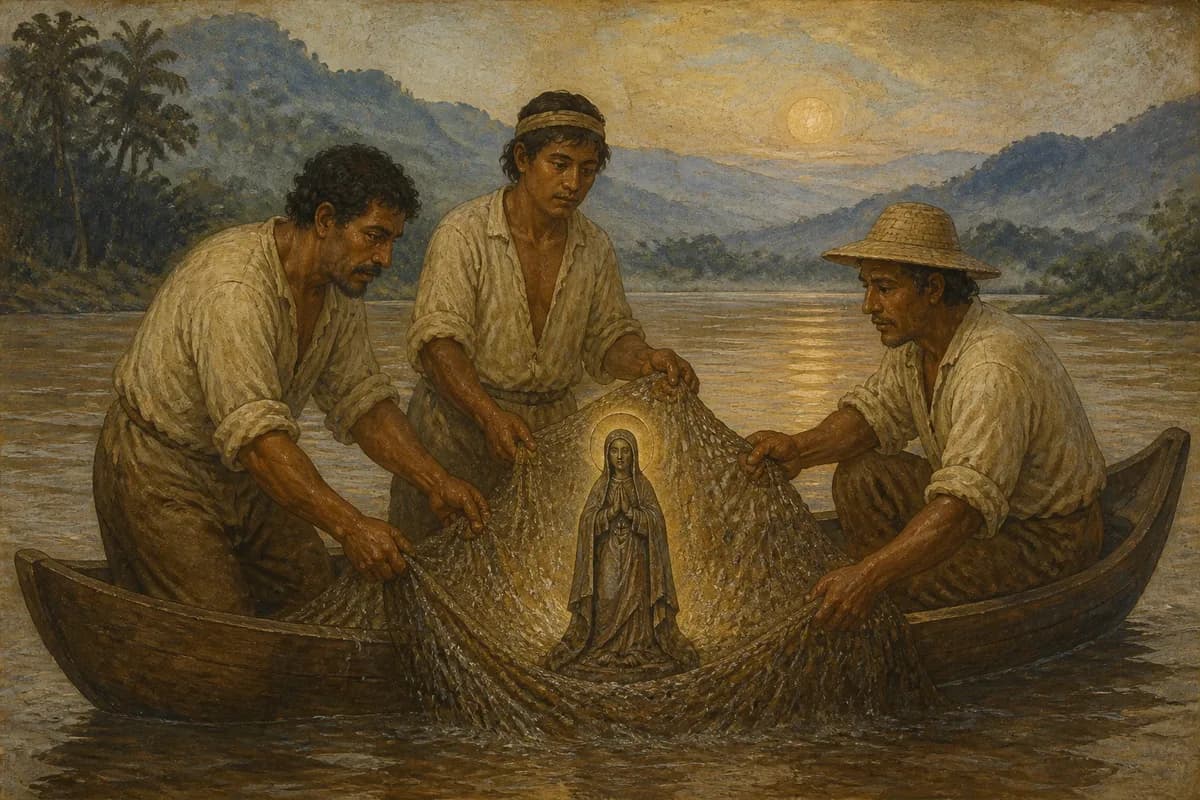
Domingos Garcia, João Alves and Filipe Pedroso — three men of the same family, living near the water — spent hours casting nets with nothing to show for it. They worked their way down to the waters of Porto Itaguaçu. There the net came up heavy, but not with fish: it held the body of a small clay statue, missing its head. Cast again in the same place, it brought up the head. Only then, the accounts say, did the fishing turn: the nets filled until the men were frightened by the catch.
Notice what the story does not contain. No vision, no voice, no message to carry to the world, no request to build a church. There is work, a river, wet clay and a shock of joy. The entire devotion of a country begins with that small scene.
A small, dark statue made of clay
The image stands about 36 centimetres — roughly fourteen inches. It is terracotta, fired clay, and it represents the Immaculate Conception: hands joined, head slightly bowed, eyes lowered. Pilgrims today almost never see the clay, because the statue is displayed wearing an embroidered mantle and a crown, which makes it look far larger and more formal than it is. Unvested, it would fit in your hands.
Who carved it is not settled. The attribution most often repeated is to Frei Agostinho de Jesus, a monk who worked in clay in the seventeenth century and who is thought to have made the piece around 1650; another hypothesis holds that it came from Portugal. No document closes the question, and nothing explains the strangest detail of all: how a devotional statue ended up on a riverbed, broken in two.
The dark colour is debated as well. It has been credited to the clay itself and to a varnish darkened by age, to the years underwater, and to the smoke of the candles it stood before for generations. None of these explanations is conclusive, and you do not have to choose one. The historical effect is what matters: in a country whose population was largely Black and mixed-race, and much of it enslaved, the figure being venerated was a small dark Lady kept in a poor family's house. Popular tradition preserved stories of enslaved people set free in front of her — told as devotional memory rather than documented miracle. They still say something true about who recognised themselves in that statue first.
From a fisherman's house to a national shrine
The statue was taken home. Silvana da Rocha Alves — wife of Domingos, sister of Filipe, mother of João — joined the two pieces and set it on a small household altar. For years the devotion was exactly that: neighbours praying the Rosary by candlelight in a dirt-floored room.
It grew slowly, by contact. In 1732 the statue moved to a public oratory built by Atanásio Pedroso, Filipe's son. On 26 July 1745, the feast of Saint Anne, a first chapel of rammed earth was inaugurated on land donated by a widow, Margarida Nunes Rangel. The settlement that formed around that chapel eventually became a town — and the town took the statue's name: Aparecida.
In 1834 work began on the church Brazilians still call the old basilica. On 8 December 1904, the feast of the Immaculate Conception, the statue received its canonical coronation with the approval of Pope Pius X. In under two centuries, an object found by accident had become the religious centre of a country.
Why this is not an apparition — and why the difference matters
Here is the distinction most accounts get wrong.
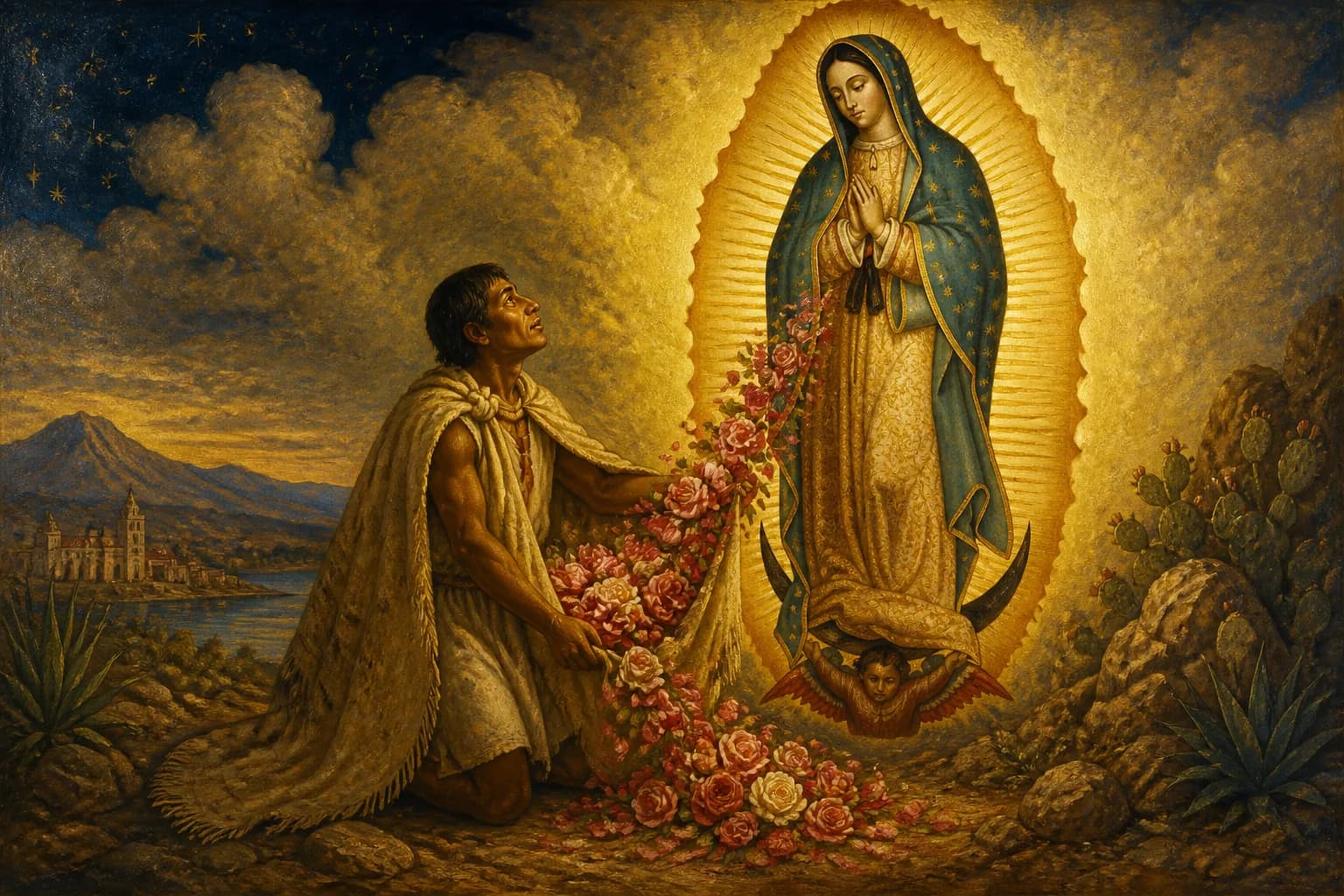
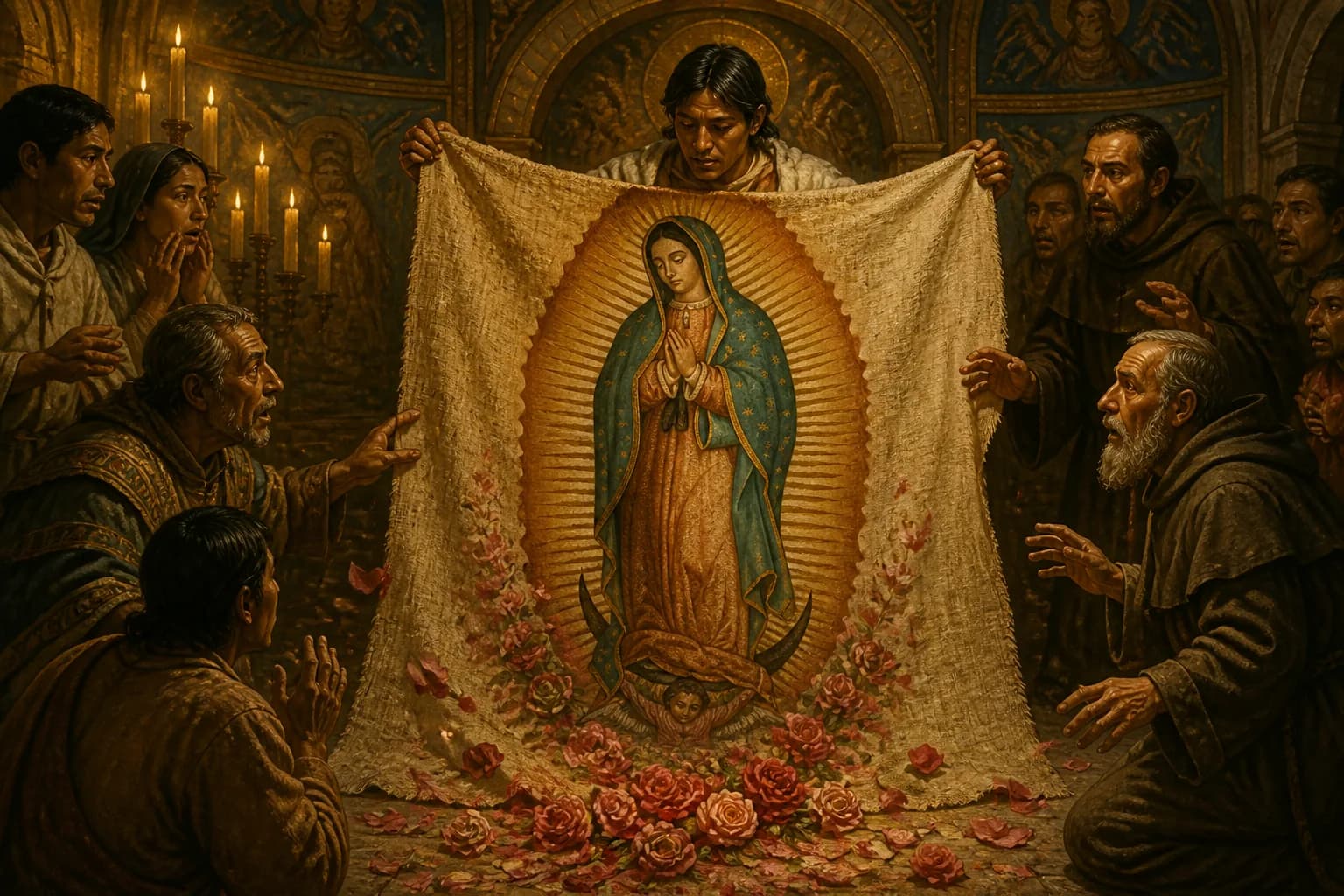
At Guadalupe, in 1531, there is a visionary with a name and a biography, there is dialogue, there is a message, and there is a physical sign left behind — the tilma of Juan Diego. Lourdes and Fátima follow the same pattern: someone sees, someone hears, someone is sent to tell. These are apparitions, and the Church examines them as such, weighing the visionary, the doctrinal soundness of the message, and the fruits.
Aparecida has none of that. No visionary, no message, no reported vision. The Church has never approved an apparition at Aparecida for the simplest possible reason: there has never been one to approve. The name misleads English readers especially, because Aparecida sounds like "the one who appeared to someone." Its original sense is different: the one who appeared in the water, in the net, at the end of a bad afternoon's fishing.
So what is venerated? Not the clay. Catholic teaching is old and clear on this: honour given to an image passes to the person represented, never to the object. What Aparecida documents is not a prodigy but a devotion — three unbroken centuries of people praying before the same small figure, and a country gradually recognising itself in it.
The difference even changes the kind of question worth asking. About Guadalupe, people argue over the fabric, the pigment, the eyes, what technical analysis can and cannot account for. About Aparecida there is no test to run: it is a seventeenth-century clay statue, and nobody claims otherwise. The whole weight of the story sits in what came after it.
1930: patroness of Brazil
On 16 July 1930, at the request of the Brazilian bishops, Pope Pius XI declared Our Lady Aparecida — under the title of the Immaculate Conception — the principal patroness of Brazil. The decision recognised something that had long been true in practice: the devotion was already national, carried along the roads, the railways and the pilgrim routes climbing the Paraíba valley.
The civil holiday, however, is far more recent than most visitors assume. It was created by a federal law signed on 30 June 1980 — meaning Brazilians born before that knew October 12 as a religious feast without a day off. The date now shares the calendar with Children's Day, which falls on the same October 12 for entirely unrelated reasons.
The basilica
The new basilica was begun in 1955, in the town of Aparecida in the state of São Paulo, to hold crowds the older church could no longer contain. Built in exposed brick, it is one of the largest Marian shrines in the world and receives pilgrims in the millions every year — on foot, by bus, by bicycle, in parish groups that cross the state together.
On 4 July 1980, John Paul II consecrated the new basilica and raised it to the rank of minor basilica. In 2007 Benedict XVI opened there the Fifth General Conference of the Latin American and Caribbean bishops, which produced the text known as the Aparecida Document. In July 2013 Pope Francis visited during World Youth Day in Rio, in the first months of his pontificate.
The shrine also carries a scar. In 1978 a man seized the statue from its throne and it fell to the floor, breaking into many pieces. It was restored and returned to public veneration. The image pilgrims see today is, quite literally, a reassembled one — for the second time in its history.
What survives the fact-checking
Strip Aparecida of everything undocumented and a great deal remains: an improbable find in 1717, a poor family's front room turned into an oratory, an oratory turned into a chapel, a chapel turned into a town, a town turned into the pilgrimage destination of a continent-sized country, and a date every Brazilian knows by heart.
October 12 falls in the middle of the month of the Rosary, which makes the beads the natural way to mark it — see why October is the month of the Rosary. And the symmetry with the other end of the continent is worth noticing: at Guadalupe, heaven sought out a poor indigenous man and spoke to him; at Aparecida, three poor fishermen went looking for fish and found a clay Lady at the bottom of a river. They are different kinds of story. The gesture they produce is the same.