Our Lady of Guadalupe
Tepeyac, New Spain. Juan Diego, the tilma, and the roses of Castile. Fifteen thirty-one.
Nineteen episodes on a December morning in fifteen thirty-one, on a rocky hill outside the ruins of Tenochtitlán. An indigenous farmer hears a young woman call him by name in Nahuatl. Four days later, an image that has lasted nearly five hundred years appears on a cloth of maguey fibre.
19 episodes · Narrated in English, Portuguese, Spanish, French and German
Episode 1 is free
Episodes
- 01
The End of a World
Valley of Mexico, 1474. A city built on an island in a lake. A boy is born in a tributary village to the north.
- 02
The Men of Iron
Gulf of Mexico coast, 1519. A fleet arrives from Cuba. A few hundred men armed with steel.
- 03
The Night of Sorrows
Tenochtitlan, first half of 1520. The empire does not yet know it is dead. In little more than a year, the city will fall.
- 04
The Twelve Friars
Coast of Veracruz, 1524. Twelve barefoot men step off the ship. They are going to a city still rising from its ruins.
- 05
Cuauhtlatoatzin
Cuauhtitlan, 1524 to 1531. A grown man receives a new name. A few years later, he loses his wife.
- 06
The Song of the Birds
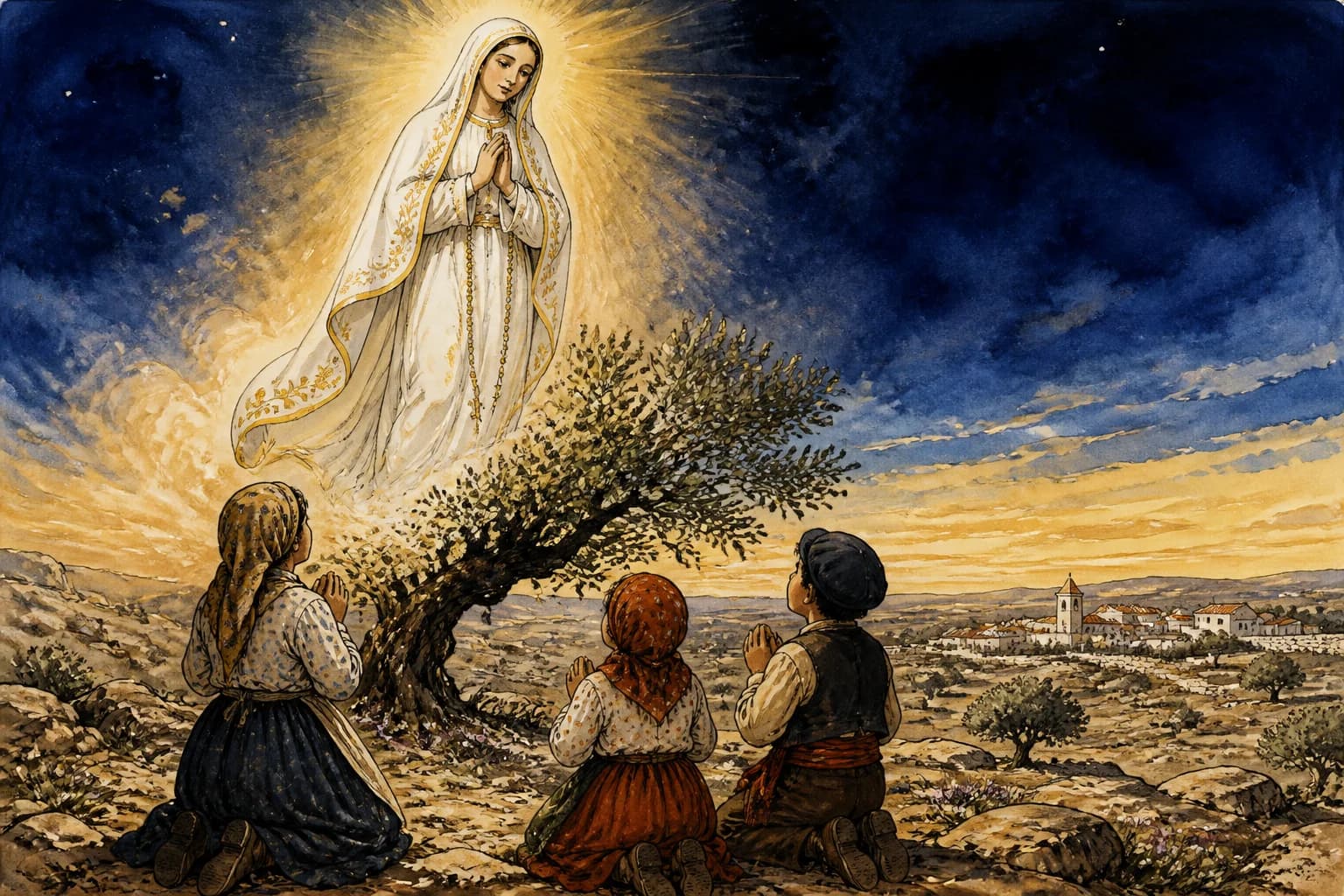
Tepeyac, Saturday the ninth of December, 1531. As dawn breaks, a widower over fifty climbs the hill.
- 07
Bishop Zumárraga
Mexico City, Saturday the ninth of December, 1531. In a house in the colonial center lives a Basque Franciscan, the first bishop of Mexico.
- 08
The Second Visit
Mexico City and Tepeyac, Sunday the tenth of December, 1531. The Indian returns. The bishop listens. He asks for a sign.
- 09
The Sick Uncle
Valley of Mexico, Monday the eleventh of December, 1531. Juan Diego's uncle is gravely ill. The nephew stays.
- 10
The Roses of Castile
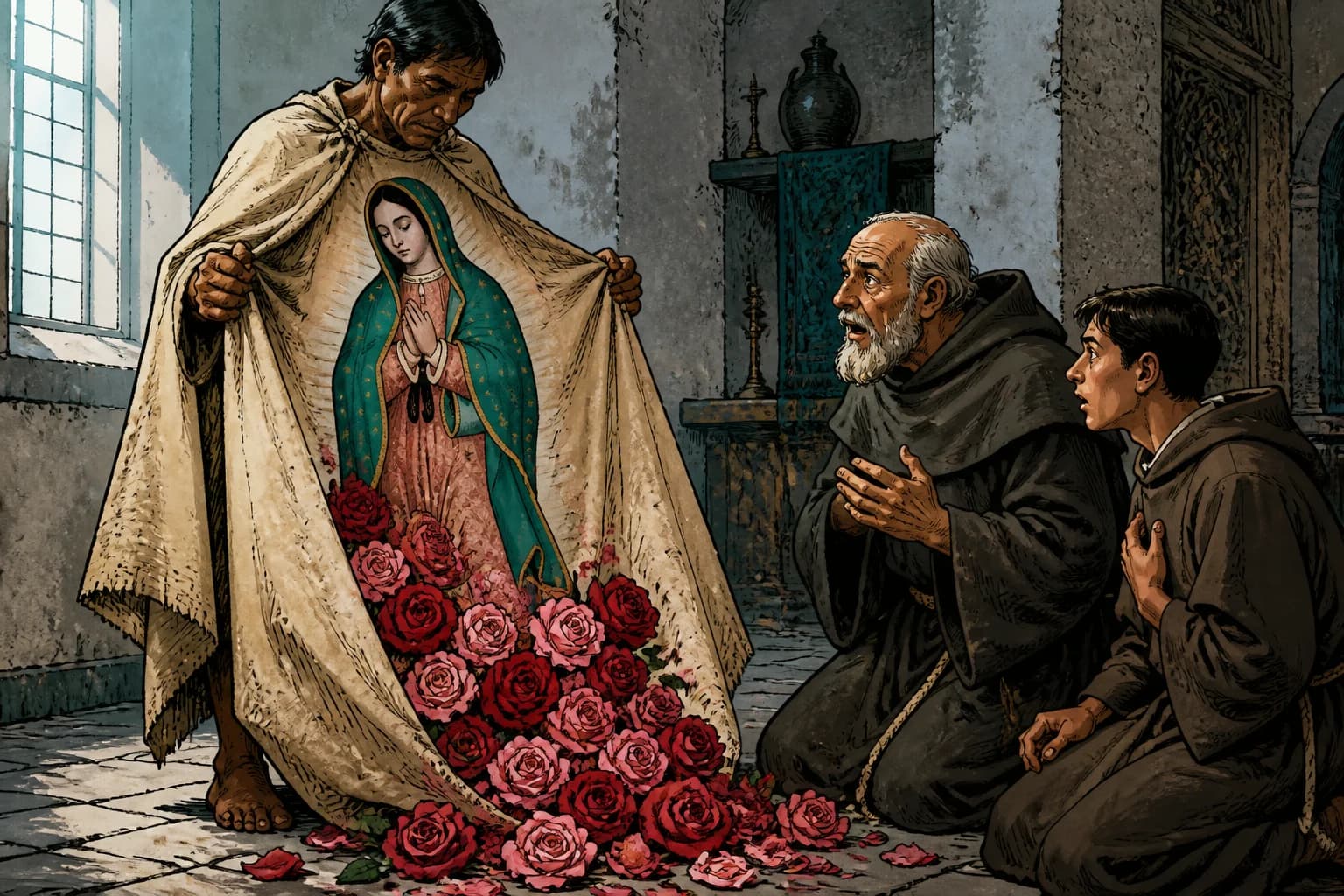
On the road to Tepeyac, Tuesday the twelfth of December, 1531. Before sunrise. According to the account, Castilian roses in the dead of the Mexican winter.
- 11
The Image
Mexico City, Tuesday the twelfth of December, 1531. A long wait. The flowers fall. Something appears on the cloth.
- 12
One Image, Two Languages
The image on the tilma. Nearly five hundred years of reading. What it shows to whoever comes near.
- 13
Five Million Baptized
Tepeyac and the Valley of Mexico, 1531 to 1629. Mass baptisms, by the friars' own count. The chapel fills.
- 14
The Flood of 1629
Mexico City, the twenty-first of September, 1629. The water rises. The image is carried by boat through the drowned city.
- 15
The Banner of Hidalgo
Atotonilco and Dolores, Mexican Bajio, the sixteenth of September, 1810. A priest, a crowd, and an image of the Virgin taken from a sanctuary.
- 16
The Bomb of 1921
Old Basilica of Guadalupe, Mexico City, the fourteenth of November, 1921. Monday morning. A man enters with a bouquet of flowers.
- 17
The Eyes
Mexico City, 1929 to today. People looking at the image with lenses. Each one sees something different.
- 18
The Disagreement
Tepeyac and colonial archives, 1576 to today. The same hill, different voices. Five centuries of asking.
- 19
Millions a Year
Basilica of Guadalupe, Mexico City, today. A moving walkway. The image above. Millions of people a year.
How this series was researched
The narration and the place and date labels were broken down into factual claims and checked against sources: 921 claims in this series were checked against a cited source. Where the sources did not support a claim, the text was corrected or reduced to what the sources actually say.
A second, independent check then went through the whole series again.
The text was reviewed separately in each of the five languages it is narrated in.
Main sources
- Nican mopohua (in Huei tlamahuiçoltica) — Luis Lasso de la Vega (ed.); attrib. Antonio Valeriano (1649)
- Imagen de la Virgen María Madre de Dios de Guadalupe — Miguel Sánchez (1648)
- Información de 1556 (sermón de Bustamante) — Archbishop Alonso de Montúfar (inquiry) (1556)
- Historia verdadera de la conquista de la Nueva España — Bernal Díaz del Castillo (1632)
- Homily for the canonization of Juan Diego — John Paul II (2002)
- The Story of Guadalupe: Laso de la Vega's Huei tlamahuiçoltica — L. Sousa, S. Poole, J. Lockhart (eds.) (1998)
Tradition and debate
Where the sources are thin or disagree, the series says so. For example:
- The burning of Cortés's ships is a legend invented long afterward; he had them stripped, bored through and run aground.
- Alvarado's famous leap across a canal, vaulting on his lance, is told as legend; Bernal Díaz, who was there, denied it.
- The Nican Mopohua, the Nahuatl account of the apparitions, is traditionally attributed to the indigenous scholar Antonio Valeriano.
Read more on the Journal
Our Lady of Aparecida: The 1717 Statue Found in a River
Our Lady of Aparecida: three fishermen, a clay statue pulled from the Paraíba do Sul river in 1717, patroness of Brazil since 1930 — and no apparition.
Saint Juan Diego — The First Indigenous Saint of the Americas
The humble Indigenous convert who carried roses in his cloak — and on whose tilma Our Lady of Guadalupe left her image in 1531.
The Tilma of Juan Diego: Science, Faith, and the Image of Guadalupe
The tilma of Juan Diego at Tepeyac in 1531 — the image of Our Lady of Guadalupe, scientific tests on the fabric, the eyes, and what remains unexplained.