Saint Paul the Apostle
The Pharisee who became the Apostle to the Nations
Sixteen episodes on the life of Saul of Tarsus, strict Pharisee who persecuted the first Christians and was struck down by a light on the road to Damascus. They cover sixty-two years: from his birth in Tarsus to his training under Gamaliel, from the martyrdom of Stephen to his conversion, from three years in the Arabian desert to the first baptism of a Roman in Cyprus. From the stoning at Lystra to the Council of Jerusalem, from the vision of Macedonia to the earthquake at Philippi, from the Areopagus of Athens to the tribunal of Gallio in Corinth. From three years in Ephesus to shipwreck on Malta, from house arrest in Rome to beheading on the Via Ostiense, at the place called Three Fountains. The life of the greatest traveler of the New Testament, writer of thirteen letters that still today make up half of the Christian Bible.
16 episodes · Narrated in English, Portuguese, Spanish, French and German
Episode 1 is free
Episodes
- 01
The Zealot
Jerusalem, the year 33 of the Christian era. A young Pharisee named Saul learns the Law, and learns to hate.
- 02
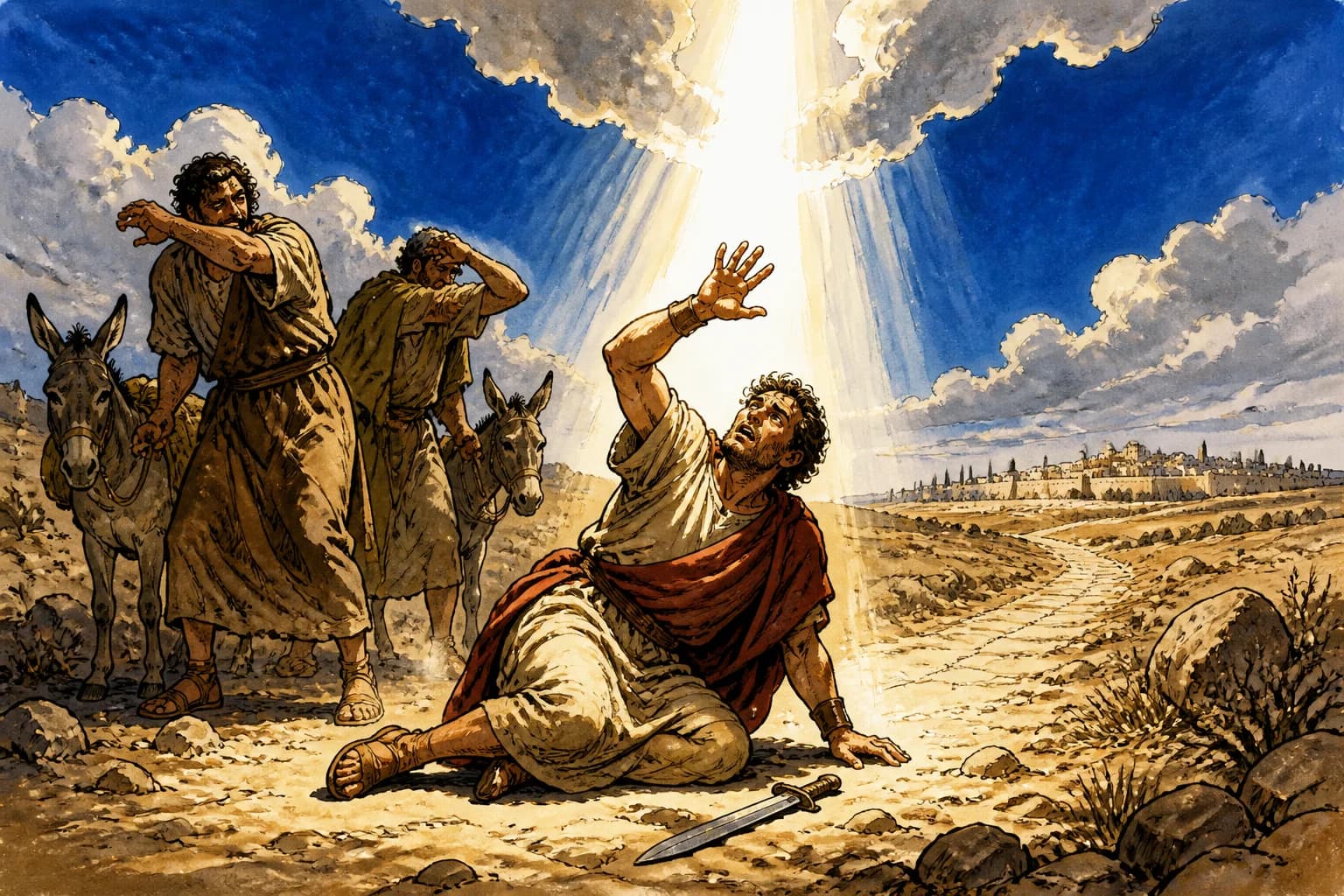
The Road to Damascus
The northern road, the year 34. Saul rides with letters to arrest Christians. Halfway there, a light will throw him down.
- 03
The Silent Years
Damascus and Arabia, the years 34 to 43. Saul vanishes into the desert, escapes in a basket, and matures in silence.
- 04
Antioch, the First Christians
Antioch in Syria, the years 43 to 46. In a pagan metropolis, a new word begins to be spoken: Christians.
- 05
Cyprus, the First Roman Convert
The island of Cyprus, the year 47. Saul confronts a sorcerer and wins over a proconsul. Here he changes his name forever.
- 06
Stoned at Lystra
Roman Galatia, the years 47 and 48. In four cities, Paul is hailed as a god, and nearly dies by stoning.
- 07
The Council of Jerusalem
Antioch and Jerusalem, the years 49 and 50. The apostles gather to decide whether the faith requires circumcision.
- 08
The Macedonian Vision
Antioch to Troas, the year 50. Paul and Barnabas part ways. A dream carries the Gospel to Europe for the first time.
- 09
Philippi, Midnight
Philippi, the year 50. A seller of purple. A slave girl set free. A prison. And an earthquake at midnight.
- 10
Athens and Corinth
Athens and Corinth, the years 50 to 52. Paul debates philosophers on the Areopagus and spends eighteen months making tents.
- 11
Ephesus, Three Years
Ephesus, the years 53 to 56. The capital of Asia trembles amid miracles, burned books and the silversmiths' riot.
- 12
Farewell at Miletus
Macedonia to Miletus, the years 56 and 57. Paul writes his greatest letter, raises a young man in Troas, and bids farewell to the elders of Ephesus.
- 13
Arrested in the Temple
Jerusalem, the year 57. A false accusation, a riot in the Temple, a Roman tribune, and forty men sworn to kill Paul.
- 14
Caesarea, Three Hearings
Caesarea, the years 57 to 59. Two governors delay, a king takes interest, and Paul appeals to Caesar himself.
- 15
Shipwreck on Malta
Caesarea to Rome, the years 59 and 60. Fourteen nights without seeing the stars, a viper in the fire, and Rome at the edge of the horizon.
- 16
Three Fountains
Rome, the years 60 to 67. A rented house, a journey to the West, a final dungeon, and the road that ends at three fountains.
How this series was researched
The narration and the place and date labels were broken down into factual claims and checked against sources: 503 claims in this series were checked against a cited source. Where the sources did not support a claim, the text was corrected or reduced to what the sources actually say.
A second, independent check then went through the whole series again.
The text was reviewed separately in each of the five languages it is narrated in.
Main sources
- Acts of the Apostles 7–28 (1st century)
- Letter to the Galatians 1–2 — Paul of Tarsus (1st century)
- Second Letter to the Corinthians 11–12 — Paul of Tarsus (1st century)
- Second Letter to Timothy 4 (1st century)
- First Letter of Clement to the Corinthians, 5 — Clement of Rome (c. 96)
- Historia Ecclesiastica II.22; II.25 — Eusebius of Caesarea (c. 313–325)
Tradition and debate
Where the sources are thin or disagree, the series says so. For example:
- The name Three Fountains comes from a legend: Paul's head is said to have struck the ground three times, and a spring rose at each spot.
- Paul's second arrest and last imprisonment in Rome come to us through tradition; the exact place where he was held is not known.
- That Ephesians, Philippians, Colossians and Philemon were written during his Roman captivity is the traditional view.