Saint Francis of Assisi
The man who married poverty
Sixteen episodes on the merchant's son who stripped naked in the public square, served the lepers, walked unarmed into the camp of the Sultan, received the wounds of the Crucified on a mountain, and died bare on the ground. From the battle of Collestrada to the larks circling the roof of the Portiuncula — the life of the saint told in historical detail and in reverent silence.
16 episodes · Narrated in English, Portuguese, Spanish, French and German
Episode 1 is free
Episodes
- 01
The Merchant's Son
Assisi, 1181 or 1182. An Italian town among the hills of Mount Subasio. A boy has just been given two names.
- 02
The War, the Cell, the Convalescence
Collestrada, 1202. A hill above the Tiber, a battle, a defeat. The young merchant's son from Assisi is about to learn what it means to be locked away.
- 03
The Voice at Spoleto
Spoleto, around 1205. On his way to war in Apulia, young Francesco falls ill and, half asleep, hears a voice that sends him back to his own land.
- 04
The Leper
The plain below Assisi. Francesco, on horseback, comes face to face with a leper. At the end of his life, he will say this is how the Lord led him to begin his penance.
- 05
The Cross of San Damiano
San Damiano, 1205–1206. A church almost in ruins, abandoned by everyone, on the slope below Assisi. A man lying prostrate before a painted crucifix. His biographers say that the cross spoke.
- 06
Naked Before the Bishop
The bishop's residence, Assisi, 1206. Pietro di Bernardone takes his complaint against his son to the consuls, then to the bishop. The son answers by taking off his clothes.
- 07
The First Brothers and the Gospel Opened Three Times
Assisi, from 1206. Three ruined chapels, a wealthy gentleman of the town, a man named Pietro, a simple man named Giles. A Gospel book opened at random will give them their form of life.
- 08
The Pope Dreams of a Falling Church
Rome, around 1209. Twelve men in rough tunics ask Pope Innocent the Third for leave to live by the Gospel. The pope, it is said, dreamed of the Lateran basilica about to fall.
- 09
The Knight's Daughter
Assisi, Palm Sunday. A young noblewoman chooses the road of poverty. The Order of Poor Ladies begins at San Damiano, the church Francesco rebuilt.
- 10
The Sermon and the Wolf
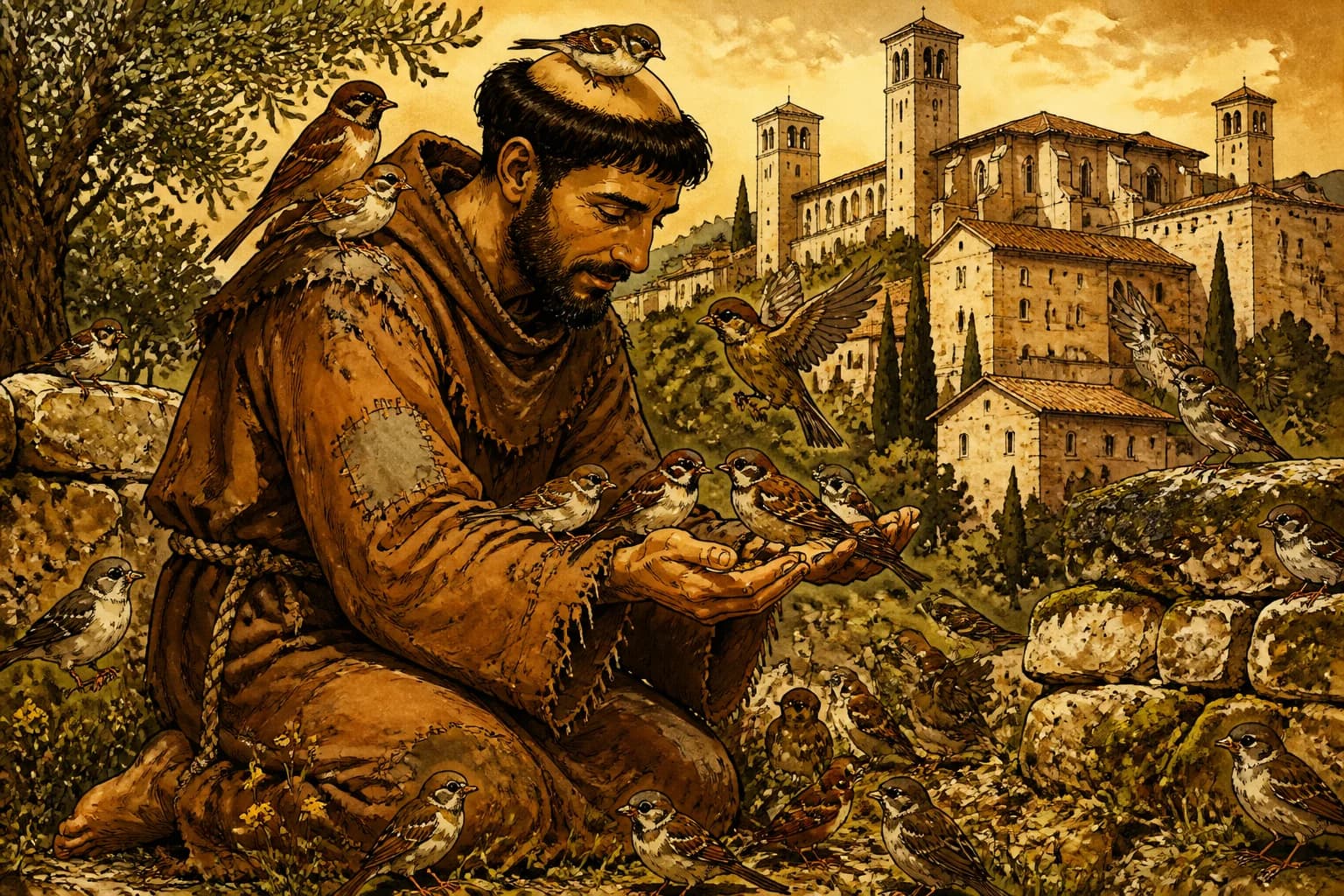
Bevagna. Francesco preaches to the birds — an early account, recorded a few years after the saint's death. Gubbio. A wolf is tamed — a devotional account, written about a century later. Crucis Lux tells both with the truth each one holds.
- 11
The Sultan's Tent
Damietta, Egypt, 1219. An unarmed friar crosses the battle lines. Sultan al-Kamil, Saladin's nephew, receives him. Centuries later, the Church would hold up the encounter as a model of dialogue between Christians and Muslims.
- 12
Five Heads in Marrakesh, a Rule at Fonte Colombo
1220 to 1223. The Order's first martyrs are beheaded. Francesco gives up the leadership. Pietro Catani dies. Brother Elias takes the helm. Two Rules will be written. The bull Solet annuere fixes on parchment what was still only a voice.
- 13
Christmas at Greccio
Greccio, Rieti Valley, Christmas night, 1223. A nobleman of the region prepares what Francesco asked of him. An ox and a donkey. Hay in a manger. Over it, Mass is celebrated. For Pope Francis, that is where the tradition of the Nativity scene began.
- 14
The Seraph on La Verna
Mount La Verna, the Tuscan Apennines, August to September 1224. Francesco climbs the mountain for a forty-day fast. One morning, around the Feast of the Exaltation of the Holy Cross, he sees, according to Thomas of Celano and Bonaventure, a six-winged seraph bearing the figure of a man nailed to a cross. According to the same accounts, the five wounds of the Crucified appear on his body.
- 15
The Blind Singer
San Damiano and Rieti, between 1224 and 1226. Francesco is nearly blind from an eye disease contracted in the East. At San Damiano he composes the Canticle of Brother Sun, one of the earliest poems in Italian. A new stanza on forgiveness reconciles the bishop and the podestà of Assisi. Near Rieti, a surgeon cauterizes him with a red-hot iron, and he speaks to the fire as to a brother.
- 16
Sister Death
The Porziuncola, October 1226. Francesco dies after lying naked on the bare earth and intoning Psalm one hundred and forty-two. According to his companions, larks circle above the roof. The next morning, the procession stops at San Damiano, where Clare and her sisters see his body one last time.
How this series was researched
The narration and the place and date labels were broken down into factual claims and checked against sources: 604 claims in this series were checked against a cited source. Where the sources did not support a claim, the text was corrected or reduced to what the sources actually say.
A second, independent check then went through the whole series again.
The text was reviewed separately in each of the five languages it is narrated in.
Main sources
- Testamentum — Francis of Assisi (1226)
- Vita prima sancti Francisci — Thomas of Celano (1228–1229)
- Legenda maior sancti Francisci — Bonaventure of Bagnoregio (1260–1263)
- Francis of Assisi: Early Documents (3 vols.) — R. J. Armstrong, J. A. W. Hellmann, W. J. Short (eds.) (1999–2001)
- General Audience on Saint Francis of Assisi — Benedict XVI (2010)
Tradition and debate
Where the sources are thin or disagree, the series says so. For example:
- That Francis's family home stood where Assisi's Chiesa Nuova stands today rests on tradition.
- The exact year Francis and his first companions met Pope Innocent III in Rome, and received his spoken approval, is still debated.
- A church in Gubbio keeps the tradition that the wolf tamed by Francis was buried there; an animal skeleton found nearby does not prove the story.
Read more on the Journal
The Prayer of Saint Francis — Who Really Wrote It
Lord, make me an instrument of your peace: the full text, the documented origin of the prayer in 1912, why it carries Francis's name, and what he actually wrote.
Saint Francis and the Wolf of Gubbio: What the Legend Means
Saint Francis and the Wolf of Gubbio — the medieval account in the Fioretti, the 1872 skeleton discovery, and what the legend teaches about peacemaking.
The Stigmata of Saint Francis at La Verna, September 14, 1224
The stigmata of Saint Francis at La Verna on September 14, 1224 — the seraph vision, the eyewitness sources, and the first stigmata in Christian history.