
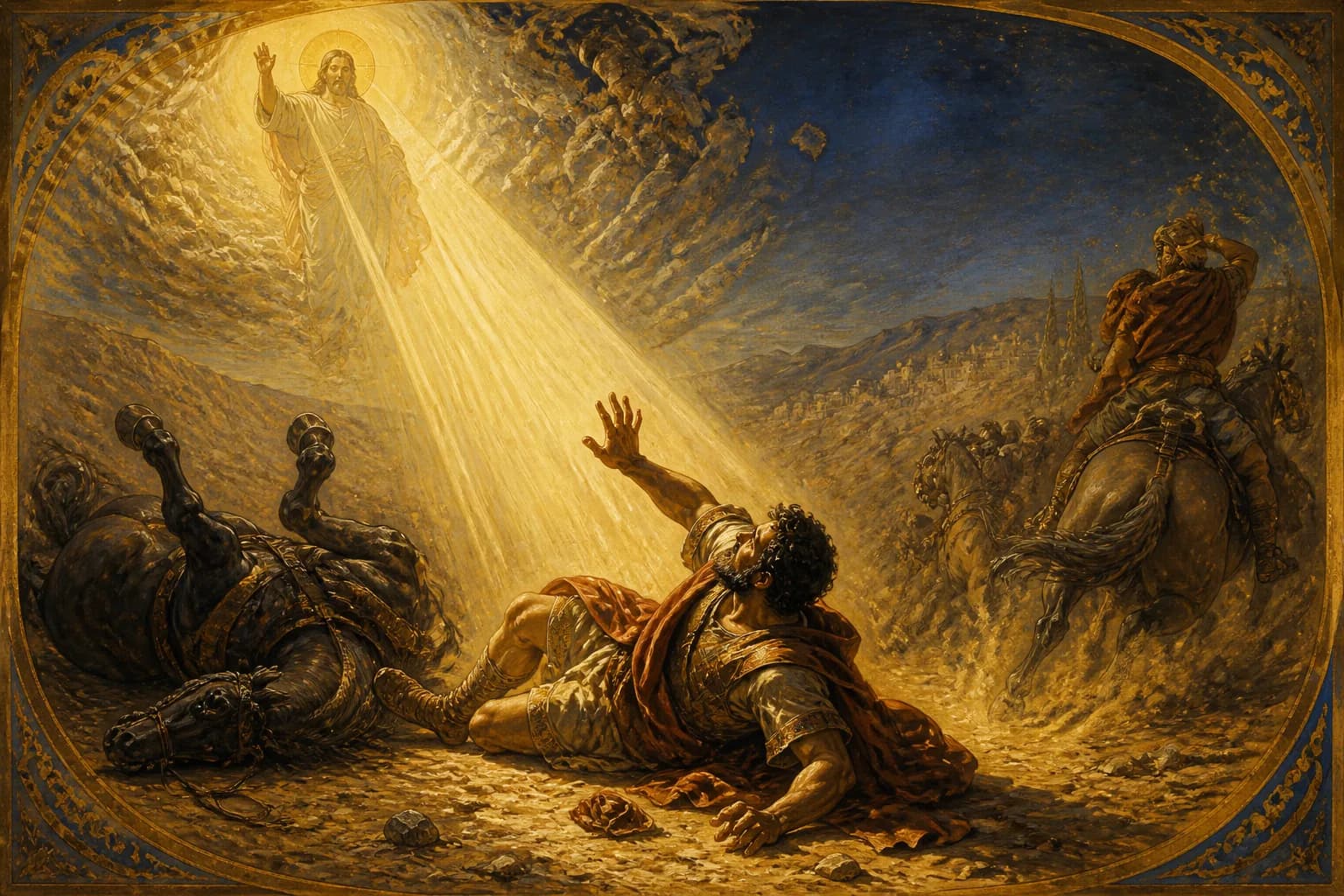
He was a Pharisee from Tarsus in his early thirties, traveling north on the Roman road from Jerusalem to Damascus with letters of authorization from the high priest to arrest any Jewish believers in the Way he could find in the synagogues of the Syrian capital. He had been in Jerusalem at the stoning of Stephen the year before, holding the cloaks of the men who threw the stones. He had volunteered for this mission. He believed, with the strict conviction of someone trained in the school of Gamaliel, that the followers of the Nazarene were blasphemers and that the future of Israel depended on suppressing them. By the time he reached the gate of Damascus he was blind, helpless, and being led by the hand. Three days later he would be baptized. Within months he would be preaching in the same synagogues he had come to police.
The conversion of Paul of Tarsus, sometime around AD 33 or 34, is the second most consequential single event in Christian history after the Resurrection itself. It is also one of the best-attested, told three times in the Acts of the Apostles (chapters 9, 22, and 26) and referenced in several of Paul's own letters. The three accounts differ in small details and agree in the substance.
Saul of Tarsus Before the Road
Saul — his Hebrew name; Paul was the Latin form he later used in the Gentile world — was born in Tarsus, the capital of Cilicia, in the southeastern Roman province of what is now Turkey. The city was a major Greek-speaking commercial center with a Jewish diaspora community. Saul was born into Roman citizenship by inheritance, a fact he would later use to his advantage repeatedly when arrested. His tribe was Benjamin. His sect was Pharisaic. His teacher was Gamaliel, one of the most respected Pharisaic rabbis of the early first century.
He was trained as a tentmaker, the traditional trade-skill Jewish rabbis often kept to support themselves. He would never abandon the trade; he supported himself in his later missionary work in Corinth, Thessalonica, and elsewhere by working with his hands.
In his own words, in the letter to the Philippians, he was circumcised on the eighth day, of the people of Israel, of the tribe of Benjamin, a Hebrew of Hebrews; as to the Law, a Pharisee; as to zeal, a persecutor of the Church; as to righteousness under the Law, blameless. He had nothing to apologize for in his Jewish observance. He was not a wandering soul looking for meaning. He was a successful religious scholar at the top of his profession.
He was also, by his own admission years later, complicit in violence. He was present and approving at the stoning of Stephen, the first Christian martyr, around AD 33. After Stephen's death, Saul threw himself into a personal campaign against the Jerusalem church — entering houses, arresting men and women, imprisoning them. When the believers fled Jerusalem, Saul pursued them. The Damascus mission was the extension of this campaign across the Syrian border.
The Road
Damascus is about 215 kilometers from Jerusalem by the Roman road. The journey on foot took five or six days; with a small mounted party, less. Saul was traveling with a group — Acts says those who journeyed with him — almost certainly armed.
The encounter, according to Acts 9, comes at midday, in full sun. Saul is near Damascus. The traditional Christian site, marked since the Byzantine era, is just outside the modern city, on the road from the southwest. A light from heaven — brighter than the sun, Paul will later say in his testimony before King Agrippa — flashes around him. Saul falls to the ground. A voice speaks:
Saul, Saul, why are you persecuting me?
The voice is in Aramaic, Paul will later specify. The repetition of the name — Saul, Saul — is the form used in the Hebrew Bible for divine address (compare Abraham, Abraham; Moses, Moses; Samuel, Samuel).
Saul answers: Who are you, Lord?
The voice: I am Jesus, whom you are persecuting.
This is the theological pivot. Jesus identifies himself not with the doctrine the disciples are preaching but with the disciples themselves. To persecute them is to persecute him. The implications for Catholic ecclesiology — the doctrine of the Church as the Body of Christ — start here.
The voice tells Saul to enter the city and wait for instructions. Saul gets up. He has been blinded by the light. The men with him stand speechless. They had heard the sound but not seen anyone; one of the small narrative differences across the three Acts accounts. They lead Saul by the hand into Damascus.
He stays at the house of a man named Judas, on a street called Straight — the Via Recta, one of the major Roman streets of ancient Damascus and still one of the city's main thoroughfares today, now called Bab Sharqi. For three days Saul does not eat or drink. He prays.
Ananias
The conversion of Saul is not finished without Ananias of Damascus, a disciple of the Way living in the city. The Lord appears to Ananias in a vision and tells him to go to the house of Judas on Straight Street and lay hands on Saul.
Ananias objects. He has heard about Saul. He has heard about the letters of arrest. Going to him is asking to be arrested. The Lord answers: Go, for this man is a chosen instrument of mine to carry my name before Gentiles and kings and the children of Israel.
Ananias goes. He puts his hands on Saul and says: Brother Saul, the Lord Jesus, who appeared to you on the road by which you came, has sent me, so that you may regain your sight and be filled with the Holy Spirit.
Something like scales falls from Saul's eyes. He sees. He is baptized. He eats. The Acts of the Apostles does not waste words on the interval.
The tradition in Damascus has long pointed to a chapel — the Chapel of Saint Ananias — built over the cellar of what was traditionally Ananias's house. The chapel is still in use as a Catholic site of pilgrimage.
The First Years
Saul did not go immediately to Jerusalem. According to his own account in Galatians, he went into the desert of Arabia — probably the Nabataean kingdom around what is now Petra — for an unspecified period he calls three years. He used the time, the early Church Fathers presumed, to think through what he had encountered on the road in light of the Hebrew Scriptures he already knew by heart. When he later writes Romans and Galatians, the deep coherence of his arguments suggests he had spent years working out his theology in silence before speaking it.
After Arabia he returned to Damascus, then went briefly to Jerusalem to meet Peter and James — fifteen days, Galatians says — and then back to his native Tarsus, where Barnabas eventually found him and brought him to Antioch around AD 42 or 43. From Antioch, the missionary journeys began.
The Apostle to the Gentiles
The mission Paul took up was distinctively his. Other apostles preached primarily to Jews; Paul concentrated on the Gentile world. He began in Antioch, fanned out through Cyprus, Galatia (central Asia Minor), Macedonia and Greece, eventually reached Rome under arrest, and may have traveled as far as Spain.
He founded the churches at Philippi, Thessalonica, Corinth, Ephesus, Galatia, Colossae, and Rome's house-churches. Most of the letters he wrote to these communities have survived — fourteen letters in the standard New Testament canon, though contemporary scholarship distinguishes between letters where authorship is universally accepted (Romans, 1–2 Corinthians, Galatians, Philippians, 1 Thessalonians, Philemon) and letters where the question is more debated (Ephesians, Colossians, 2 Thessalonians, the Pastoral Epistles, Hebrews).
These letters are the earliest written documents of the Christian movement. They predate the Gospels by ten to thirty years. They contain some of the most cited passages in Christian theology — the hymn to love in 1 Corinthians 13, the kenotic hymn of Philippians 2, the great Christological passage of Colossians 1, the entire architecture of justification by faith in Romans and Galatians.
The Death of Paul
Paul was arrested in Jerusalem around AD 57 or 58 after a riot in the Temple, and held in custody in Caesarea for two years before exercising his Roman citizen's right to appeal to Caesar. He was transferred to Rome and spent two years under house arrest while awaiting trial. The Acts of the Apostles ends here, in Acts 28.
The most reliable extra-biblical sources — Clement of Rome's letter to the Corinthians (c. 96), Ignatius of Antioch (c. 107), Eusebius's Ecclesiastical History — agree that Paul was martyred in Rome during the persecution of Nero. As a Roman citizen, he could not be crucified; he was beheaded, traditionally at the site now marked by the Abbey of the Three Fountains (Tre Fontane) outside Rome. The traditional date is between AD 64 and AD 67.
His tomb is in the Basilica of Saint Paul Outside the Walls (San Paolo Fuori le Mura), one of the four major basilicas of Rome. In 2009 the Vatican announced that carbon-14 testing of bone fragments from a sarcophagus discovered beneath the basilica confirmed remains dating to the first or second century, consistent with the tradition. The Vatican summary of the investigation is publicly available.
What the Conversion Meant
Paul did not stop being a Pharisee in his patterns of thought. He brought every tool of rabbinic training into the service of his new understanding of who Jesus of Nazareth was. He did not soften his original convictions about the holiness of God or the seriousness of the Law. He read the Law in a new light.
What changed was a single fact: that Jesus, whom he had been persecuting, was alive. Paul never argues for the Resurrection in his letters; he assumes it as the given of his existence. Everything he writes follows from it.
The conversion of Paul stands beside the conversion of Augustine four centuries later and the restoration of Peter on the shore of Galilee as one of the three great conversions in the Catholic tradition. Each is a different pattern. Augustine is the slow, intellectual, almost embarrassed conversion of a man finally cornered by grace. Peter is the restoration of a leader who failed. Paul is the lightning strike — an instantaneous reversal of a whole life by direct encounter with the risen Christ.
Catholic tradition has held the three together because together they cover the territory. Some people are converted slowly, some are restored after failure, some are knocked off horses. The Lord uses all three.
Listen to Saint Paul on Crucis Lux
Crucis Lux tells the story of Paul of Tarsus and the road to Damascus as a slow-paced, illustrated audio series — every scene narrated, every panel illustrated in the style of medieval frescoes, in five languages.