
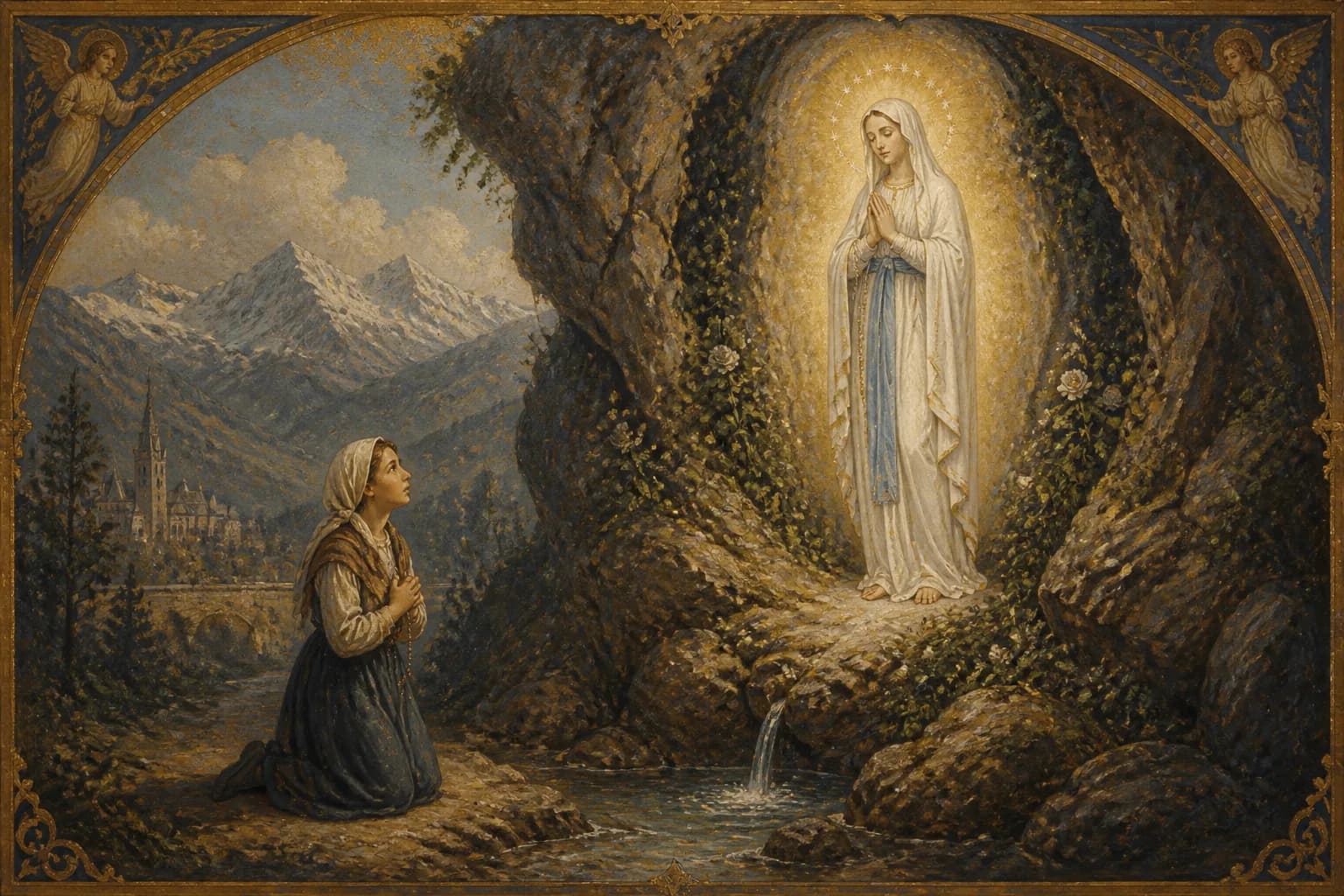
She was fourteen years old, asthmatic, illiterate in French, and the daughter of a miller whose family was so poor they were living in a former jail cell called the cachot. On the morning of February 11, 1858, gathering firewood near a damp grotto on the bank of the Gave de Pau in the Pyrenees, Bernadette Soubirous looked up and saw a young woman standing in a niche in the rock. The woman wore white with a blue sash. The encounter lasted only a few minutes. Bernadette went home and told her sister. Within months, fifty thousand people would gather at the grotto. Within twenty years, the Catholic Church would declare the apparitions worthy of belief. Within a century and a half, the small market town of Lourdes would be receiving six million pilgrims a year.
This is what is known about the eighteen apparitions at Massabielle, the testimony Bernadette gave under cross-examination, the spring that appeared, and what the International Medical Committee of Lourdes has verified about the cures.
Bernadette and Her Family
Marie-Bernarde Soubirous, called Bernadette, was born on January 7, 1844, the eldest of six surviving children of François Soubirous, a miller, and Louise Castérot. The family's downward economic spiral was steady. By 1857, François had lost his mill, taken work as a day laborer, and been briefly jailed on suspicion of theft. The family of eight lived in a single room of about sixteen square meters, the cachot, formerly the town's prison cell. The Soubirous were among the poorest of the poor in a town already on the edge.
Bernadette suffered from chronic asthma. She had nearly died of cholera in 1855. She spoke the Bigourdan dialect of Occitan, not standard French; she had never been to school; she could not yet receive First Communion because she had not learned the catechism.
She was, by every account, a quiet child, slow to speak, slow to laugh, unremarkable except in her reliability.
The First Apparition: February 11, 1858
That Thursday morning, Bernadette went with her sister Toinette and a friend, Jeanne Abadie, to gather firewood across the Gave de Pau at the grotto of Massabielle. The other two girls crossed an icy stream. Bernadette, fearing her asthma, hung back. As she began to remove her stockings, she heard a sound like wind, looked up, and saw a Lady in the niche above the grotto.
The Lady held a rosary. She made the sign of the cross. Bernadette took out her own rosary and prayed with her. When the Lady disappeared, Bernadette joined her sister.
Toinette dragged the story out of her. By that night, the whole cachot knew. By the next day, the town knew.
The Cycle of Eighteen Visits
The apparitions continued from February 11 through July 16, 1858, in eighteen separate visits. The Lady never gave her name during the first thirteen visits. The pattern usually involved Bernadette walking to the grotto, sometimes accompanied by an increasing crowd, falling into a state of ecstasy in which her face transfigured, and either receiving instruction silently or repeating audibly what she was told.
Key episodes:
- February 18. The Lady speaks for the first time. She asks Bernadette: "Will you do me the kindness of coming here for fifteen days?" Bernadette agrees.
- February 21. A crowd of about a hundred follows Bernadette. The police commissioner Jacomet interrogates her that evening for hours, trying to break her story.
- February 24. The Lady speaks the word Penance, penance, penance, and asks Bernadette to pray for sinners.
- February 25. The Lady tells Bernadette to drink from the spring and wash. There is no spring visible. Bernadette scratches at the muddy ground at the back of the grotto and a trickle of muddy water appears. By the next day it is a clear stream. The spring still runs today, producing about a hundred and twenty thousand liters a day.
- March 2. The Lady asks Bernadette to tell the priests to build a chapel and to have processions come.
- March 4. The end of the fifteen days. A crowd of about ten thousand gathers. The apparitions do not stop, but they become less frequent.
March 25, 1858: "Que soy era Immaculada Counceptiou"
The most decisive apparition came on the Feast of the Annunciation. Bernadette had repeatedly asked the Lady her name and received no answer. On March 25, the Lady joined her hands, raised her eyes to heaven, and said, in the Bigourdan dialect Bernadette spoke:
Que soy era Immaculada Counceptiou.
"I am the Immaculate Conception."
The phrase was theologically precise. Pope Pius IX had only defined the dogma of the Immaculate Conception — that Mary was preserved from original sin from the moment of her conception — in the apostolic constitution Ineffabilis Deus on December 8, 1854, three years and four months earlier. Bernadette did not know the theological term. She could not read. She walked from the grotto to the parish house repeating the phrase out loud over and over so she would not forget it before she could tell the parish priest, Abbé Peyramale.
Peyramale was a skeptic. When Bernadette delivered the name, he was shaken. A fourteen-year-old shepherdess from the cachot could not have invented the precise theological phrase the Pope had used. From that moment, the local clergy began to take the apparitions seriously.
The Last Apparitions
The seventeenth apparition was on April 7, the Wednesday after Easter. Bernadette held a lit candle during her ecstasy; the flame burned around her fingers without harming them. A doctor present, Pierre-Romain Dozous, examined her hand afterward and found no burn. He wrote the incident up in detail.
The eighteenth and last apparition was on July 16, 1858, the Feast of Our Lady of Mount Carmel. The grotto had been fenced off by the prefect of the Hautes-Pyrénées to prevent disorder; Bernadette saw the Lady from a distance across the river. The Lady did not speak. Bernadette later said simply, "I have never seen her so beautiful."
The Investigations
Civil authorities investigated. Commissioner Jacomet, the imperial prosecutor, the prefect — all interrogated Bernadette, sometimes harshly. She never embellished. She never recanted. When her interrogators tried to trip her with theological vocabulary she did not know, she answered with the few words the Lady had given her and refused to elaborate.
Bishop Bertrand-Sévère Laurence of Tarbes opened a canonical commission in 1858 and worked for four years before issuing his judgment on January 18, 1862: the apparitions were worthy of belief. The same formal verdict the Catholic Church has used ever since.
Bernadette's Later Life
Bernadette could not bear the attention. In 1866, at twenty-two, she entered the convent of the Sisters of Charity of Nevers, twelve hundred kilometers from Lourdes, and never returned to the grotto. She suffered from tuberculosis of the bone, which progressively crippled her. She nursed sick sisters in the infirmary, kept a small role as a sacristan, and refused to be a celebrity. When pilgrims asked the convent to see her, she usually slipped away.
Her last recorded words, on April 16, 1879, were Holy Mary, Mother of God, pray for me, a poor sinner. She was thirty-five.
Her body, exhumed for the canonization process in 1909, 1919, and 1925, was found incorrupt — without the ordinary signs of decay expected after decades in the ground. The body is now displayed in a glass reliquary at the convent in Nevers, where it has remained for a century. Whatever one makes of bodily incorruption as a phenomenon, the visual evidence is available to any visitor.
She was canonized by Pope Pius XI in 1933, on the feast of the Immaculate Conception. Her own feast day is April 16.
The Medical Bureau and the Verified Cures
The Lourdes Medical Bureau, founded in 1883, has investigated every reported cure at the grotto for more than a century. Its standards are deliberately rigorous: the illness must be documented prior to the alleged cure, the cure must be instantaneous or near-instantaneous, complete, lasting, and medically inexplicable. The Bureau works with secular as well as religious physicians.
To date, the Catholic Church has formally recognized seventy cures as miraculous, out of approximately seven thousand cases the Bureau has examined. Many more cures the Bureau classifies as "remarkable but not meeting the strict criteria" — patients who improved dramatically but whose cases lack one of the verification elements. The most recent cure to be formally declared was that of Sister Bernadette Moriau, recognized by Bishop Jacques Benoit-Gonin of Beauvais in February 2018, after twelve years of medical and theological review.
The Bureau publishes its work openly. Skeptical inquiry is welcomed.
Why Lourdes Matters
Lourdes is the most visited Marian shrine in Europe and the second most visited in the world after Guadalupe. It is also the largest annual gathering of the sick and disabled in the Christian world. The town has more hotel beds than any French city except Paris, almost entirely to handle pilgrim volume.
The Lourdes message is closely linked to Fátima: penance, the rosary, the consecration to Mary. The doctrinal anchor — the Immaculate Conception — has been incorporated into the liturgical calendar of the universal Church. The witness of Bernadette herself — illiterate, asthmatic, jailed-house poor, unflinching under interrogation — remains the most quoted piece of testimony in modern Marian devotion.
Lourdes is also a working pilgrimage. A visitor today can drink from the spring, bathe in the pools, walk the same path from the cachot to Massabielle, attend the evening candlelight procession that gathers tens of thousands every summer night, and place a hand on the same rock face where the niche held a young woman in white in 1858.
Listen to Lourdes on Crucis Lux
Crucis Lux tells the story of Bernadette Soubirous and the apparitions of Lourdes as a slow-paced, illustrated audio series — every apparition narrated, every panel illustrated in the style of medieval frescoes, in five languages.