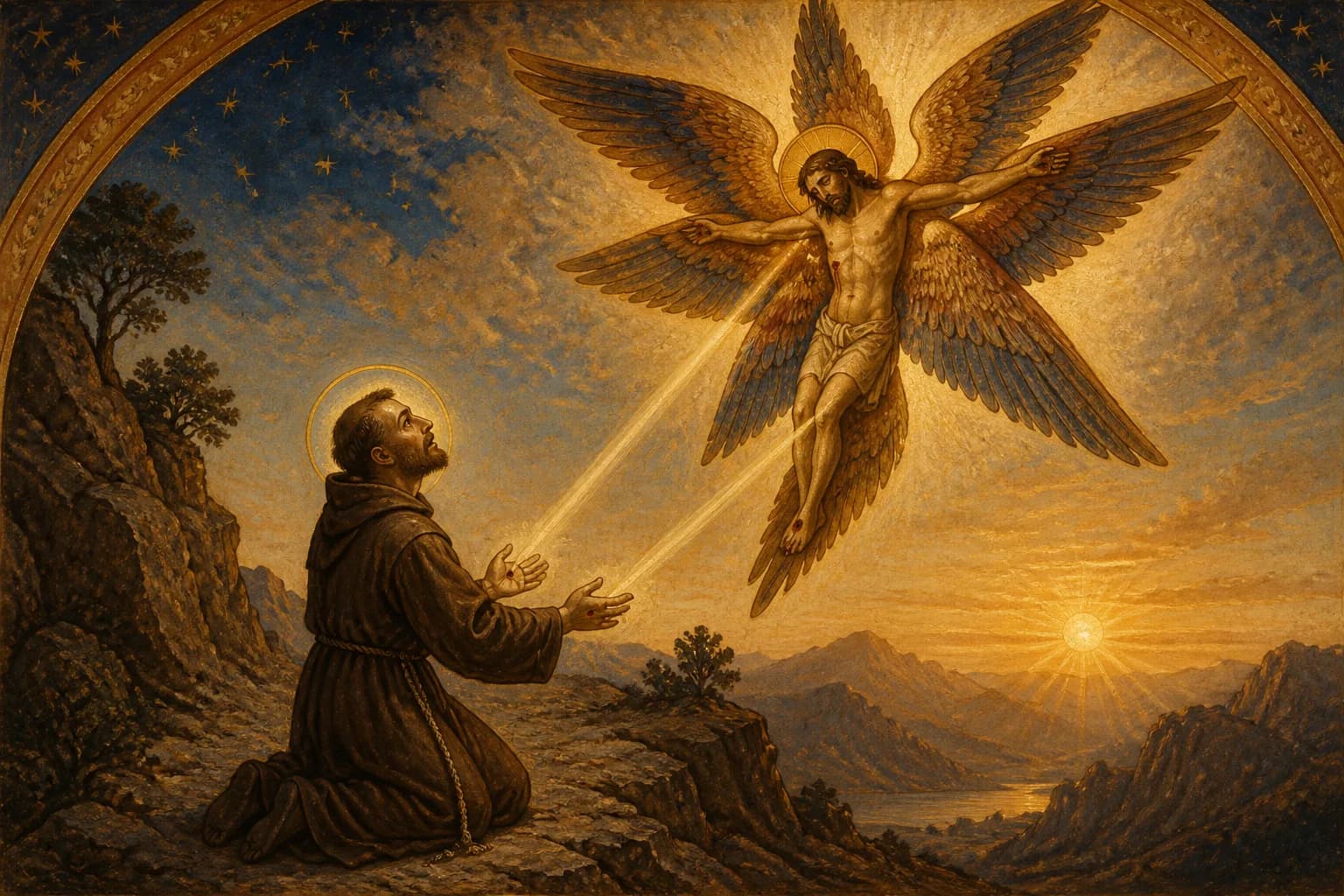
He had climbed up Mount Alverna in the Tuscan Apennines for forty days of fasting and prayer in late summer. He was forty-two years old, exhausted, half-blind from trachoma, and increasingly unable to eat without pain. He had begun the long withdrawal from leadership of the movement he had founded. On the eve of the Feast of the Exaltation of the Cross — September 14, 1224 — Francis of Assisi prayed alone on a ledge near the summit and saw a vision: a seraph with six wings, with the figure of a crucified man at its center, suspended in the air above him. When the vision ended, his hands, his feet, and his side were marked with the wounds of the crucifixion. He became the first documented stigmatic in Christian history.
This is what the earliest sources say happened. There are good reasons to take them seriously — and one of them is that Francis did everything in his power to keep what had happened private until the day he died.
The Eyewitness Sources
Three sources within a generation of the event preserve the account:
- Thomas of Celano, Vita Prima Sancti Francisci, written 1228–1229, only two to five years after the event, commissioned by Pope Gregory IX for the canonization. Celano had personally known Francis. He had access to the brothers who were on Mount Alverna with Francis.
- Brother Leo, Francis's secretary and confessor, who was with him on Alverna and who left a short Latin text — the Chartula — which Francis himself wrote on, blessing Leo. The chartula survives, kept at the Basilica of Saint Francis in Assisi.
- Bonaventure of Bagnoregio, Legenda Maior, written 1260–1263, drawing on the testimony of brothers still alive who had been there.
The accounts converge in the essentials: Francis went to Alverna with a small group of brothers for the customary forty-day fast leading to Michaelmas; he withdrew alone to a small hermitage cell on the south side of the mountain; on or about September 14 he received the vision and the wounds; he tried to keep the marks hidden by wearing his habit pulled down over his hands and bandages on his feet; only after his death two years later, on October 3, 1226, did the brothers see the wounds fully and document them.
Mount Alverna
The mountain — La Verna in modern Italian — rises sharply to 1,283 meters in the Casentino forest of Tuscany. Count Orlando Cattani of Chiusi had given it to Francis in 1213 as a place of retreat, in gratitude for a sermon. Francis preferred remote places for the most intense periods of prayer. La Verna became his favorite.
The mountain has a small Franciscan friary today on the site of the original hermitage. The cleft in the rock where Francis prayed — the Sasso Spicco, the Stone of Cleavage — is still accessible. The cell where the stigmata occurred is preserved as a chapel.
What the Vision Was
The seraph vision is the most striking element of the account, and the part where the four Gospel accounts of the Transfiguration come most clearly into echo.
Celano and Bonaventure describe Francis seeing a figure with six wings descending from heaven. Two wings covered the figure's head, two covered the feet, two were spread for flight. At the center of the figure, between the wings, was the form of a crucified man. The figure was beautiful and the man was suffering. Francis felt at once joy at the beauty and grief at the suffering.
The vision lasted for some time — Bonaventure suggests a sustained ecstasy. When it ended, Francis discovered the marks. The hands and feet had what looked like nails, with the heads visible on the palms and tops of the feet and the points bent over on the other side, as if the iron had passed through. The right side had a wound that bled.
The combination — the seraph and the crucified — is theologically loaded. The seraph in Isaiah 6 is one of the highest orders of angels, the order whose name in Hebrew is connected to fire. The crucifix at the seraph's center fuses the highest spiritual order with the deepest physical suffering. That is the heart of what the vision says.
How the Wounds Behaved
Celano, Bonaventure, and Leo are consistent on the physical character of the wounds for the two years Francis lived afterward.
- The marks in the hands and feet looked like nails — Celano uses the Latin clavorum, the brothers used the Italian chiodi — not simply wounds. The heads of the nails were on the palms and the tops of the feet; the bent-over points were on the backs of the hands and the soles of the feet.
- The right-side wound was open and bled. Witnesses said it left blood on Francis's tunic.
- Francis could not walk without significant pain. He was usually carried on a donkey for the remaining two years of his life.
- He hid the wounds. He pulled his sleeves over his hands and bound his feet with strips of cloth. Only Brother Leo, his confessor, regularly saw the marks while he lived.
The contrast with Padre Pio, seven hundred years later, is instructive: where Padre Pio's wounds bled like ordinary wounds, Francis's appeared more like puncture marks with the nail itself somehow embedded in the flesh. Both cases are genuinely strange and have resisted easy medical categorization.
The Witnesses After His Death
Francis died at the Portiuncula on the evening of October 3, 1226, in his mid-forties. The brothers immediately laid his body on the ground, in keeping with his last wishes, and prepared it for burial. The hidden wounds were now visible to everyone.
Hundreds of brothers, citizens of Assisi, and clergy came to see the body before its burial. The wounds were inspected with care; Celano records that the nails in the hands and feet were unmistakable. Several testified under oath during the canonization investigation, which began less than two years later. Pope Gregory IX canonized Francis on July 16, 1228 — one of the swiftest canonizations in Church history — and personally testified to the existence of the stigmata.
The papal bull of canonization, Mira circa nos, refers explicitly to the wounds.
The First Stigmatic
The Catholic Church has documented hundreds of stigmatics since Francis — most of them women, most of them in the late medieval and modern eras. Catherine of Siena. Padre Pio. Marie-Julie Jahenny. Theresa Neumann. Anne Catherine Emmerich.
Francis is, however, the first. Before September 14, 1224, no Christian sources describe a living person bearing the wounds of the crucifixion. After Francis, the phenomenon becomes part of the spiritual landscape of Catholic mysticism.
The Catholic Church has never made bodily stigmata a requirement of sanctity or a confirmation of it. Stigmata is treated as a charism — a gift given by the Spirit for the upbuilding of the Church, not a private prize for the recipient. Many saints have not had them; some who have had them have not been formally canonized; the Church examines each case carefully.
What is true of all the cases the Church has accepted is that the recipients did not seek the wounds, suffered from them, hid them when they could, and used them as a goad toward greater conformity with the suffering of Christ. Francis is the prototype.
Why the Feast of the Exaltation of the Cross
The dating is not coincidental. September 14 in the Catholic calendar is the Feast of the Exaltation of the Cross — the feast commemorating the recovery of the True Cross by the Emperor Heraclius in 628 and, more deeply, the celebration of the cross as the instrument of salvation.
Francis had structured his life as a literal imitation of the crucified Christ. He had stripped himself before his father and the bishop of Assisi in 1206. He had embraced the leper outside the walls. He had begged for alms door to door. He had organized his entire community around the Lady Poverty. The stigmata on the eve of the Feast of the Cross is read by Catholic tradition not as a divine intrusion but as the natural completion of forty years of imitating Christ — the body finally catching up to the soul.
Francis himself wrote two prayers shortly after the event, both of which survive. One is the Praises of God he wrote on the chartula for Brother Leo. The other is a blessing — May the Lord bless you and keep you — which Francis added in his own hand at the bottom of the same chartula. The piece of parchment is one of the oldest surviving Franciscan relics.
La Verna Today
The friary at La Verna remains a working Franciscan house. The cell where Francis received the stigmata is now a chapel called the Cappella delle Stimmate. The Sasso Spicco where he prayed is accessible by a short path. Brothers conduct a daily procession to the chapel chanting the Office of the Passion, a practice maintained since the late thirteenth century.
The mountain is one of the most visited Franciscan pilgrimage sites in Italy, second only to Assisi itself. Pilgrims often walk the Cammino di San Francesco — the Franciscan way — from La Verna to Assisi to Rome, retracing portions of Francis's own footsteps. The Vatican's pilgrimage office maintains references to the route.
What the Stigmata Asks
Francis received the wounds and immediately tried to hide them. He did not interpret them as a sign of personal greatness. He continued to dictate the Canticle of the Creatures, to pray, to suffer, and to die. Two years later he was dead.
The stigmata is not a trophy of the spiritual life. It is, as the Franciscan tradition has read it ever since, a sign that conformity to the suffering of Christ is not metaphor. For most Christians it remains spiritual and hidden. For a few across history, it has been visible. Francis was the first.
Listen to Saint Francis on Crucis Lux
Crucis Lux tells the story of Saint Francis and the stigmata at La Verna as a slow-paced, illustrated audio series — every scene narrated, every panel illustrated in the style of medieval frescoes, in five languages.