
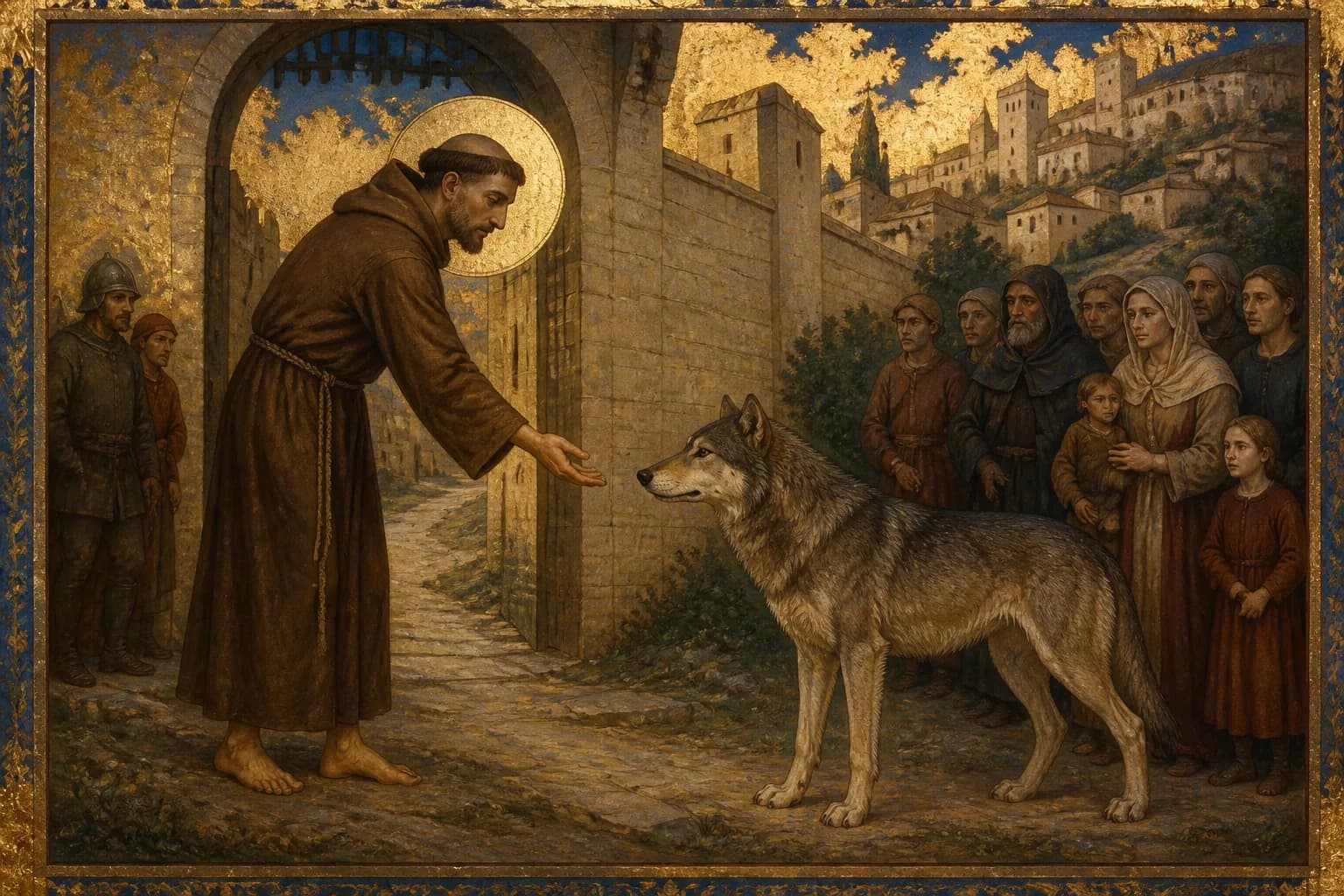
A wolf has been killing villagers outside Gubbio in the Apennines. The townspeople do not leave their walls without weapons. The friar from Assisi walks out alone, unarmed, in his patched habit. He stands in the road. The wolf comes at him with its jaws open. He makes the sign of the cross. The wolf lies down at his feet. By the end of the afternoon, the friar walks the wolf back into Gubbio on a leash made of his own belt, brokers a treaty between the wolf and the townspeople, and gets every household to commit to feeding the animal in exchange for an end to the killing.
This is the most famous of all the Franciscan stories outside the stigmata of La Verna. It is also one of the most misunderstood. It is not the story of a saint who tames wild beasts the way a circus tamer does. It is a parable about peacemaking, hospitality, and the relationship between human violence and animal violence — preserved in a fourteenth-century compilation called the Fioretti. In 1872 something happened in Gubbio that has complicated the conversation: workmen restoring an old Romanesque chapel found, beneath the slabs of the floor, the skeleton of a large wolf, buried with apparent care.
The Source: The Fioretti
The Fioretti di San Francesco — The Little Flowers of Saint Francis — is a collection of fifty-three short stories about Francis and his early followers, written in Tuscan Italian and compiled around 1390, more than 160 years after Francis's death in 1226. The compiler drew on an earlier Latin work, the Actus Beati Francisci et Sociorum Eius, which itself drew on memories preserved in Franciscan houses.
The Fioretti is not strict history. It is a hagiographical collection — stories told to teach, to delight, and to convey the spirit of early Franciscanism rather than to satisfy a modern fact-checker. The episode of the Wolf of Gubbio appears as Chapter 21. The Italian text is short, perhaps twelve hundred words.
The framing is that of moral parable. The Italian word San Francesco tells the citizens that the wolf's violence is not its own — it is hungry, abandoned, untrained — and that the violence of the citizens against it has been part of the cycle. He proposes a covenant: the people will feed the wolf, the wolf will not harm them or their animals. Both sides agree. The wolf raises its paw to seal the pact. It lives among them for two more years, fed from door to door, until it dies naturally and the people mourn it.
What the 1872 Discovery Was
In 1872, during restoration work at the church of San Francesco della Pace in Gubbio — a small Romanesque chapel local tradition had long associated with the wolf legend — workmen lifting the stone slabs of the floor found a hidden chamber. Inside the chamber was the skeleton of a wolf, large and apparently old, buried not as carrion would have been dumped but laid carefully beneath the floor of the church.
The find was reported in local newspapers and documented by the Franciscan custodianship of the church. The bones were re-interred in a new sealed urn beneath the altar of the chapel and a plaque was placed.
The discovery is sometimes presented in popular sources as scientific proof of the historical wolf. That is more than the evidence supports. What it suggests is that the people of medieval Gubbio took the story seriously enough to bury a wolf as a kind of memorial near the chapel they associated with Francis, perhaps centuries after Francis's death. The age of the skeleton has not been carbon-dated and published in modern scientific literature, so the connection to the early thirteenth century remains a local tradition, not a confirmed archaeological fact.
What is confirmed: the Gubbio townspeople had a wolf buried in their church floor and they did so deliberately. That much is a stronger devotional history than the legend usually receives.
Francis and the Animals: A Broader Pattern
The wolf of Gubbio is not isolated in the Franciscan record. The earliest biographies of Francis — Thomas of Celano's Vita Prima (1228, two years after the saint's death) and Vita Secunda (1247), and Bonaventure's Legenda Maior (1263) — preserve many accounts of Francis with animals.
- The sermon to the birds at Bevagna, preserved by Celano: Francis stops on a road, addresses a flock of birds, asks them to listen, and preaches to them. The birds do not fly away. He notes their colors, their songs, their freedom from labor, and tells them to praise God.
- The cicadas of the Portiuncula, who fall silent when Francis asks them to sing for the Lord and then sing on command.
- The fish in Lake Rieti, who according to one episode listened to him.
- The pheasants and the larks of the Marches.
The pattern is consistent: Francis treats animals as fellow creatures within a single creation. He does not project sentimentality onto them; he speaks to them as creatures owed respect. The Canticle of the Creatures — Francis's late vernacular hymn, the oldest surviving Italian literary work — extends the same logic: Brother Sun, Sister Moon, Brother Wind, Sister Water, Sister Mother Earth. It is not anthropomorphism. It is theological cosmology.
The wolf of Gubbio fits into this pattern because the wolf is treated as a creature capable of being addressed, capable of receiving a covenant, capable of being responsible — and capable of being hungry, which is the prosaic explanation of its violence.
What the Legend Teaches
The point of the story, when one reads the Fioretti on its own terms, is not biological wonder. It is theological. Three things matter.
Violence is a system, not just an act
The townspeople had been arming themselves and going out to kill the wolf. The wolf had been killing their livestock and, the text says, their people. Each side fed the other's violence. Francis arrives and breaks the system not by punishing one side but by proposing a different arrangement: the people will feed the wolf; the wolf will not hunt. Provision replaces predation.
Peace requires confession of need
The wolf is hungry. The legend does not romanticize this. The wolf killed because it was abandoned and starving. The townspeople had not provided. Francis names this. The covenant works because both sides agree to acknowledge what the violence had cost.
A peacemaker may have to walk out alone, unarmed
This is the most uncomfortable part of the legend and the part the early Franciscans cherished. Francis goes out without weapons, against the advice of everyone in Gubbio. He goes out trusting only in the presence of God and his own willingness to die if necessary. This is also the structure of his earlier journey to meet Sultan al-Kamil at Damietta in 1219, in the middle of the Fifth Crusade, when he crossed enemy lines unarmed to preach the Gospel to a Muslim ruler — an episode the historical record confirms.
The Historicity Question
A scholar will distinguish three layers of the wolf of Gubbio story.
- The behavior of Francis — that he addressed animals, lived among them, and preached peace as a public vocation. This is solidly documented across early Franciscan sources, not just the Fioretti.
- The Gubbio episode itself — that an event occurred in Gubbio involving Francis and a wolf, leading to a local memory strong enough to survive into the Fioretti. The 1872 burial supports a robust local tradition, but the precise events of the encounter remain in the genre of medieval hagiography.
- The literary form — the Fioretti version, with its dialogues, paw-shake, and named characters, is shaped by storytellers across the late thirteenth and fourteenth centuries. The shape is a parable.
What this means in practice: a Catholic can read the wolf story as a real event recorded with theological color, or as a parable with a historical kernel, without losing the substance of what the story communicates. The Catholic Church has never canonized the legend; it has canonized Francis.
Francis as Patron of Peace and Ecology
Pope John Paul II declared Saint Francis the patron of ecologists in 1979. Pope Francis (the first pope to take the name) opened his 2015 encyclical Laudato Si' by quoting the Canticle of the Creatures: Praise be to you, my Lord, through our Sister, Mother Earth. The choice of Francis as a patron of integral ecology rests on the same logic as the wolf of Gubbio: creatures share a common Creator and a common dignity.
The wolf of Gubbio belongs in the same imaginative space as the conversion of Augustine, the transverberation of Teresa of Avila, and the stigmata of Francis himself — moments in which the natural and the supernatural intersect and the result is a different way of living together.
Gubbio Today
Gubbio is still there, in the foothills of the Apennines in Umbria. The church of San Francesco della Pace still has the urn with the wolf's skeleton beneath the altar. The Festival of the Wolf — La Festa del Lupo — is celebrated annually. Pilgrims walk the medieval streets between the chapel and the cathedral; tour guides recite the legend; the wolf is sculpted in stone and painted on walls.
The town's contemporary identity rests on the wolf story almost as much as on its other history. It is a small Italian town that learned, eight centuries ago, that the friar from Assisi had something to say about violence — and remembered.
Listen to Saint Francis on Crucis Lux
Crucis Lux tells the story of Saint Francis of Assisi as a slow-paced, illustrated audio series — every scene narrated, every panel illustrated in the style of medieval frescoes, in five languages.