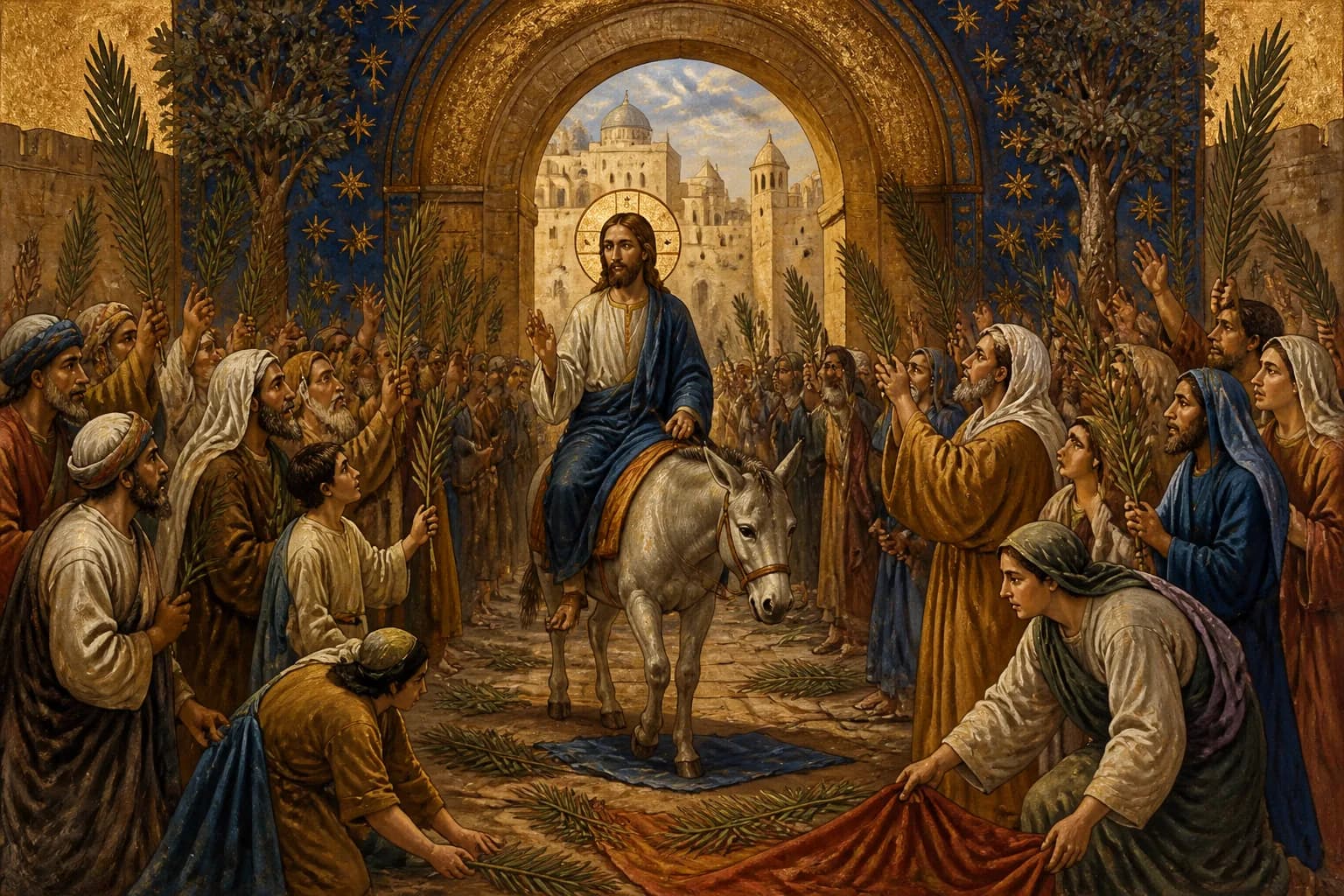
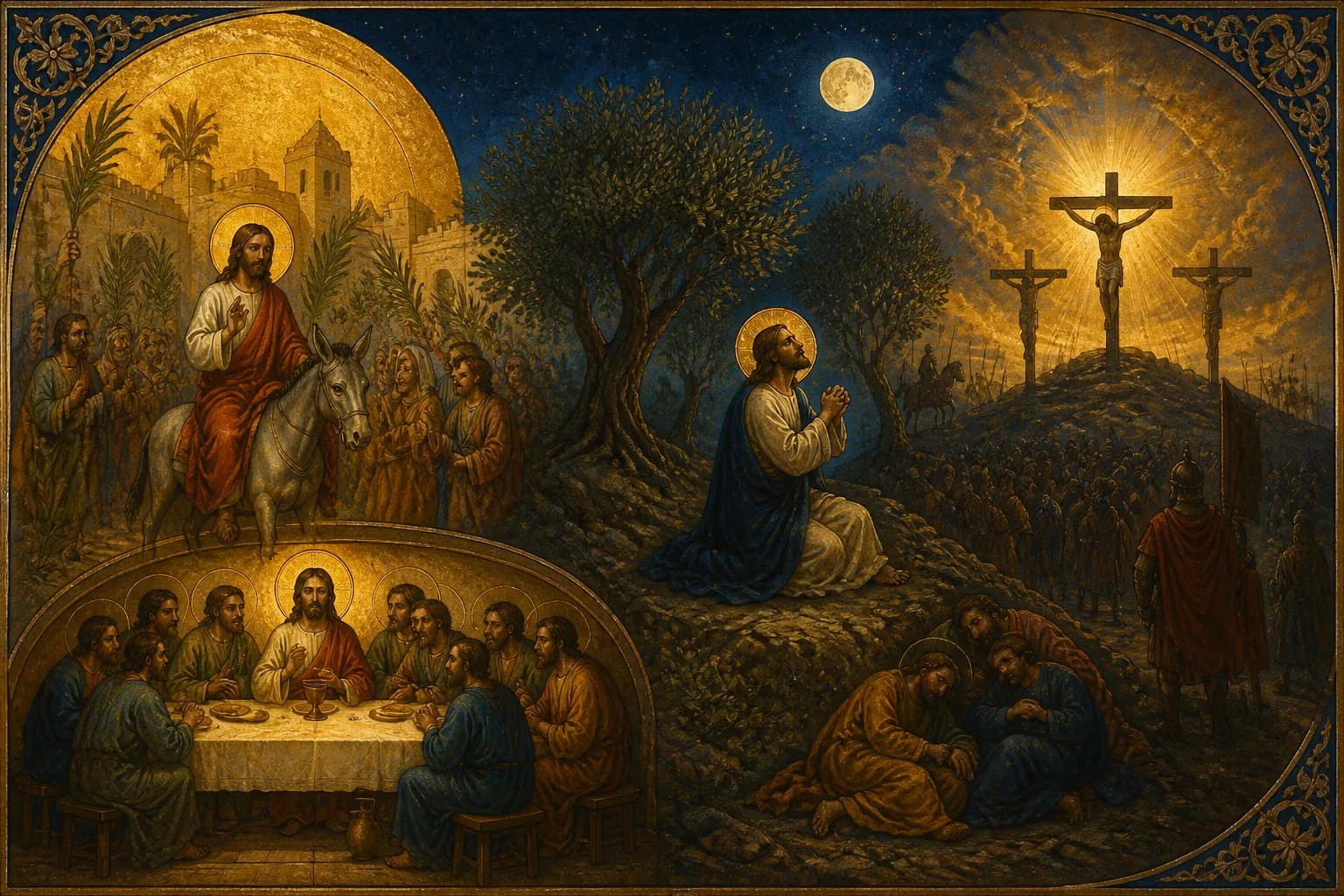
A donkey colt steps onto the road from Bethphage. Cloaks fall in front of it. Palm branches snap and wave. Inside the walls of Jerusalem, the Temple authorities are already discussing what to do about the prophet from Galilee. Six days later, the same crowd will be silent and a centurion will say, "Truly this man was the Son of God." Holy Week is the shortest, most compressed week in Christian history, and the most consequential.
This Holy Week timeline walks through the Passion of Christ day by day, drawing on all four Gospels — Matthew, Mark, Luke, and John — and the broader liturgical tradition that shaped Christian memory of these events. Where the Gospels disagree on small details, we name the disagreement.
Palm Sunday: The Entry into Jerusalem
Jesus enters Jerusalem from the east, riding a young donkey down the Mount of Olives. The crowd shouts Hosanna (Hebrew: "save us") and quotes Psalm 118: "Blessed is he who comes in the name of the Lord." Matthew, Mark, and Luke locate the moment around Passover week; John places it six days before the feast.
The detail of the donkey is deliberate. Jesus is enacting Zechariah 9:9: "Behold, your king comes to you, humble and riding on a donkey." A Roman general would have entered on horseback. Jesus enters as a king who refuses the military reading of the Messiah.
That same day or shortly after, he weeps over the city — "if only you had recognized the hour of your visitation" — and enters the Temple, turning the tables of the money-changers. The Temple was the economic heart of Judea as well as its spiritual one. By Monday morning, the chief priests were calculating loss.
Holy Monday and Tuesday: The Final Teachings
Monday and Tuesday of Holy Week are the days of confrontation. Jesus returns to the Temple. He curses the barren fig tree on the way in — a sign-act about a system that bore leaves but no fruit. He teaches in parables aimed directly at the religious authorities: the wicked tenants, the wedding feast, the two sons.
The Sanhedrin sends delegations to trip him. They ask about Roman taxes, about resurrection, about the greatest commandment. Each question is a trap; each answer leaves the questioners silent. By Tuesday evening, the leadership has decided he must die, but they want him handled before the feast begins to avoid riots.
It is also during these days that Jesus delivers the Olivet Discourse on the slope facing the Temple — the long teaching about the destruction of Jerusalem, the end of the age, and the Son of Man coming on the clouds. Forty years later, in AD 70, the Temple will be rubble.
Holy Wednesday: The Betrayal Is Set
The Gospels are quieter on Wednesday. Mark and Matthew place Jesus at Bethany, in the house of Simon the leper, where a woman anoints his head with costly nard. Jesus interprets the act as preparation for his burial. Judas Iscariot, troubled or grasping or both, goes to the chief priests and agrees to hand over his teacher for thirty pieces of silver.
The Christian tradition has long called this day Spy Wednesday — the day the betrayal was contracted in the dark.
Holy Thursday: The Last Supper and Gethsemane
Thursday evening, Jesus and the Twelve gather in an upper room in Jerusalem. The Synoptic Gospels treat the meal as the Passover seder; John places the meal before the Passover. The debate is ancient. What is not in dispute is what happened at the table.
Jesus washes the disciples' feet — a slave's task — and tells them to do the same for one another. He breaks bread, calls it his body, blesses the cup, calls it his blood of the new covenant. He commands: Do this in memory of me. The Eucharist begins here, the act the Catholic Church has repeated every day for two millennia.
After supper, they cross the Kidron Valley and climb to the Garden of Gethsemane on the western slope of the Mount of Olives. The name means "oil press." Jesus prays while the disciples sleep. Luke says his sweat was "like great drops of blood falling to the ground." Judas arrives with a detachment of Temple guards. He kisses Jesus. The arrest is bloodless except for one severed ear, which Jesus heals.
Peter follows at a distance. In the high priest's courtyard, warming himself by a charcoal fire, he denies knowing Jesus three times before the rooster crows. The shame of that moment will shape the rest of his life — and the restoration on the shore of Galilee after the Resurrection.
Good Friday: Trial, Crucifixion, Burial
Good Friday is the day Christians call good because of what God did through what men did.
The Trials
There are six trials in roughly nine hours. Three are Jewish: before Annas, before Caiaphas, before the full Sanhedrin at dawn. Three are Roman: before Pilate, before Herod Antipas (Luke only), back before Pilate. The charges shift. Before the Sanhedrin, the charge is blasphemy. Before Pilate, the charge becomes sedition — "he claims to be a king."
Pilate finds no case. He offers the crowd a choice: Jesus or Barabbas, a revolutionary. The crowd chooses Barabbas. Pilate washes his hands in a gesture that has become proverbial. Jesus is scourged, crowned with thorns, and condemned to crucifixion.
The Via Dolorosa
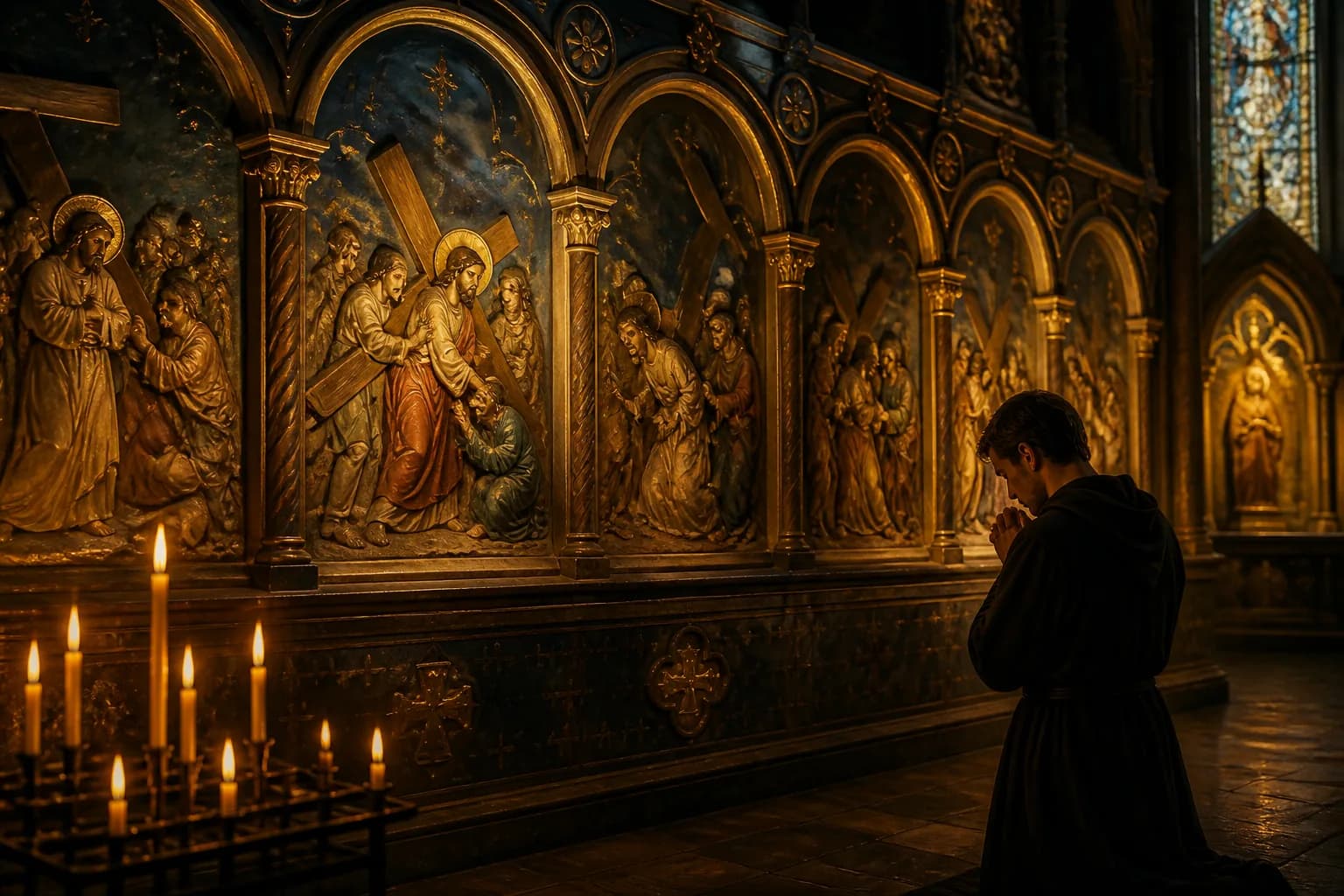
The traditional fourteen Stations of the Cross trace the path from Pilate's praetorium to Golgotha. Some stations come directly from the Gospels (Simon of Cyrene carries the cross; Jesus speaks to the women of Jerusalem). Others come from pious tradition that thickened over centuries (Veronica wiping his face).
Calvary
Crucifixion was the Roman empire's most degrading execution. The condemned man often took two or three days to die, suffocating slowly as his arms gave out. Jesus is crucified at the third hour (about 9 a.m.) between two thieves. He speaks seven last words from the cross, commits his mother to John, forgives the soldiers, and dies at the ninth hour (about 3 p.m.). The Temple veil tears. An earthquake. A centurion's confession.
Joseph of Arimathea, a wealthy member of the Sanhedrin who had not consented to the verdict, requests the body. He and Nicodemus wrap it with about a hundred pounds of myrrh and aloes — a king's burial — and lay it in a new tomb cut from rock. A great stone is rolled across the entrance before the Sabbath begins at sunset.
Holy Saturday: The Silent Day
Saturday is the day the Church remembers Christ "in the heart of the earth." There is no Mass anywhere in the world on Holy Saturday — the only such day of the year. The Apostles' Creed says he descended to the dead. Eastern tradition calls this the Harrowing of Hell: Christ entering Sheol to lead out the righteous of the Old Covenant. Adam and Eve, Abraham, Moses, David, the prophets — the icon shows Christ pulling Adam by the wrist from a broken-open tomb.
For the disciples, hidden in the upper room, it is the longest day of their lives.
Easter Sunday: The Empty Tomb
Before dawn on the first day of the week, a group of women — including Mary Magdalene — come to the tomb with spices. They find the stone rolled away. The angel speaks: "He is not here. He is risen, as he said."
The Resurrection appearances unfold over forty days. Mary Magdalene first, then Peter and John at the tomb, then the two disciples on the road to Emmaus who recognize him in the breaking of bread, then the Eleven in the upper room, then the encounter on the shore of Galilee, then five hundred at once according to Paul, then the Ascension from the Mount of Olives.
The Christian liturgical year is built on this week. Every Sunday Mass is a small Easter. Every Eucharist is the Last Supper continued. The whole faith hangs on what happened between Thursday night and Sunday morning.
How Catholic Liturgy Holds the Week
The Triduum — Thursday evening through Easter Vigil — is a single three-day liturgy in the Catholic tradition. The Holy Thursday Mass of the Lord's Supper ends in silence; no dismissal. Good Friday has no consecration; the faithful venerate the cross. The Easter Vigil begins in total darkness with the lighting of the Paschal candle and the singing of the Exsultet. The Church does not so much remember Holy Week as walk through it again, year after year. For a deeper read on the liturgical tradition behind these days, the Vatican's catechetical resources lay out the official theology.
Listen to the Passion on Crucis Lux
Crucis Lux tells the story of the Passion of Christ as a slow-paced, illustrated audio series — every scene from Palm Sunday through the empty tomb narrated, every panel illustrated in the style of medieval frescoes, in five languages.