
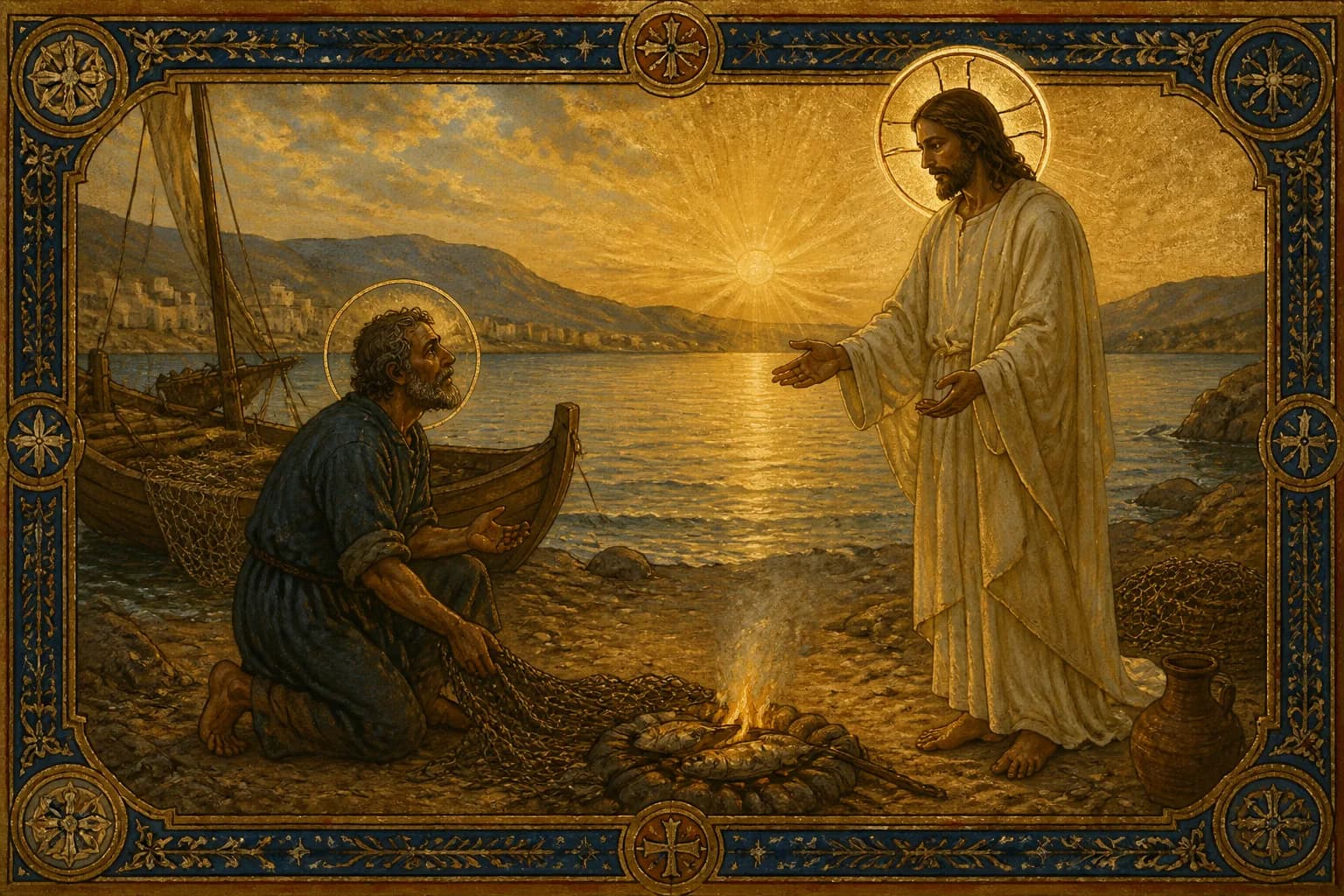
A charcoal fire is burning on the lake shore in the cool of the dawn. The men climbing out of the fishing boat are tired from a night that produced nothing until a stranger on the beach told them to throw the net to the other side of the boat and they pulled in a hundred and fifty-three large fish. The stranger has bread and fish ready on the fire. They recognize him now: it is the same man they had seen die two weeks earlier on a Roman cross in Jerusalem. After breakfast, the stranger draws one of them — the impulsive one, the one who had wept bitterly two weeks earlier in a high priest's courtyard — aside, and asks him a question. He will ask it three times. Three is not a coincidence. Three weeks before, beside another charcoal fire, this same man had denied knowing him three times. Now the asking is undoing the denying.
The Denial: Three Stories in One
The denial of Peter is told by all four Gospels — Matthew 26:69–75, Mark 14:66–72, Luke 22:54–62, and John 18:15–18, 25–27 — which is itself unusual. Most events in the Passion appear in only some of the Gospels. Peter's failure was apparently too important to leave out anywhere.
The setting is the courtyard of the high priest's house in Jerusalem on the night Jesus is interrogated by Annas and Caiaphas. Peter has followed from a distance — the phrase is in three of the four Gospels. He gets into the courtyard, where servants and soldiers are warming themselves around a fire. John uses the specific word anthrakian — a charcoal fire, the same Greek word he will use again only in chapter 21 by the lake.
The three denials follow in quick succession.
- A servant girl at the gate asks Peter whether he is one of the disciples. He says, I am not.
- He moves nearer the fire. Another servant identifies him. He denies again.
- A bystander says: surely you are one of them, your accent gives you away — Peter's Galilean dialect was apparently noticeable in Jerusalem. He denies a third time, with cursing.
The rooster crows. Luke adds the detail that breaks every reader: and the Lord turned and looked at Peter. Jesus, being led from one part of the high priest's complex to another, makes eye contact with his most senior disciple at the moment of the third denial. Peter goes out and weeps bitterly.
The Charcoal Fire on the Shore
The fourth Gospel is the only one to tell the restoration scene. It is in John 21, the chapter widely held to be either an epilogue by John himself or an early addition by his community. It is one of the most carefully constructed passages in the New Testament.
After the Resurrection, after appearances in Jerusalem, the disciples have returned to Galilee. Peter, characteristically, says: I'm going fishing. The others go with him. They fish all night without catching anything.
At dawn a man calls out from the shore. He asks if they have any fish, then tells them to cast the net on the right side of the boat. The catch is so large they cannot haul it in. John, the beloved disciple, recognizes first. He says to Peter: It is the Lord. Peter, characteristically, puts on his outer cloak (he had been fishing nearly naked) and jumps into the water rather than wait for the boat.
On the shore is a charcoal fire — John uses the same word, anthrakian, as in the courtyard scene. Bread is ready. Fish are cooking. The risen Lord has prepared breakfast for his disciples after their night of unsuccessful work.
The text is precise about details that matter. The same kind of fire. The same disciple who had failed before standing in front of it again. The same Lord — now risen — present.
"Simon, Son of John, Do You Love Me?"
After they have eaten, Jesus turns to Peter and asks him three questions, each one matching one of the three denials. The Greek of John 21:15–17 plays on a distinction between two verbs for love — agapaō and phileō — that Greek-speaking readers have debated for centuries.
The exchange runs:
- Jesus: Simon, son of John, do you love me (agapas) more than these? Peter: Yes, Lord, you know that I love you (philō). Jesus: Feed my lambs.
- Jesus: Simon, son of John, do you love me (agapas)? Peter: Yes, Lord, you know that I love you (philō). Jesus: Tend my sheep.
- Jesus: Simon, son of John, do you love me (phileis)? Peter, grieved that he asked a third time: Lord, you know all things; you know that I love you (philō). Jesus: Feed my sheep.
The interpretation of the verb shift has occupied commentators since the Greek Fathers. The two most defensible readings:
The first reading holds that the difference between agapaō and phileō in this passage is rhetorically meaningful — Jesus is asking for a higher love (agapē) and Peter is offering the lower love (philia) he is honest enough to claim. In the third question, Jesus meets Peter where he is and uses phileō himself.
The second reading, supported by many modern Greek scholars, holds that John uses the two verbs interchangeably elsewhere and that the shift is stylistic rather than theological. The triple structure is the load-bearing element, matching the triple denial. Peter is being given the opportunity to undo what he did beside the fire in Jerusalem.
Both readings agree on the larger meaning: the threefold restoration repairs the threefold denial without explicitly naming it. Jesus does not say I forgive you for denying me three times. He asks Peter three times if he loves him and three times entrusts Peter with the care of his sheep.
The Threefold Charge
Each affirmation is followed by a charge. The Greek verbs and nouns vary slightly:
- Feed (boske) my lambs (arnia)
- Tend (poimaine) my sheep (probata)
- Feed (boske) my sheep (probata)
The variations have been read by Catholic tradition as a comprehensive commissioning — Peter is to feed and to tend, to care for the lambs and the sheep, the young and the mature. The pastoral office is given to him in full.
This is the textual foundation of what Catholic tradition calls the Petrine primacy — the special authority given to Peter and, by succession, to the bishops of Rome. The other apostles are present. The risen Lord addresses Peter alone. The charge is universal: my sheep — all of them.
The site of this exchange, on the northwest shore of the Sea of Galilee at what is now called Tabgha, has been a pilgrimage destination since the fourth century. The Church of the Primacy of Saint Peter, a modest Franciscan chapel built in 1933 on Byzantine foundations, marks the traditional location. The flat rock at the center of the chapel — the Mensa Christi, the Table of Christ — is identified with the breakfast scene. Pilgrims who visit can stand on the rocks at the water's edge and read John 21 there. The shoreline is largely unchanged.
What Jesus Predicts at the End
Jesus does not leave the restoration only as forgiveness. He extends Peter's commissioning forward in time. When you were young you used to dress yourself and walk where you wanted. When you grow old, you will stretch out your hands and someone else will dress you and carry you where you do not want to go. John adds in the next verse: This he said to indicate the kind of death by which Peter would glorify God.
Catholic tradition has read this as the prophecy of Peter's martyrdom. By the most reliable second-century sources (Clement of Rome's letter to the Corinthians, written c. 96 AD; Tacitus's account of the Neronian persecution; Eusebius's Ecclesiastical History), Peter was crucified in Rome during the persecution under Nero, around 64 or 67 AD. Origen and other early sources add that Peter, requesting that he not be crucified in the same posture as his Lord, was crucified upside down. The tradition has been consistent.
The remains traditionally identified as Peter's bones were found beneath the high altar of Saint Peter's Basilica during the excavations of the 1940s and 1950s under Pius XII and authenticated, after extensive scientific and historical examination, by Paul VI in 1968. The Vatican's official summary of the archaeological evidence describes the dating and forensic work.
Why the Restoration Matters
Peter's denial and restoration is one of the load-bearing pastoral stories of the New Testament. It is the proof, written into the Church's earliest scriptures, that the failure of the leader does not disqualify the leader, provided the leader is willing to be restored.
Peter goes from the cowardice of a high priest's courtyard to the death of a martyr at the hands of Nero. The path runs through breakfast on a beach. The Lord does not pretend the denial did not happen. He also does not require Peter to grovel. He asks him three times, in the simplest possible form, whether he loves him. Peter's answer each time is yes. The yes is enough.
For broader context on how the disciples were transformed by the Resurrection, see Mary Magdalene at the empty tomb and Paul on the road to Damascus. Each story is a different mode of resurrection encounter — the woman who weeps and is the first witness, the persecutor blinded into apostleship, and the cowardly leader fed breakfast on a beach.
The threefold question is also a pattern Catholic spiritual direction has used for centuries. The penitent is asked, not whether his sin can be undone (it cannot), but whether he loves the Lord he failed. The answer is the threshold. Everything else follows from it.
The Tabgha Site Today
Tabgha is a few minutes' drive from Capernaum. The Church of the Primacy is open to pilgrims; the Mensa Christi rock is in the floor of the chapel; the shore is just outside. Across a short footpath is the Church of the Multiplication of the Loaves and Fishes, marking the site of the feeding of the five thousand from earlier in Jesus's Galilean ministry. The two episodes happen on the same shore — bread for the crowds, and later, after the cross, bread for the disciples who failed.
It is a small site. It does not draw the volume of Lourdes or the Basilica of Guadalupe. It rewards the pilgrim who arrives expecting to read John 21 with the water in view.
Listen to Saint Peter on Crucis Lux
Crucis Lux tells the story of Peter's denial and restoration as a slow-paced, illustrated audio series — every scene narrated, every panel illustrated in the style of medieval frescoes, in five languages.