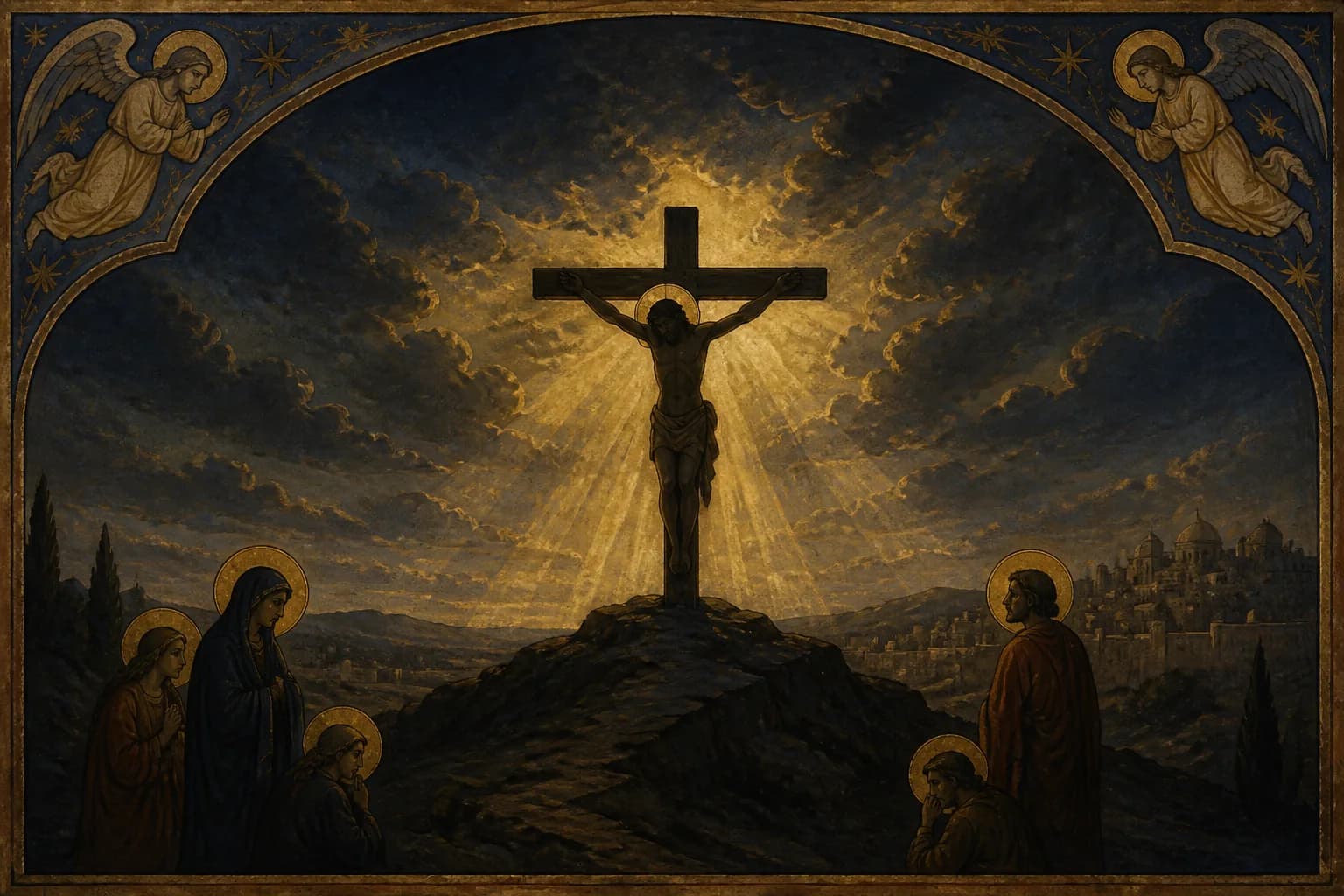
A man is dying by inches in the heat of the afternoon outside Jerusalem. Crucifixion was designed to silence its victims — the chest cavity collapses, the diaphragm fails, breath becomes the most expensive thing in the world. And yet between the third hour and the ninth hour, Jesus of Nazareth speaks seven times. The Seven Last Words of Christ are not seven essays. They are gasps. Each one costs him.
The seven words (more accurately, seven sayings) are not all recorded by any single Gospel. They are harmonized from Matthew, Mark, Luke, and John. The Catholic tradition of the Tre Ore — the three-hour Good Friday devotion meditating on each saying — dates to a Peruvian Jesuit, Alonso Messía, around 1687, and spread across the Catholic world from there.
"Father, forgive them, for they do not know what they are doing." (Luke 23:34)
This is almost certainly the first word, spoken as the soldiers nail him to the cross. The textual tradition is interesting — some early manuscripts of Luke omit the verse, which has led some scholars to argue it was added later. The mainstream Catholic tradition, however, has received it as authentic and central.
The prayer is shocking on its face. Roman soldiers carrying out a state execution are not obvious candidates for divine forgiveness. Jesus does not pray for them to be excused. He prays that God will not hold against them what they cannot yet see. The plea is for the executioners and, by extension, the crowd, the leaders, and everyone implicated in the moment — which is to say, all of us.
Saint Augustine read this prayer as the seed of the Church: the first act of intercession by the High Priest on the altar of the Cross.
"Truly I tell you, today you will be with me in paradise." (Luke 23:43)
Two criminals are crucified beside him. One mocks. The other — tradition calls him Saint Dismas, the Good Thief — rebukes the first and turns to Jesus: "Remember me when you come into your kingdom."
The answer is immediate. Not one day. Not if you complete certain conditions. Today. The Greek word is paradeisos, a Persian loan-word meaning a walled garden — the language of Eden restored.
Catholic tradition has cherished this saying for a specific theological reason: it is the clearest scriptural ground for the doctrine that a single sincere act of repentance, even at the very end, can save. The Good Thief had no time for sacraments, no time to make restitution, no time to do anything except believe and ask. It was enough.
"Woman, behold your son. Behold your mother." (John 19:26–27)
Below the cross stand four women — Mary the mother of Jesus, her sister, Mary the wife of Clopas, and Mary Magdalene — and one disciple, the one Jesus loved, traditionally identified as John.
Jesus addresses his mother as Woman. The form sounds cold in English; it is not. He used the same address at Cana, at the start of his ministry. Catholic tradition reads it as deliberately echoing Genesis 3:15 — "I will put enmity between you and the woman" — making Mary the new Eve.
Then he gives her to John and gives John to her. On the surface, a practical arrangement: a dying son providing for a widowed mother. The Church Fathers, however, read more in it. From the cross, Christ entrusts his mother to the beloved disciple as a representative of every disciple. Mary becomes mother of the Church.
"My God, my God, why have you forsaken me?" (Matthew 27:46 / Mark 15:34)
In Aramaic: Eloi, Eloi, lema sabachthani. Some onlookers misheard and thought he was calling for Elijah.
This is the most theologically difficult of the seven sayings. How can the Son of God, eternally one with the Father, be forsaken? The Church Fathers wrestled with it. The standard Catholic reading, taught from Augustine through Thomas Aquinas, is that Jesus is praying the opening line of Psalm 22 — a psalm that begins in anguish but ends in vindication and the praise of God by all the nations. To pray the first verse of a known psalm in ancient Judaism was to invoke the whole psalm. Read Psalm 22 from end to end and the cry sounds different.
It is also a real cry. Jesus is genuinely experiencing the abandonment that human suffering feels like. He does not perform the cry; he means it. And by meaning it, he sanctifies every honest cry of every person who has ever felt forsaken.
"I thirst." (John 19:28)
The fifth saying is one of the shortest and most physical. After hours on the cross — likely deeply dehydrated, in shock, near death — Jesus says I thirst. A soldier soaks a sponge in posca, the cheap sour wine of the Roman army, lifts it on a hyssop branch, and offers it to his mouth.
John adds that this happened so that the Scripture might be fulfilled — a reference to Psalm 69:21, "for my thirst they gave me vinegar to drink." But the cry is not staged for symbolism. It is a real man dying of real thirst.
Mother Teresa of Calcutta built her entire spirituality around this saying. I thirst is written above the crucifix in every Missionaries of Charity chapel in the world. For her, it was the thirst of Christ for souls — and the thirst of the poorest of the poor in whom Christ is found. The connection runs from Calvary to the dying in Kalighat.
"It is finished." (John 19:30)
In Greek: Tetelestai. One word. A perfect-tense verb meaning it has been brought to completion and it stands completed.
The word was stamped on receipts in the Roman world to mean paid in full. Soldiers used it when a campaign objective was achieved. Tetelestai is not the gasp of a man who has given up. It is the report of a mission accomplished.
Everything the Old Testament gestured toward — the Passover lamb, the bronze serpent, the suffering servant of Isaiah 53, the scapegoat of Yom Kippur — converges and is finished here. The work the Father gave the Son to do is done.
"Father, into your hands I commit my spirit." (Luke 23:46)
The seventh and final word. Jesus quotes Psalm 31:5, the prayer pious Jews said as they fell asleep — the Jewish equivalent of now I lay me down to sleep. He prays it as a dying man, and he adds one word the psalm does not have: Father.
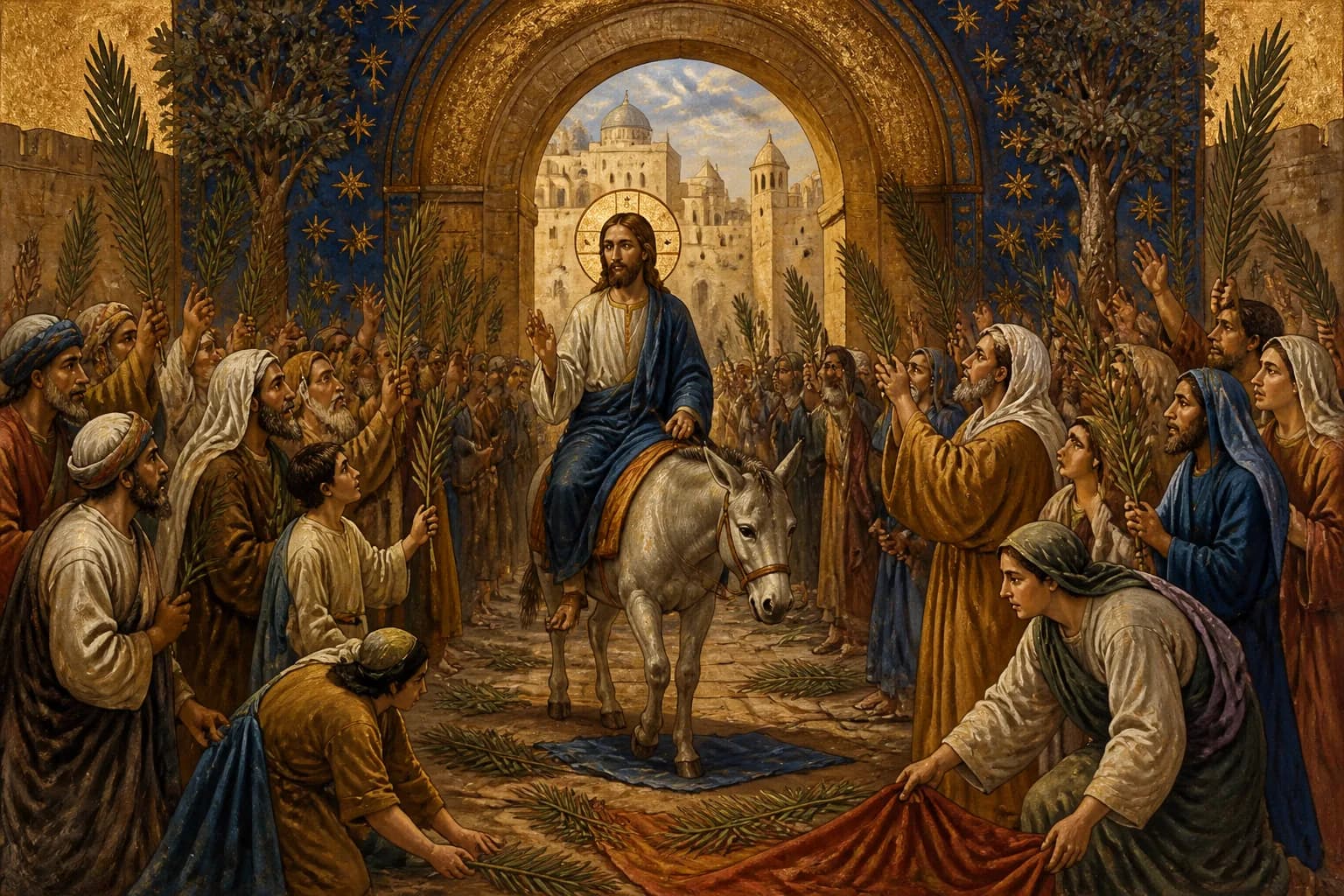
He had begun on Palm Sunday by entering Jerusalem as a king. He had ended the night before in Gethsemane asking the Father if the cup could pass. Now, at the end, he addresses his Father once more and commits himself entirely. The Gospel says he "breathed his last." John says he "bowed his head and handed over the spirit" — the verb is active, deliberate. He does not lose his life. He gives it.
The Order and the Sources
The seven sayings, in the order traditional since the patristic era, are drawn from three Gospels (Mark and Matthew share the fourth word):
- Father, forgive them — Luke
- Today you will be with me in paradise — Luke
- Woman, behold your son — John
- My God, my God, why have you forsaken me? — Matthew and Mark
- I thirst — John
- It is finished — John
- Father, into your hands I commit my spirit — Luke
The harmonization is ancient and well-established. No single Gospel was attempting to record all seven; each evangelist preserved what served his theological purpose.
How Catholics Pray the Tre Ore
The Tre Ore — the three-hour devotion held from noon to 3 p.m. on Good Friday — meditates on the seven sayings in sequence, often with a homily on each one, alternating with hymns and silence. Joseph Haydn wrote his great chamber work The Seven Last Words of Our Saviour on the Cross for this devotion in 1786. César Franck and Théodore Dubois followed in the nineteenth century.
The devotion does not require music. It can be prayed alone with a Bible and a crucifix. Read the seven sayings in their Gospel contexts. Let each one stand. Don't rush. The point is to sit beneath the cross long enough to hear what the dying man is saying — to his Father, to his mother, to the thief, to the soldier, and to anyone willing to listen across two thousand years. The story is also told from Peter's perspective and from Mary Magdalene's, and each angle deepens the others.
Listen to the Passion on Crucis Lux
Crucis Lux tells the story of the Passion of Christ and the Seven Last Words as a slow-paced, illustrated audio series — every saying narrated in context, every panel illustrated in the style of medieval frescoes, in five languages.