
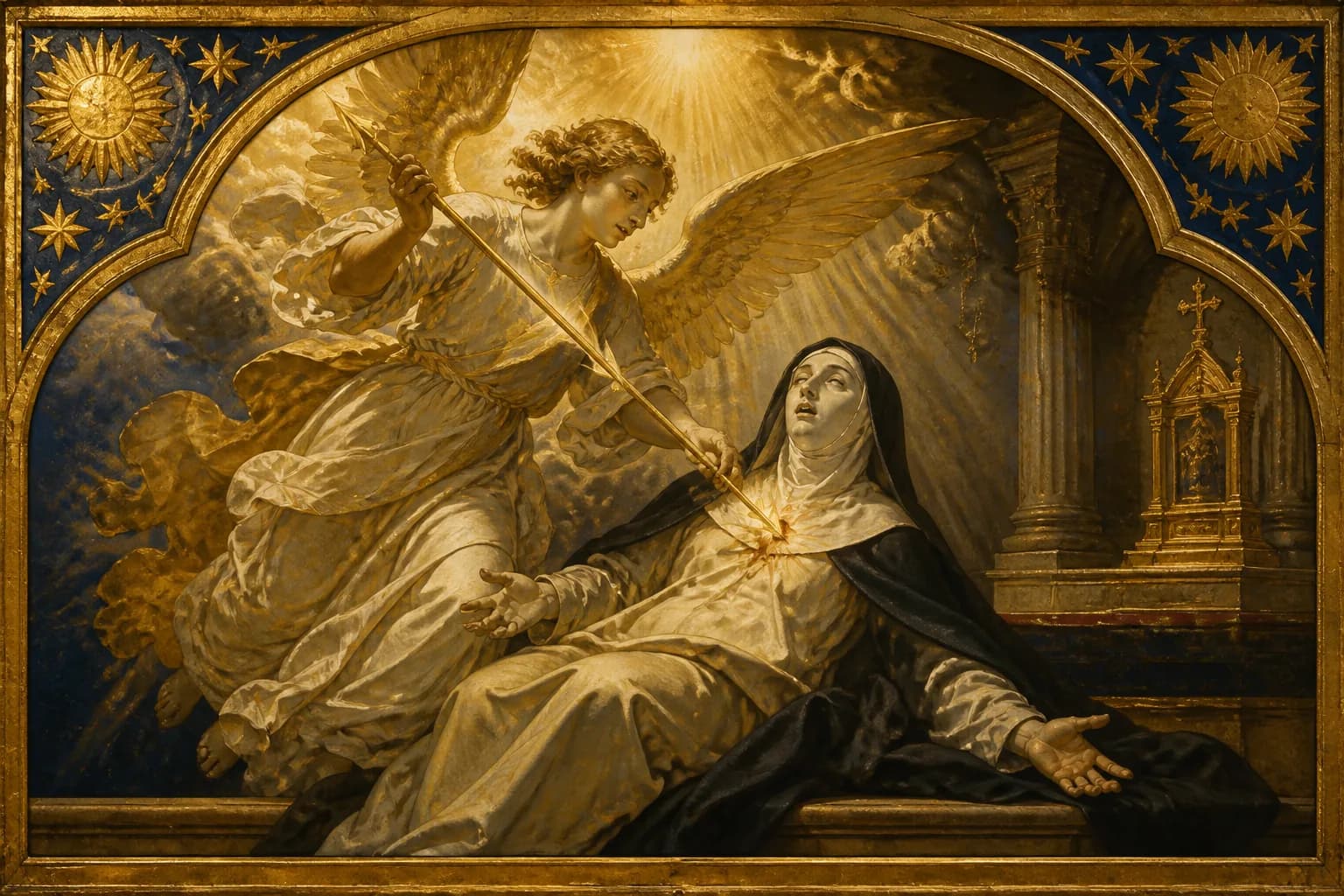
She was a Carmelite nun in her early forties, fully professed for half her life, living in the Monastery of the Incarnation in Ávila in central Castile, when she had the experience that would later be carved into white marble in a side chapel of a Roman church and would define, for the next four centuries, how the Western imagination pictured Catholic mysticism. The experience itself — what she calls the transverberación — lasted only a few minutes. She refused to describe it for years. When she finally wrote it down in her Life, she did so under obedience, in plain Castilian prose, with the embarrassed precision of a woman trying to be honest about something almost impossible to say.
The Carmelite from Ávila
Teresa de Cepeda y Ahumada was born March 28, 1515, in Ávila, the high walled city in old Castile, to a family of converso descent — her grandfather, Juan Sánchez de Toledo, had been reconciled to the Catholic Church after a Jewish background uncovered by the Spanish Inquisition. Her father, Don Alonso, was a pious Catholic who hid his family's converso roots and rose into the lower nobility. Teresa was the third child of his second marriage.
She was extroverted, charming, restless. At seven she ran away from home with her younger brother Rodrigo, intending to be martyred by the Moors in North Africa. An uncle caught them outside the city walls and brought them home. At sixteen, after her mother's death, her father sent her to be educated in an Augustinian convent in Ávila. At twenty she entered the Carmelite Monastery of the Incarnation against her father's wishes.
The Incarnation in those years was not a strict house. The Carmelite Order in sixteenth-century Spain had become genteel; the monastery had close to two hundred nuns, parlors where visitors came for hours of conversation, and a relatively comfortable life. Teresa spent twenty years there in what she later described as a divided state — devoted enough to pray, worldly enough to find prayer impossible for long.
A serious illness around age twenty-three left her partially paralyzed for three years. She recovered slowly. Her interior life began to deepen only in her late thirties and early forties, in the years immediately before the transverberation.
What She Wrote
The account of the transverberation is in Chapter 29 of the Libro de la Vida, the Book of Her Life, written between 1562 and 1565 under the order of her Dominican confessor, García de Toledo. The book is not a strict autobiography; it is, in form, a confessional examination of her interior life submitted to her spiritual directors for evaluation. Teresa was always aware that she was being read by men with the authority to suppress what she wrote — or worse, to refer it to the Inquisition. She wrote with a working theologian's discipline about her own experience.
The passage runs as follows, in summary of Teresa's own description.
She saw beside her, on her left, a small angel in bodily form. He was beautiful — fire on his face. She understood without being told that he was one of the highest orders of angels, what tradition calls a cherub. He held a long golden dart, with a small flame at its tip. He plunged the dart into her heart, several times, and drew it back so that her entrails seemed to come with it. The pain was so sharp she moaned aloud. The sweetness in the pain was so excessive she did not want it to end. It is not a bodily pain, she clarifies, but spiritual, although the body shares in it — even considerably.
When the angel withdrew, she was left aflame with love of God.
Teresa is careful with the language. She uses transverberación in Spanish — meaning pierced through — to distinguish what happened from a vision merely seen or a wound merely felt. She also distinguishes the experience from anything sexual, anything imagined, or anything induced. She says, plainly: this was not something I sought, it was not something I expected, and it left me physically and spiritually changed.
After her death in 1582, when her body was prepared for burial, the postmortem examination of her heart found a deep linear scar or tear — a cisura — running through it. The heart itself, preserved as a relic, is on display at the Carmelite convent in Alba de Tormes, where Teresa died. The relic has been examined by physicians several times over four centuries. The scar is real and visible.
What the Catholic Tradition Calls Mystical Theology
The transverberation belongs to a category Catholic mystical theology has named precisely. The standard sources — John of the Cross, who was Teresa's collaborator in the reform of the Carmelites; later writers like John of St. Thomas and, in the twentieth century, Reginald Garrigou-Lagrange — distinguish between infused contemplation (a passive gift of God to a soul prepared for it) and acquired prayer (the work of the person disposed to receive grace).
Within infused contemplation, the tradition recognizes phenomena like locutions (interior voices), visions (intellectual or imaginative), raptures, and ecstasies. Some of these are sensible — perceived through bodily senses or imagination. Some are purely intellectual. Some leave bodily marks. Stigmata is one example; transverberation is another. The Church treats these phenomena as charisms — gifts given for the building up of the Church and the sanctification of the recipient, not as proofs of holiness in themselves.
Teresa's own Interior Castle, written in 1577, is the most systematic treatise on these matters by any saint of the Catholic mystical tradition. The book maps the soul as a series of seven dwelling places, with the transverberation belonging to the sixth dwelling place — close to but not yet at the spiritual marriage that is the seventh and innermost.
Bernini, the Cornaro Chapel, and the Image That Took Over
In 1647, sixty-five years after Teresa's death and twenty-five years after her canonization, the Venetian Cardinal Federico Cornaro commissioned Gian Lorenzo Bernini to design his family chapel in Santa Maria della Vittoria in Rome. The chapel was to honor Teresa, whose Discalced Carmelite reform had spread across Catholic Europe.
Bernini's design is one of the most theatrical works of Baroque art. The chapel is staged like a theater: members of the Cornaro family, sculpted in marble in lifelike postures, sit in box seats on either side of the central niche. At the center, in white Carrara marble, is the Ecstasy of Saint Teresa — Teresa fainting backward on a cloud, an angel raising the golden dart, gilded bronze rays descending from a hidden window above to illuminate the scene with real daylight.
The piece was finished in 1652 and has been one of the most photographed sculptures in the world for three and a half centuries.
It has also been one of the most misread. The Bernini image, with Teresa's face slack in what looks like erotic abandon, has invited generations of secular commentators — Jacques Lacan most famously in the 1970s — to read the transverberation as a thinly disguised orgasm. The reading is not new; it was already being made in the eighteenth century. The reading is also, by Teresa's own explicit testimony and by the broader logic of Catholic mystical theology, wrong as a description of what was happening to her.
Teresa knew the body. She knew sexual love by the description of others (she had a youthful flirtation with a cousin around fifteen, before entering the convent, that she never repeated). When she said the transverberation was not bodily pleasure, she meant it. The body, she wrote, participates in spiritual ecstasy because the human person is body and soul together — but the source of the experience is not erotic.
Bernini's sculpture is doing something more sophisticated than its critics realize. It is depicting, in marble, the union of body and spirit at the moment of grace — and depicting it precisely as the female body in extremis can sometimes mirror what mystical experience does to a person. Bernini is showing the body as a sign of the soul, not a substitute for it. That is more difficult to convey than a parody.
Teresa as Doctor of the Church
Teresa was canonized in 1622 alongside Ignatius of Loyola, Francis Xavier, Philip Neri, and Isidore the Farmer. In 1970, Pope Paul VI declared her a Doctor of the Church — only the second woman in history to receive the title (the first was Catherine of Siena, declared the same year). The declaration formally recognizes her writings as authoritative theological exposition of the Catholic faith, with universal value for the Church.
Teresa's principal writings are:
- The Life (Libro de la Vida) — 1562–1565
- The Way of Perfection (Camino de Perfección) — 1566, for her novices
- The Foundations (Libro de las Fundaciones) — 1573 onward, the history of the houses she founded
- The Interior Castle (Castillo Interior) — 1577, the mature systematic mystical theology
She and John of the Cross together founded the Discalced Carmelite reform, splitting from the unreformed Carmelites in 1568 and establishing what would become the most influential contemplative order of the Spanish Golden Age. By her death in 1582, she had founded seventeen reformed convents and overseen the establishment of two reformed friaries with John of the Cross.
For context on other Catholic mystics whose interior experiences were marked physically, see Saint Francis at La Verna in 1224 and Padre Pio at San Giovanni Rotondo. Teresa's transverberation is the mystical event without external blood — the inward wound that becomes a permanent state of soul.
What the Experience Was For
Teresa is consistent across her writings on this point. The transverberation was not a reward, not a confirmation, not a sign for outsiders. It was a step in the long preparation by which God drew her into deeper union. After the transverberation she was the same woman with the same temperament and the same exhausting workload — founding convents, riding mules across central Spain in her sixties, writing letters, dealing with bishops, defending her sisters against the Inquisition.
She wrote about the experience because her confessors required her to. She would have preferred to keep it silent. What she said about it has shaped four centuries of Catholic prayer.
The Vatican's archive of her canonization documents preserves the testimony of her sisters in religion about her life. The most important testimony, however, is in her own books, in print continuously since 1588, translated into every major language. The transverberation is in there. Anyone can read it.
Listen to Teresa of Ávila on Crucis Lux
Crucis Lux tells the story of Teresa of Ávila and the transverberation as a slow-paced, illustrated audio series — every scene narrated, every panel illustrated in the style of medieval frescoes, in five languages.