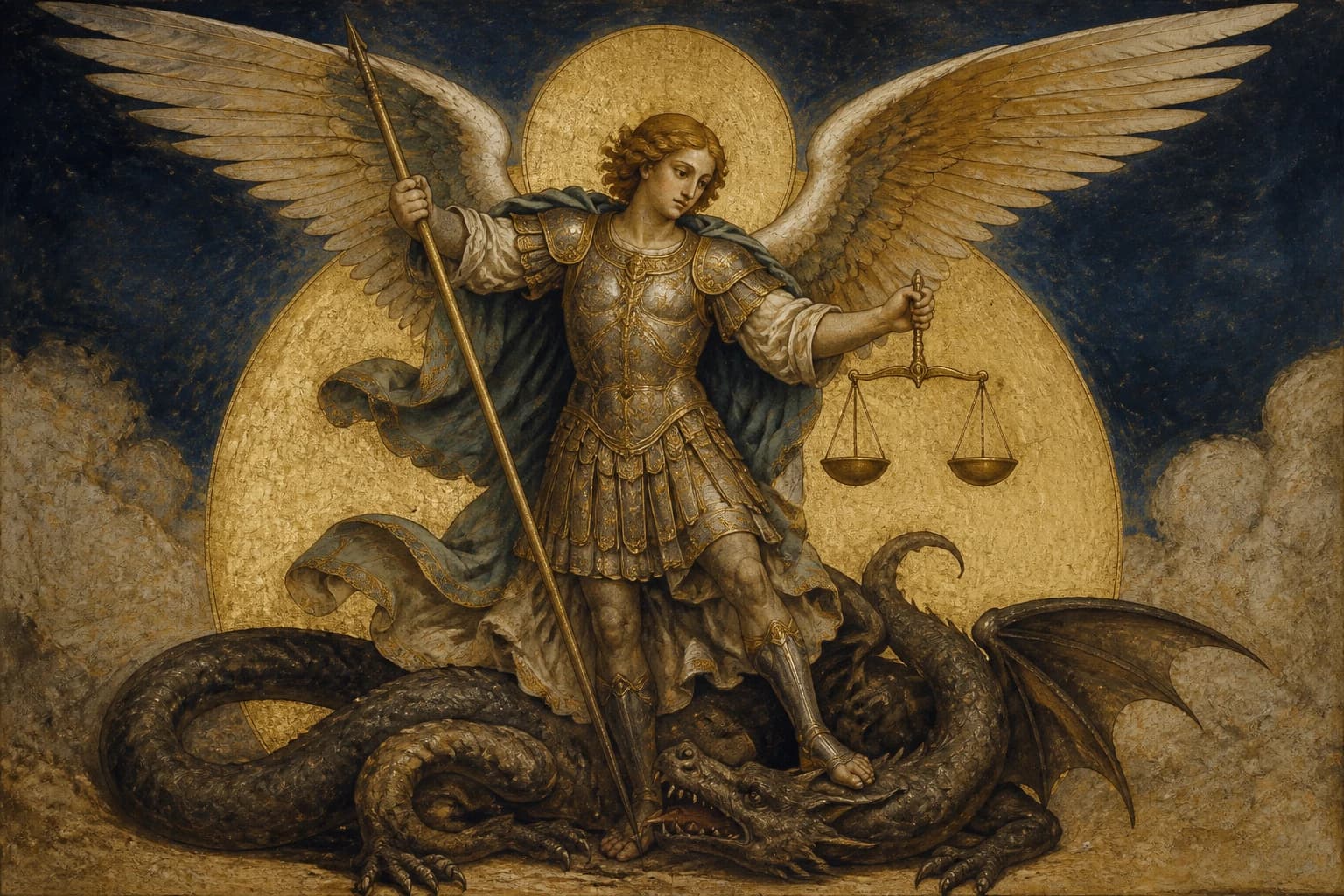
Few Catholic prayers have travelled as far on so few words. The prayer to Saint Michael the Archangel is short enough to learn in a single reading, old enough to have been said after Mass by two or three generations of Catholics, and specific enough that people who pray almost nothing else still know it by heart. This is what it says, where it came from, and what is and is not true about its origin.
The prayer
Saint Michael the Archangel, defend us in battle. Be our protection against the wickedness and snares of the devil. May God rebuke him, we humbly pray; and do thou, O Prince of the heavenly host, by the power of God, cast into hell Satan and all the evil spirits who prowl about the world seeking the ruin of souls. Amen.
Note what the prayer does not do. It does not address the devil, argue with him, or claim any authority over him. Every operative verb is directed to God or asks Michael to act by the power of God. That restraint is deliberate and is the reason the prayer sits comfortably in ordinary Catholic devotion rather than in the specialised territory of exorcism, which is reserved to priests with a bishop's mandate.
Who Michael is in Scripture
Michael is named four times in the Bible, and the picture is consistent.
In Daniel 10 and 12, he is "one of the chief princes" who comes to the prophet's aid, and "the great prince who has charge of your people" — an angel with a national and protective role rather than a merely personal one.
In the Letter of Jude, verse 9, there is a strange and restrained scene: Michael, disputing with the devil over the body of Moses, "did not presume to pronounce a blasphemous judgment, but said, 'The Lord rebuke you.'" That line is the direct source of "May God rebuke him" in the prayer. Michael does not out-argue the devil; he defers to God.
In Revelation 12, "Michael and his angels fought against the dragon" and the dragon was thrown down. This is the scene Western art almost always paints: armour, sword or spear, the serpent underfoot, the scales of judgment sometimes held in the other hand.
His name is itself a question — Mi-ka-el, "Who is like God?" — and it is asked rhetorically, as a refusal of any rival claim.
Where the prayer came from
Pope Leo XIII composed the prayer and in 1886 ordered it added to the Leonine Prayers, a short set of prayers said by the priest and people in the vernacular after Low Mass. The original context was political as much as spiritual: the papacy had lost the Papal States in 1870, and the prayers were tied to the "liberty and exaltation of Holy Mother Church."
For nearly eighty years, ordinary Catholics said this prayer after nearly every weekday Mass. The Leonine Prayers were suppressed in 1964 as part of the liturgical reforms — which is why the prayer skipped a generation, and why many people first learned it from grandparents rather than from a parish. In recent decades a large number of parishes and dioceses have restored it voluntarily after Mass, and John Paul II encouraged its private use in 1994.
About that vision
You will often read that Leo XIII wrote the prayer immediately after collapsing at the altar, having heard a conversation between Christ and Satan in which Satan was granted a century to test the Church. It is a gripping story. It is also unverified.
The account does not appear in any contemporary document from 1886. It surfaces decades later, in several mutually inconsistent versions, some of which relocate the event to a different year or a different room. Historians who have looked for a primary source have not found one. The honest position is the modest one: the prayer is documented, the vision is not. Nothing about the prayer's value depends on the legend, and repeating the legend as fact costs credibility that the prayer itself does not need.
How the prayer is used
- After Mass. The most common use — recited kneeling or standing with the congregation once the liturgy has ended.
- At the end of the Rosary. Many people add it after the Hail Holy Queen, particularly where the Fátima prayers are already customary. If you are learning the Rosary, our step-by-step guide shows where it fits.
- At a threshold. Some pray it entering a hospital, a courtroom, a difficult meeting, or their own front door at the end of a bad day.
- In the morning. Paired with the Guardian Angel prayer, it is a thirty-second start to the day; see what the Church actually teaches about guardian angels.
There is also the Chaplet of Saint Michael, a longer devotion of nine salutations, one for each choir of angels, each followed by an Our Father and three Hail Marys. It is prayed on a dedicated chaplet and is a natural next step for anyone who wants more than the short prayer.
Michaelmas, September 29
September 29 was historically the feast of the dedication of a Roman basilica of Saint Michael. In the 1969 revision of the calendar it became a single feast of the three archangels named in Scripture: Michael, Gabriel and Raphael. In England the day gave its name to Michaelmas — a quarter day when rents were paid and terms began, which is why some universities still call their autumn term the Michaelmas term.
It is the natural day to learn the prayer if you don't know it. It takes about a minute, and it has kept its place in Catholic life for a century and a half on the strength of one restrained sentence: May God rebuke him.