Some spiritual books can be read in an afternoon; others take years. The Interior Castle belongs to the second kind, and most of the difficulty is not the doctrine but the floor plan: seven dwelling places nested inside one another, and a modern reader who opens the book halfway through with no idea which room he has landed in. What follows is the plan of the building — what the book is, what happens in each dwelling, what Teresa means by "prayer" at each stage, and how to read it today without getting lost.
What the book is, and why it exists
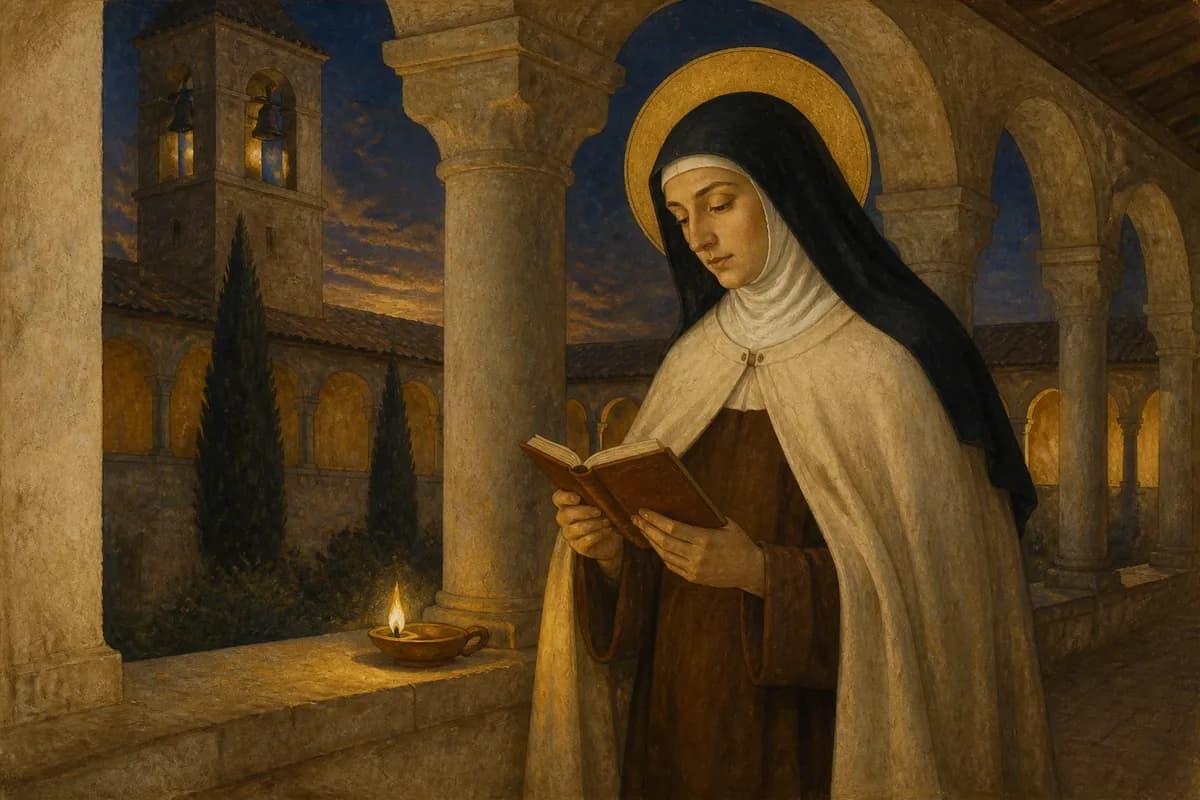
Teresa de Cepeda y Ahumada (1515–1582) — Teresa of Jesus in religion — wrote The Interior Castle, known in Spanish as Las Moradas, in 1577. She began it in Toledo in June and finished it in Ávila before the year was out, with a long interruption for travel and the business of the reform. She was sixty-two, in the hardest years of the Carmelite reform, with her Discalced foundations under suspicion and herself under scrutiny.
She did not write on her own initiative. She wrote under obedience, at the request of her superiors and confessors — the idea is usually credited to Fr Jerónimo Gracián — and there was a concrete reason behind the request. Her Book of Her Life, where she had already described her interior experience, was at that moment in the hands of the Inquisition, and her nuns could not read it. She was asked to set out the same doctrine another way.
Teresa did something cleverer than repeat herself: she changed grammatical person. Where the Life says "this happened to me," The Interior Castle says "this is what happens to the soul." A confession submitted for examination became a treatise. It was printed at Salamanca in 1588, six years after her death, in the edition of her works prepared by Fray Luis de León.
The image: a castle of crystal
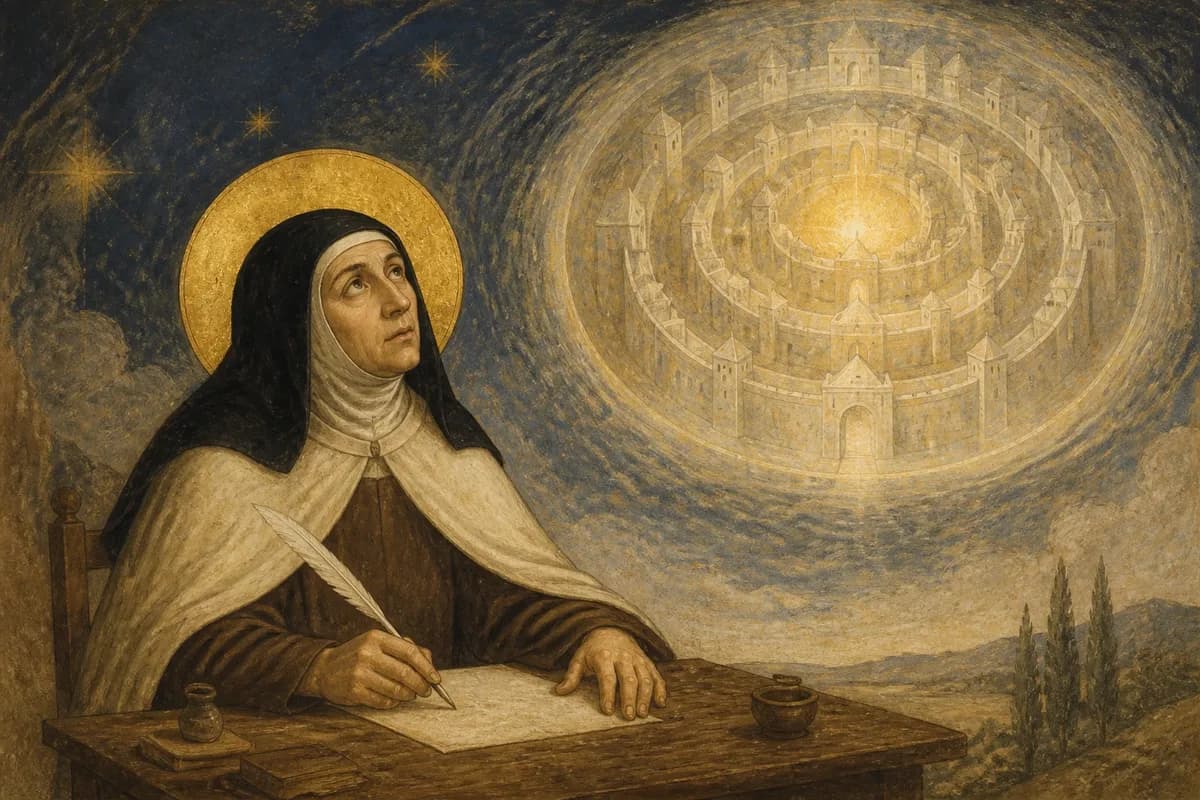
The governing image arrives in the first lines. Teresa asks us to consider the soul as a castle made of a single diamond or of very clear crystal, containing many rooms, just as in heaven there are many dwelling places. In the innermost room dwells the King.
Three features of that image carry the whole book.
First, the movement is inward, not upward: this is not a ladder of perfection with rungs left behind, but a building walked through. Second, the soul already is the castle — nobody has to construct a place for God to live in, because that place has been there since baptism, however dark and cluttered. Third, the mansions are not seven rooms: Teresa says plainly that each dwelling contains a great many, and that seven is a scheme for talking about it, not a room count.
The door in, she says, is prayer and reflection. A person who does not pray stays outside his own castle, like a cripple in the courtyard: the house is his, and he never enters it.
The first three dwelling places: what still depends on us
First dwelling places. The soul comes in. It is in a state of grace, it wants something, it prays occasionally — and its head is still full of business and worry, so the light from the centre barely reaches it. The proper work here is self-knowledge, which for Teresa is not melancholy introspection but humility. With a warning almost nobody remembers: stare at yourself indefinitely and the soul shrinks and takes fright; it must also go out and look at the greatness of God, like the bee leaving the hive to make honey.
Second dwelling places. Here the soul begins to hear the call — through sermons, reading, conversations, an illness, a loss. This, Teresa says, is the stage of hardest combat, because one now knows enough to be uncomfortable and has neither the habit nor the consolation yet. The virtue of these rooms is not devotion but determination: keep praying when prayer gives you nothing.
Third dwelling places. An ordered, devout, honest, charitable life. Many good people live and die here, and Teresa says so without contempt. But this is also where her prose turns sharpest, because the danger of this dwelling is self-satisfaction: the soul that has done everything right for years and then, in a dry spell or a humiliation, discovers it is not as surrendered as it thought. Prayer here is still substantially our own work — meditation, reading, examination — assisted by grace.
Fourth dwelling places: where the work changes hands
This is the hinge of the book. Teresa distinguishes consolations from spiritual delights. Consolations arise from our own activity: you meditate on a scene of the Passion, you are moved, and that is good. Delights are something else — they begin in God, and the soul receives them without being able to produce them.
She explains it with two water troughs: one filled by an aqueduct, with noise and engineering; the other filled directly from the spring at its own bottom, silently, until it overflows. The first is discursive prayer. The second is what she calls the prayer of recollection and the prayer of quiet.
The practical consequence is uncomfortable for any method-minded reader: no technique produces this. What is in our power is disposing ourselves — humility, detachment, fidelity — and not forcing. Teresa spends pages arguing against the strain of "thinking about nothing," which exhausts the head and leads nowhere.
Fifth dwelling places: the silkworm
The prayer of union. It is brief — half an hour would be a great deal, she says — and in it the faculties are as though suspended; the soul knows with certainty that it has been in God, though it cannot say how.
The image is the silkworm: it feeds, spins its cocoon, dies inside it, and comes out a small white butterfly. The cocoon, Teresa says, is Christ. What dies is the worm's former life.
And here she sets the test that makes this book more than a phenomenology of inner states. How do you know the union was real? Not by the sweetness felt, but by the effects: love of neighbour and the doing of God's will. A nun convinced she has risen very high who then treats her sisters badly has arrived nowhere.
Sixth dwelling places: the longest and the hardest
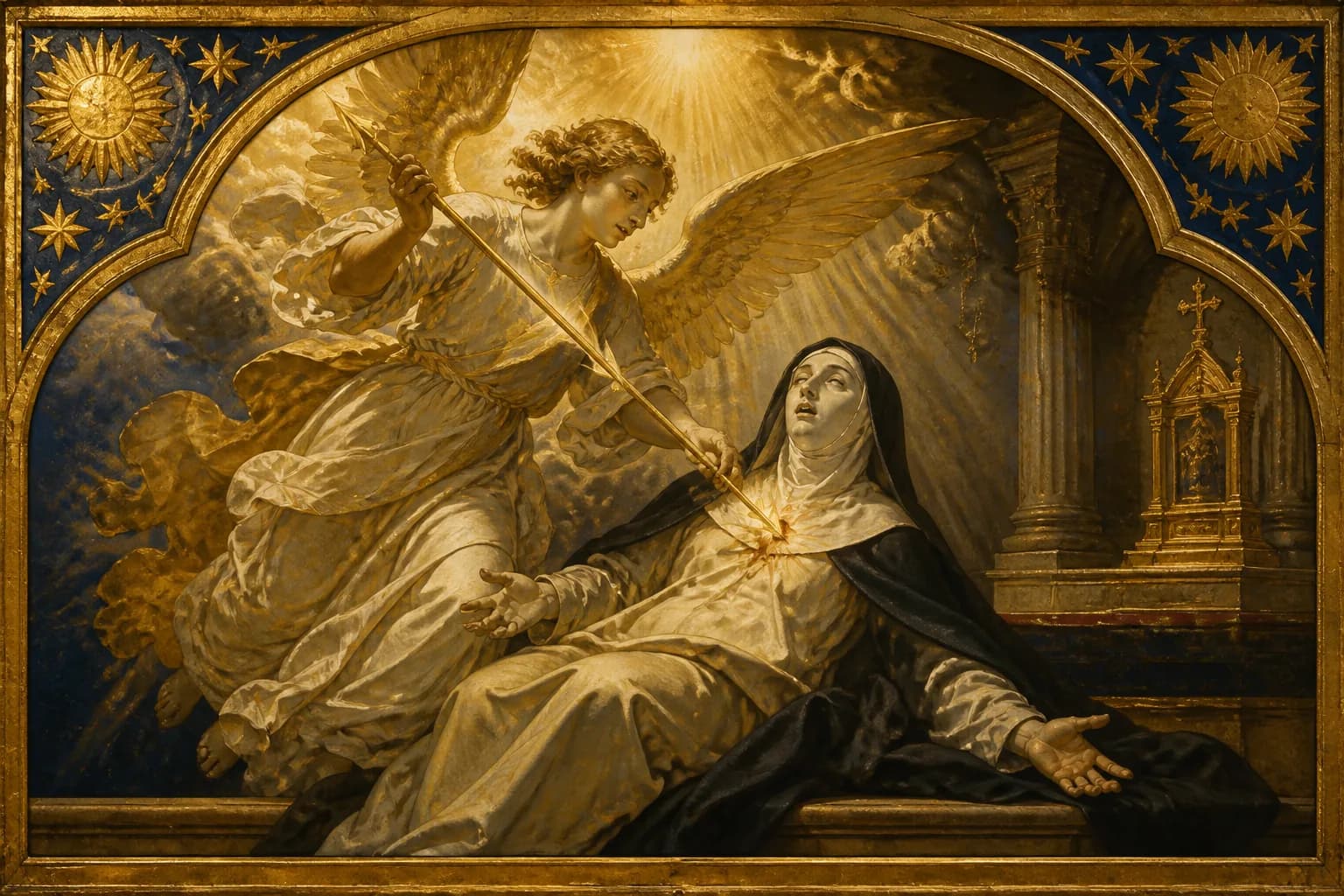
This is the longest section of the book and the one most often quoted out of context. It is the dwelling of spiritual betrothal, and in it Teresa describes, with something close to technical precision, the phenomena the tradition calls mystical: raptures, ecstasies, interior locutions, intellectual and imaginative visions, flight of the spirit, and the wound of love she herself knew and Bernini carved in marble a century later — we tell that story in the transverberation of Teresa of Ávila.
What is almost never quoted is the other half of these rooms: the trials. Gossip; praise, which she considers worse; long illnesses; confessors who advise the opposite; the fear of being deceived. Teresa treats all of it as seriously as the ecstasies.
And she leaves a rule that governs the whole book: never turn away from the humanity of Christ. Against those who advised leaving the meditation of Jesus' life behind to rise to something purer, she answers that this is how people lose the road — with the authority of someone who tried it and was wrong.
Seventh dwelling places: the centre
Spiritual marriage. Teresa describes it as a stable union, unlike the passing rapture: the faintings of the earlier stages subside, because the soul has become able to bear what it receives. She speaks of an intellectual vision of the Trinity, and of a peace at the centre of the castle that holds while the outer rooms are still full of noise, work and contradiction.
The ending surprises anyone expecting a dreamlike finale. Teresa insists — to paraphrase her closing point — that what is born of this spiritual marriage is always works, and more works; that Martha and Mary must go together; and that the end of prayer is not prayer but a life given away. The innermost room of the castle does not lock the soul in. It sends it back out into the house.
What Teresa means by prayer
In her Life she had given the definition that holds the rest together: mental prayer, as she sees it, is nothing but friendship — often taking time to be alone with the one we know loves us. Friendship, not technique.
In the first dwellings that friendship takes the form of what anyone can do: read, think, speak, ask — very close to the movement described in lectio divina step by step. From the fourth onward, the initiative passes to God and the soul's task is to receive without spoiling it. But nothing earlier is abolished: Teresa defends vocal prayer to the end and is visibly irritated by anyone who looks down on it.
How to read it today without getting lost
- Don't start at the sixth dwelling places. That is the spectacular part and the worst door to come in by.
- Read the prologue. It sets the tone: a sick woman with a headache and too much work, writing because she was told to.
- Go slowly, in short stretches. Ten pages taken calmly are worth more than a chapter read at speed.
- Use an annotated edition. Good editions number chapters and paragraphs and summarise each dwelling; Teresa's syntax is spoken, and it circles.
- Don't self-diagnose. Teresa wrote the book so her nuns would recognise the road, not so they could score themselves on it.
- Consider starting with The Way of Perfection. It is shorter and more practical, and it tunes the ear for The Interior Castle.
Readers coming from the Ignatian tradition will find a useful contrast: the Spiritual Exercises of Saint Ignatius are a directed, timed itinerary, while The Interior Castle describes what God does in a soul. They fit together better than they are usually said to.
Why it still counts as doctrine
Teresa died in 1582, was canonised in 1622, and in 1970 was declared a Doctor of the Church — the first woman to receive the title, in the same year as Catherine of Siena. That declaration is not a prize for her biography: it recognises her writings as an authoritative exposition of the faith, of value to the whole Church.
Her feast is 15 October. It is a good day to open the book at the beginning, read the first dwelling places, and stay there as long as it takes. The rest of her story is in our series on Teresa of Ávila.