Somewhere on earth, at this moment, someone is praying the same psalm that sits at the top of today's Evening Prayer. That is not a poetic flourish; it is how the Liturgy of the Hours works. It is the Church's own daily prayer, spread across the clock and across the world, and it has been running more or less continuously for longer than any nation now in existence.
It is also, for most people who try it, confusing for about two weeks. Four volumes, five or six ribbons, a page that tells you to turn to another page, a calendar nobody explained. This guide is meant to get you through those two weeks.
What the Liturgy of the Hours actually is
The Liturgy of the Hours — also called the Divine Office, or simply the Office — is the public prayer of the Church outside the Mass. Its raw material is the Book of Psalms, framed by hymns, short readings from Scripture, canticles from the Gospels, intercessions and a closing prayer.
Two things distinguish it from private devotions like the Rosary. First, it is liturgy: when you pray it, you are not praying alongside the Church but as the Church, in her words and on her calendar. Second, it is tied to time. Each hour is meant to sanctify a particular stretch of the day — the waking, the working, the evening, the going to sleep — so that the whole day is claimed rather than one corner of it.
Clergy are bound to the Office; most religious orders build their day around it. The Second Vatican Council, in the constitution on the liturgy Sacrosanctum Concilium, also warmly encouraged lay people to take it up, whether with priests, in groups, or alone at home. You are invited, not obliged. That distinction matters when you fall behind.
The hours, one by one
Office of Readings. The longest hour, and the only one not tied to a fixed time — it can be prayed at dawn, at lunchtime, or late at night. It has three psalms, a substantial passage of Scripture, and a second reading from a Church Father, a saint, or a document of the Church. On Sundays, solemnities and feasts, the Te Deum is added. If you like reading, this hour is where the Office becomes a slow year-long tour through Scripture and the Christian tradition.
Morning Prayer (Lauds). Prayed on rising. A morning psalm, an Old Testament canticle, a psalm of praise, a short reading, and then the Gospel canticle: the Benedictus, Zechariah's song from Luke 1. Intercessions for the day follow, then the Our Father and the closing prayer.
Daytime Prayer. Historically three hours — Midmorning (Terce), Midday (Sext) and Midafternoon (None). Those bound to the Office in ordinary circumstances pray one of the three; everyone else can treat it as a short pause with three psalms and a couple of verses, five minutes at a desk.
Evening Prayer (Vespers). Prayed as the day winds down. Two psalms, a New Testament canticle, a short reading, then the Magnificat, Mary's song from Luke 1, followed by intercessions, the Our Father and the closing prayer. Along with Morning Prayer, this is the hour most often sung in parishes.
Night Prayer (Compline). The shortest and gentlest hour: an examination of conscience, one or two psalms of trust, a short reading, the Nunc Dimittis — Simeon's farewell from Luke 2 — a blessing for a peaceful night, and a Marian antiphon to close. It changes very little from day to day, which is exactly why it is the easiest place to begin.
The four-week Psalter
Open a breviary at random and you will see a heading like Week II, Thursday. That is the four-week Psalter: the psalms are distributed over a repeating four-week cycle, so that nearly the whole Psalter is prayed in the course of a month. A handful of psalms and verses whose violence sits badly in public prayer were left out of the cycle, but the rest is there.
The cycle runs alongside the liturgical year rather than independently of it. Weeks of the season are numbered, and the psalter week follows: the first week of Advent uses Week I, the second uses Week II, and so on, resetting after four. On Sundays, solemnities and feasts the psalms of the day are replaced by proper ones, so the cycle pauses and resumes.
You do not have to understand this to pray it. The book or app tells you which week you are in. But knowing why the psalms repeat every four weeks is what turns the repetition from monotony into recognition — after a few months you start hearing the same psalm return like a face you know.
Start with two hours, not five
Sacrosanctum Concilium calls Morning Prayer and Evening Prayer the two hinges on which the whole daily Office turns, and names them as the chief hours. That is the Church's own answer to the beginner's question of where to start.
In practice, start with one hinge. Evening Prayer alone, every day for a month, is worth more than a heroic week of all five hours followed by silence. Night Prayer is the other good entry point: it is short, almost unchanging, and it fits where a habit is easiest to hang — the last thing before sleep.
Once one hour is genuinely automatic, add the other. Most lay people who keep the Office for years settle at two or three hours, not five, and there is nothing second-class about that. The same principle applies to any rule of prayer; it is the logic behind the daily examen, where fifteen honest minutes beat an hour you never repeat.
What a single hour looks like from the inside
Take Evening Prayer as the model. You open with God, come to my assistance / Lord, make haste to help me, and the Glory Be. Then a hymn suited to the season. Then the psalmody: an antiphon, a psalm, the Glory Be, the antiphon again — twice over, followed by a canticle from the New Testament in the same shape.
The antiphons are not decoration. They are the Church's hint about how to hear the psalm today: the same Psalm 110 sounds different under an Advent antiphon than under a martyr's. After the psalmody comes a short reading of a few verses, a responsory, and then everyone stands for the Magnificat. Intercessions, the Our Father, the closing prayer, and you are done. Fifteen minutes, unhurried.
Notice how much of it is not your own words. That is the point of the Office and the reason it carries you on days when you have nothing to say. Where lectio divina slows down on one passage until it speaks to you personally, the Office hands you the Church's words and asks you to grow into them.
Book or app
The four-volume breviary is the complete edition, one volume per season or stretch of the year, and it is the best long-term purchase if you intend to pray the Office Readings as well. Its ribbons mark the psalter, the season, the saints of the day, the commons and the ordinary — and learning to set them is genuinely the hardest part of the first fortnight. Ask someone to show you once; ten minutes of demonstration saves weeks.
One-volume editions — sold under names like Christian Prayer in English — carry Morning, Evening and Night Prayer without the Office of Readings. For someone praying two hinge hours, this is usually the right book.
Apps solve the ribbons problem outright. Universalis, iBreviary and similar apps assemble the correct hour for the correct day in one tap, in several languages, and some read it aloud. The trade-off is real: a phone is a device that interrupts, and it is worth putting it in airplane mode before you begin. Many people start on an app and move to a book once they know what the book is doing.
Following the calendar
The Office runs on the liturgical calendar, which is why the same date is never quite the same twice. Seasons — Advent, Christmas, Lent, Easter, Ordinary Time — set the hymns and much of the tone. Solemnities and feasts override the running psalter with proper texts. Memorials usually keep the psalter and change the antiphons and prayer.
The practical rule for a beginner: whatever your app or the ordo tells you, pray that, and do not try to reconstruct the logic in the moment. The logic will come. Following the saint of the day is the same calendar seen from another angle, and reading that alongside the Office makes both clearer.
When you lose the rhythm
You will lose it. Everyone does — travel, illness, a stretch of bad weeks. Three things help.
First, do not catch up. The Office is tied to the hour it belongs to; a Tuesday Vespers prayed on Friday is not owed to anyone. Open today's hour and pray that.
Second, shrink rather than stop. On a day when the full hour is impossible, pray the psalm and the Gospel canticle. On a worse day, pray the canticle alone. The habit survives on a thin day and can be fed again on a better one.
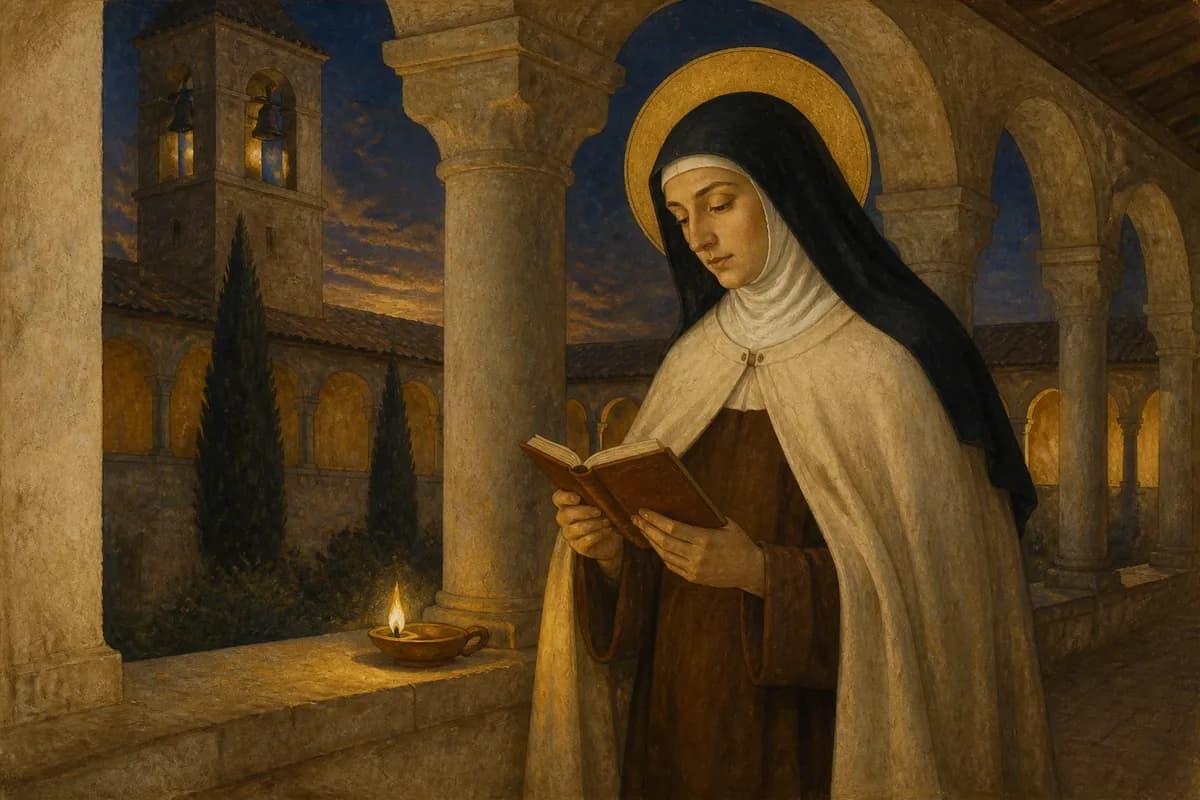
Third, expect the dryness. Teresa of Ávila, who prayed this Office every day of her religious life, wrote with unusual honesty about years when prayer felt like drawing water from a dry well — and about continuing anyway. Her account of that is the least sentimental thing in the literature, and the most useful. We tell her story in our Teresa of Ávila series.
The Office is not a spiritual technique with a guaranteed result. It is a structure: the psalms, the hours, the calendar, repeated until they are no longer something you do but something you inhabit. Start tonight with Night Prayer. It takes seven minutes.