
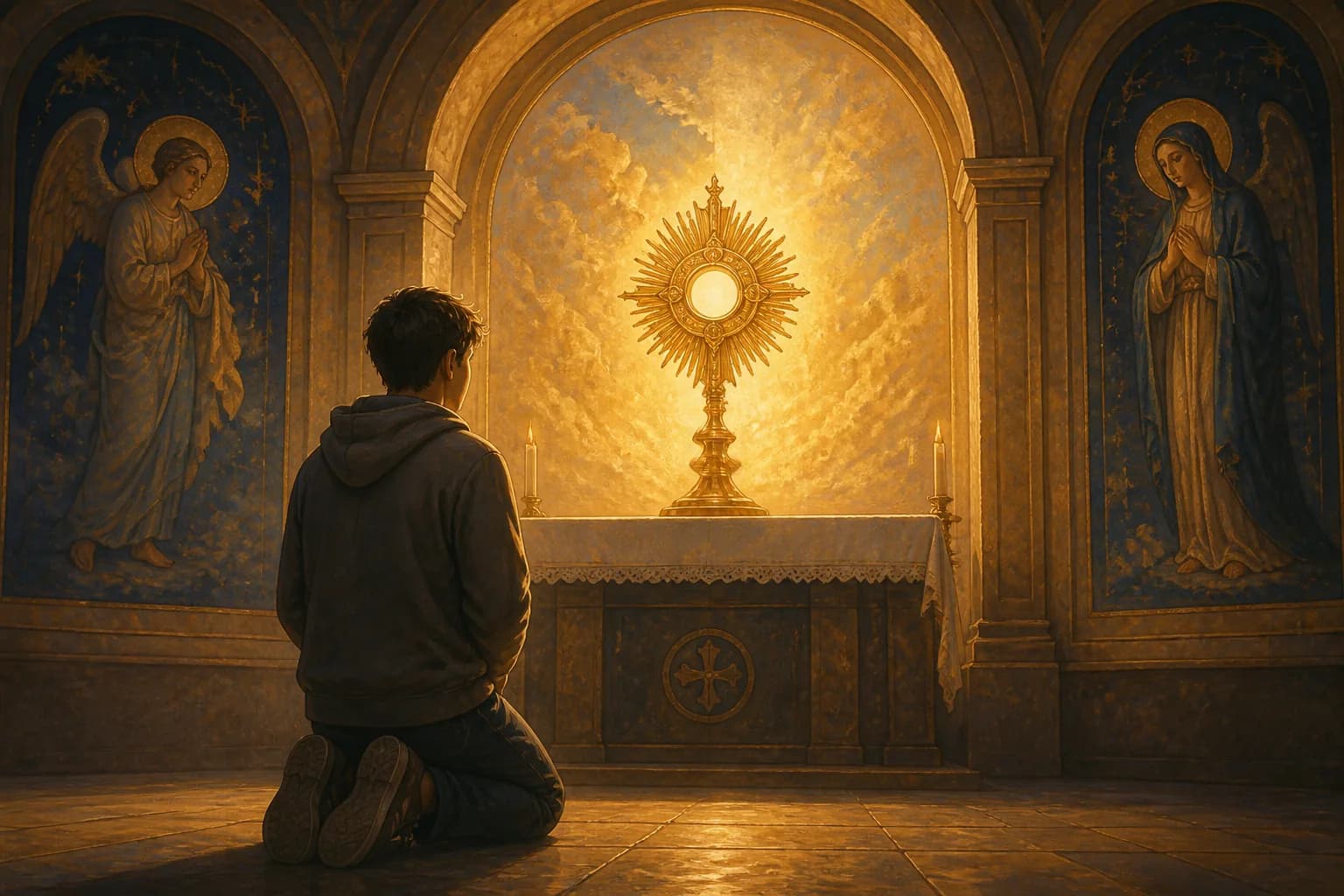
He was fifteen years old, a high school student in Milan, when he died of acute promyelocytic leukemia on October 12, 2006. He had been baptized in London, raised in Italy by a non-practicing mother who would later trace her own return to faith to her son's witness, and had spent the last three years of his life building a website. The website catalogued every documented Eucharistic miracle and approved Marian apparition in Catholic history. He coded it himself. He had taught himself programming from university-level textbooks at twelve. He had a Sony PlayStation that he limited to one hour a week so it would not distract him from prayer.
In April 2025, after a path through beatification compressed into less than fifteen years from his death, Carlo Acutis became the first millennial saint of the Catholic Church.
A Brief Life in Milan
Carlo was born May 3, 1991, in London, where his Italian parents — Andrea Acutis and Antonia Salzano — were working at the time. The family moved back to Italy a few months later and settled in Milan. He was an only child until 2010, when his twin brother and sister were born — four years after Carlo's death.
By the testimony of his mother, his teachers, his catechists, and his classmates, Carlo was both ordinary and unusual. He liked video games, soccer, and Pokémon. He had a Border Collie named Bella, two cats, and several goldfish. He went to Mass at the Jesuit church on the way to school and stopped in for daily Eucharistic adoration. He gave his pocket money to homeless men he passed on the streets of Milan. He befriended the building's doorman, the family's housekeeper, and the immigrants from sub-Saharan Africa who lived in his neighborhood.
He made his First Communion at seven, earlier than the standard Italian age, after presenting himself to the parish priest with a request that surprised the parish. He went to confession weekly. He attended Mass daily.
His mother Antonia, who tells the story in many interviews and in her own book My Son Carlo, has been honest about her own situation: she had been baptized but had attended Mass perhaps three times in her life before Carlo's catechesis began to draw her back. He effectively catechized his own mother.
The Website
In 2003, at age twelve, Carlo began researching every documented Eucharistic miracle in the history of the Catholic Church. The list runs to about 140 entries, ranging from the eighth-century miracle at Lanciano (the species of consecrated bread and wine became visible flesh and blood and have been preserved since) to twentieth-century miracles in Argentina, Mexico, Poland, and Korea.
Carlo organized the catalogue with what would now be called a designer's discipline: each miracle on its own page, with a brief description, the dates, the place, the documentation, photographs where available, and a citation to the relevant ecclesiastical investigation. He worked with the Pontifical Theological Faculty of Bologna and other scholars to verify entries. The site, www.miracolieucaristici.org, is still online and still maintained. It has been translated into more than fifteen languages.
The catalogue became the basis for a traveling exhibition that has since visited thousands of parishes and shrines worldwide, from the Vatican to small towns in the Americas and Asia.
Carlo also built a parallel site cataloguing the major Marian apparitions approved by the Church — Guadalupe, Lourdes, Fátima, and the rest.
He once told his mother: "The Eucharist is my highway to heaven."
The Illness and the Offering
In early October 2006, Carlo developed what looked like an ordinary flu. Within days the symptoms worsened. He was admitted to the hospital in Monza. Tests showed acute promyelocytic leukemia, the M3 subtype — an aggressive form that, in a fifteen-year-old, can move fast.
He told his mother on hospital admission: "I offer my sufferings for the Lord, for the Pope, and for the Church."
The disease moved as fast as the doctors feared. He died on October 12, 2006, less than a week after admission. He was buried at his request in Assisi, the town he had visited every summer of his life, where he had loved the figure of Saint Francis.
The Tomb and the Pilgrimage
In 2019, in preparation for his beatification, Carlo's body was exhumed and transferred to the Sanctuary of the Renunciation in Assisi — the church on the site where Francis stripped himself of his clothes before his father and the bishop in 1206. The body was found partially preserved. It was prepared for public display, dressed in jeans, sneakers, and a track jacket, with a wax face mask molded from his features.
The tomb has drawn pilgrims by the thousands every week since. The image — a teenager in a Nike jacket lying in a glass shrine in a medieval church — has become one of the most circulated photographs in recent Catholic devotion. The strangeness of the juxtaposition is the point: holiness, the Church wants to say, does not look like a stained-glass window. It can look like a Lombard teenager in sneakers.
Beatification and the First Miracle
The cause for Carlo's beatification opened in 2013 with the standard preliminary investigation by the Archdiocese of Milan, then was transferred to Rome. He was declared Venerable in July 2018.
The miracle required for beatification: a healing without medical explanation, attributed to Carlo's intercession. In 2013, in Campo Grande in Mato Grosso do Sul, Brazil, a four-year-old boy named Mattheus Vianna was suffering from a rare pancreatic malformation. His family brought a relic of Carlo to the local parish; the boy touched the relic and, according to the documentation submitted to the Vatican, was healed instantaneously. The pancreas, on subsequent imaging, was anatomically normal. The case was investigated by the Vatican's medical board and theological commission and approved as inexplicable. Pope Francis signed the decree in 2020.
Carlo was beatified in Assisi on October 10, 2020, with his body present in the basilica.
The Second Miracle and the Canonization
For canonization the Catholic Church requires a second verified miracle. The second case was that of Valeria Valverde, a Costa Rican university student studying in Florence. In 2022 she fell from a bicycle in the city, struck her head severely, and developed a critical cerebral hemorrhage. Surgery did not stabilize her condition. Her mother visited Carlo's tomb in Assisi to pray. Within hours of the prayer, according to the documentation, Valeria's condition began to reverse. Subsequent imaging found no hemorrhage. The Vatican's commissions investigated, theological consultors evaluated, and Pope Francis approved the decree on May 23, 2024.
Carlo Acutis was canonized by Pope Leo XIV in St. Peter's Square on April 27, 2025, as part of the Jubilee of Teenagers — a date and setting chosen deliberately. He is the first canonized saint of the millennial generation and, by Vatican announcement, the first saint to have a personal website.
Why Carlo Resonates
Carlo's appeal is not that he was extraordinary in his suffering — millions of children die of leukemia, and the saints of every era include many who died young. His appeal is that he was ordinary in everything except the focus of his attention.
He used the internet the way most people do not use the internet. He used it as a catechetical tool. He coded a website that has, twenty years on, brought more people to Catholic devotional knowledge than most parish catechesis programs. His phrase about the Eucharist being his "highway to heaven" has become one of the most quoted lines in the contemporary Church.
He also resonates because of his ordinariness. He was bad at math. He liked PlayStation but rationed it. He loved his dog. He went to school. He had a normal family and normal friends, several of whom have testified that they did not, while he was alive, particularly notice anything unusual about him — only after his death, when they read the few things he had written, did they understand that they had been near a saint.
This contrasts intentionally with the dramatic stories of other Catholic saints — the stigmata of Padre Pio, the conversion of Augustine, the seraph vision of Saint Francis at La Verna. Carlo's life is what holiness can look like in a generation that grew up online: small, daily, hidden, ordered.
Patron of the Internet?
Pope Leo XIV has not formally declared Carlo the patron saint of the internet, but the popular devotion has already designated him such, and there is wide expectation that the formal title will follow. Catholic schools and parishes have begun to invoke him in catechesis on responsible technology use.
The Acutis family foundation, the Centro Beato Carlo Acutis, continues to maintain the website and the traveling Eucharistic miracles exhibition.
The Day-to-Day Path
What Carlo modeled — and what makes him useful, not just impressive — is a daily structure most Catholics can adapt. Daily Mass. Weekly confession. Eucharistic adoration. The rosary. Acts of charity that begin with the people physically nearest you. A serious limit on digital consumption. The pattern is older than the internet but Carlo translated it into a contemporary key.
His mother has said that nothing he did was beyond the reach of an ordinary child. He simply did it. Day after day, until October 12, 2006.
Listen to Carlo Acutis on Crucis Lux
Crucis Lux tells the story of Carlo Acutis as a slow-paced, illustrated audio series — every scene narrated, every panel illustrated in the style of medieval frescoes, in five languages.