Some prayers are famous for what they say. This one is famous for who is thought to have said it — and that part is not true.
"Lord, make me an instrument of your peace" is printed on holy cards, read at weddings and funerals, quoted by presidents and sung in a dozen settings. It is attributed almost everywhere to Francis of Assisi. It is not his. What follows is the text, what the documents actually show about where it came from, and what Francis did write — which is, if anything, stranger and more beautiful.
The text
Lord, make me an instrument of your peace. Where there is hatred, let me sow love; where there is injury, pardon; where there is doubt, faith; where there is despair, hope; where there is darkness, light; where there is sadness, joy.
O Divine Master, grant that I may not so much seek to be consoled as to console, to be understood as to understand, to be loved as to love. For it is in giving that we receive, it is in pardoning that we are pardoned, and it is in dying that we are born to eternal life.
Where it comes from
The prayer's documented history begins in 1912, in Paris, in a small devotional magazine called La Clochette, the bulletin of a lay association. It appeared there in French, under the title "A beautiful prayer to say during Mass", with no author named.
From there the trail is traceable: the text was reprinted, sent to Rome, printed on the back of holy cards during the First World War — and on some of those cards the image on the front was Saint Francis. That is how a prayer written in the twentieth century acquired the name of a saint who died in 1226. By the Second World War the attribution was fixed, and it has never come loose.
None of this is contested by scholars of the Franciscan sources. The prayer does not appear in any medieval manuscript, in any early collection of Francis's writings, or in the accounts of his life written by those who knew him.
What Francis did write
Francis left real texts, and they do not sound like the peace prayer. They are more concrete, more physical, more strange.
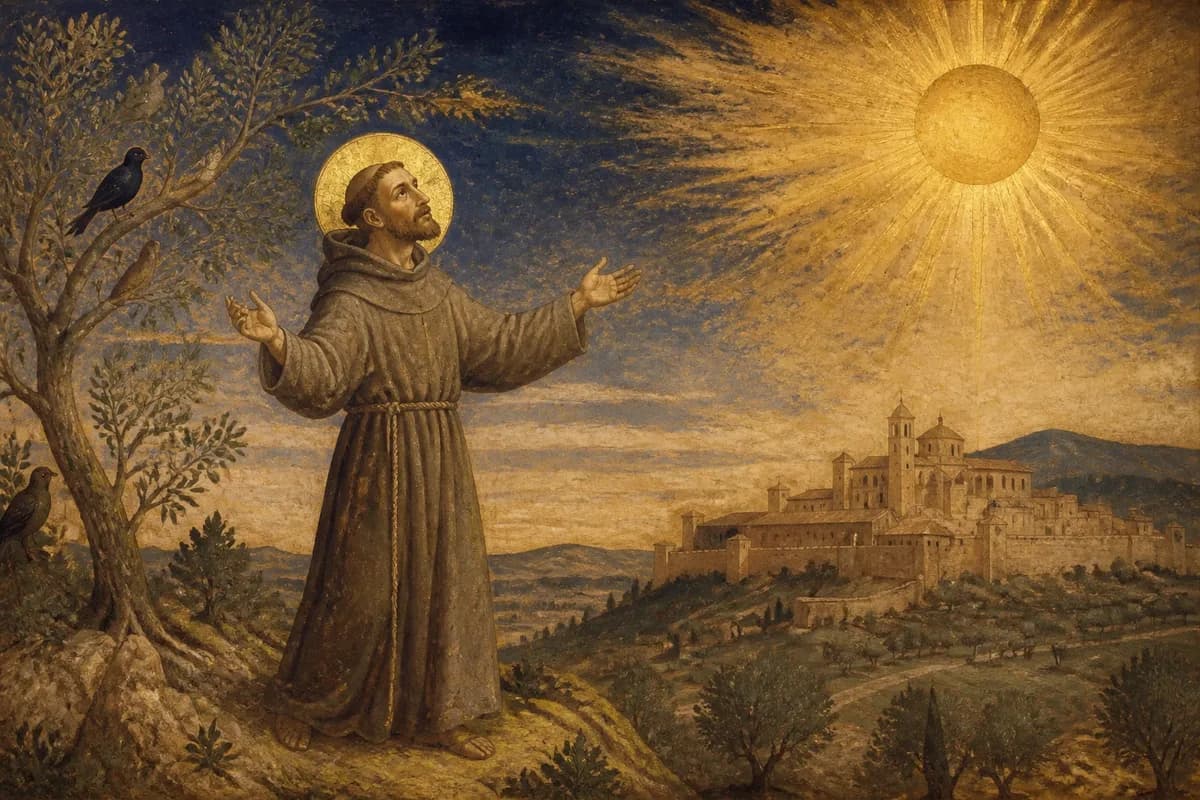
The Canticle of the Creatures — the Canticle of Brother Sun — was composed near the end of his life, in Umbrian dialect, when he was nearly blind and in constant pain. It praises God through creatures called by family names: Brother Sun, Sister Moon, Brother Wind, Sister Water, Brother Fire, and finally Sister Death, whom no living person escapes. A man in that condition writing a hymn of praise to the sun he could no longer see is the fact worth keeping.
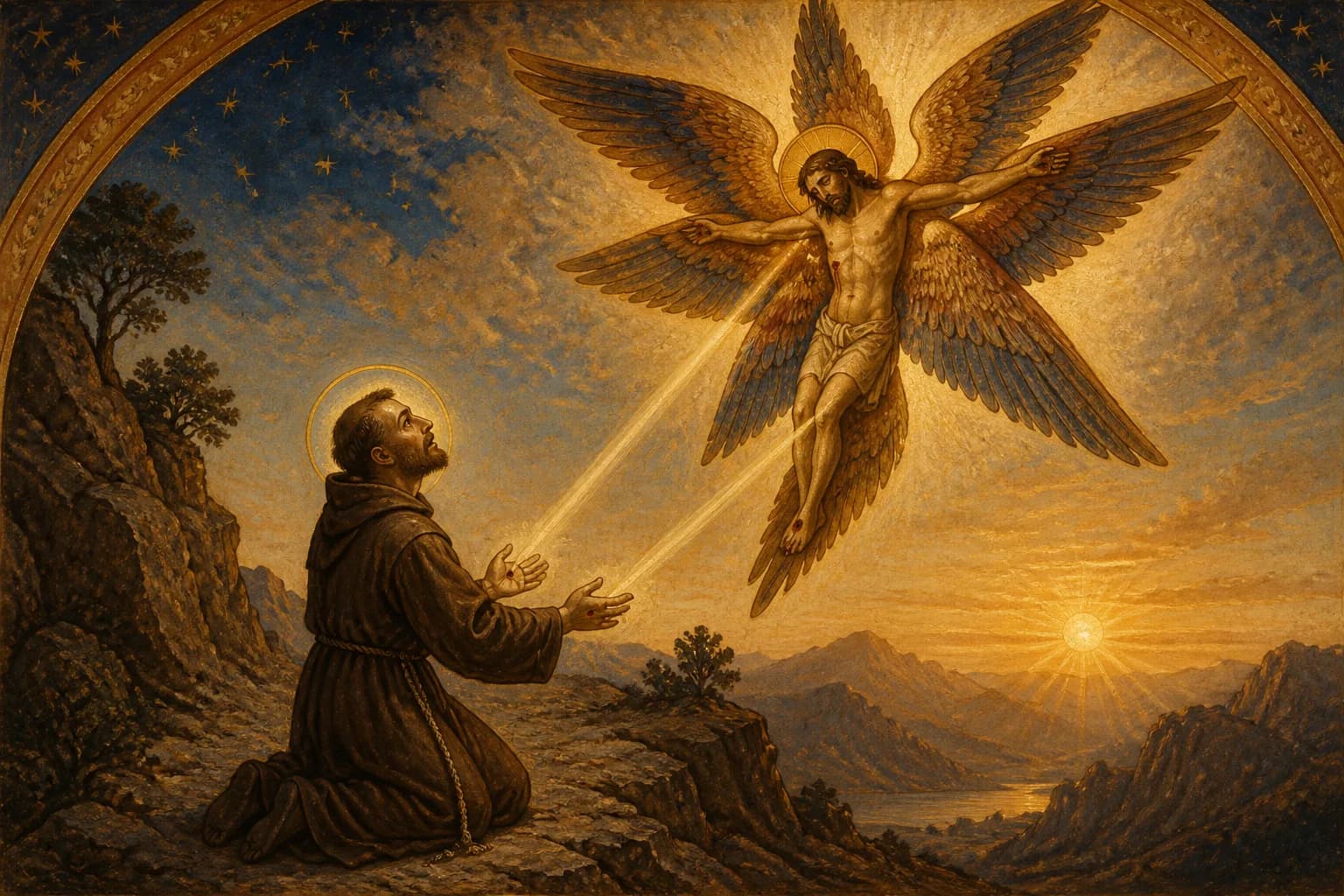
He also left the Praises of God Most High, written at La Verna after the events of 1224, and short rules and letters. Those are the documents. The stigmata at La Verna belong to the same last years.
Why the mistake persists — and why it is not a scandal
A prayer with no author is hard to carry. The mind wants a face, and "an anonymous French layman around 1912" is not a face. Francis is. And the text does echo him: the reversal of getting into giving, the preference for the lower place, the refusal to be at the centre. Whoever wrote it had read the Franciscan tradition well.
So the honest position is simple, and the one we take here: pray it if it helps you — millions do — but do not quote it as Francis's own words. Saying "the prayer traditionally attributed to Saint Francis" costs four words and is true.
The Canticle, for comparison
Read the two texts side by side and the difference in voice is immediate. The peace prayer is abstract and symmetrical: hatred and love, doubt and faith, darkness and light, each pair balanced like a scale. Francis writes nothing like that. He writes:
Praised be you, my Lord, with all your creatures, especially Sir Brother Sun, who is the day, and through whom you give us light.
Sun, moon, wind, water, fire, earth — things you can be burned by and drowned in, addressed as relatives. Then, in the stanza added when he was dying, Sister Death. He also added a stanza about those who forgive "for love of you and endure sickness and trial", and had it sung to reconcile the bishop and the mayor of Assisi, who were in open conflict. That is his idea of a peace prayer: a song, sung by others, in a specific quarrel, in a named town.
The lesson is not that the modern prayer is bad. It is that Francis was concrete where we are abstract — and that if the peace prayer moves you, the texts he actually wrote will move you more.
How to pray it
It works badly as a text to admire and well as a text to obey. Each line names a situation you will meet before the week is out: someone who has wronged you, someone in despair, someone who wants to be understood before they understand you. Take one clause — one — and hold it for the day.
The last line is the hinge, and it is not sentimental: it is in dying that we are born to eternal life. That is the Gospel's own arithmetic, the one Francis spent his life proving in public. If you want the life that produced that sentence, the story is told episode by episode in our series on Francis of Assisi, and the wolf of Gubbio is the place most people start.