For two days at the start of November the Catholic calendar does something it does nowhere else: it turns to face the dead. The first day is a celebration, the second is an act of care, and they are constantly confused with each other — including by people who keep both faithfully. The distinction is worth getting right, because it is the clearest expression of one of the strangest and most consoling things the Church claims.
1 November: All Saints
All Saints honours everyone who is already in heaven. Not only the canonised — in fact, mostly not them. Canonisation is the Church declaring with certainty that a particular person is in heaven, and by definition it covers a tiny, documented minority.
All Saints exists for the rest: the grandmother who prayed the Rosary for sixty years, the man who quietly supported a family that was not his own, the millions of people whose holiness no tribunal ever examined and no calendar records. The liturgy of the day reads the Beatitudes and the vision in Revelation of "a great multitude which no one could number." That is the point of the feast — the number is not countable, and the vast majority of the names are lost.
In most countries it is a holy day of obligation, though some bishops' conferences transfer or lift the obligation depending on the day of the week, so it is worth checking a local calendar.
2 November: All Souls
The next day turns from those who have arrived to those who are still being made ready. All Souls — the Commemoration of All the Faithful Departed — is the Church praying for the dead who are undergoing purification, which is why the two days are inseparable from the doctrine we set out in what the Church actually teaches about purgatory.
It has a specific origin. In 998, Odilo, abbot of Cluny, fixed 2 November as a day of prayer for all the dead throughout the Cluniac monasteries — an enormous network at the time. From there the observance spread across the Latin Church. Priests may celebrate three Masses on this day, a privilege extended to the whole Church by Benedict XV in 1915, in the middle of a war that had made the practice of praying for the dead brutally concrete.
Where the dates came from
Commemorations of all the martyrs existed in the East from the fourth century, usually in the Easter season. In Rome, Pope Boniface IV dedicated the Pantheon to Mary and the martyrs in 609, on 13 May.
The move to November came in stages: Gregory III, in the eighth century, dedicated a chapel in St Peter's to all the saints on 1 November, and Gregory IV extended the November date to the whole Church in the following century. The reasons were practical as much as theological — a date after the harvest could feed the pilgrims that a major Roman feast attracted.
Halloween, honestly
"Halloween" is a contraction of All Hallows' Eve, the evening before All Saints; "hallows" is simply an old English word for holy ones, preserved in "hallowed be thy name."
Beyond the name, the honest account is mixed. The vigil was a real liturgical observance. There were also older northern European seasonal customs around the turn of the year, and a great deal of what people now do on 31 October is nineteenth- and twentieth-century folk practice, much of it commercial and North American. Attempts to make the day purely pagan or purely Catholic both flatten a messier history. The word, at least, is not in dispute.
The November indulgence
Between 1 and 8 November, the Church grants a plenary indulgence, applicable only to the souls in purgatory, to the faithful who visit a cemetery and pray for the dead. On 2 November itself, a similar grant attaches to visiting a church or oratory.
The usual conditions apply — sacramental confession, Holy Communion, prayer for the intentions of the pope, and freedom from attachment to sin, that last being the demanding one. Note what the grant is not: it cannot be bought, it is not applied to yourself, and it is not a transaction. It is the Church asking people to go to a cemetery and pray, and attaching its own prayer to theirs.
Why the cemetery
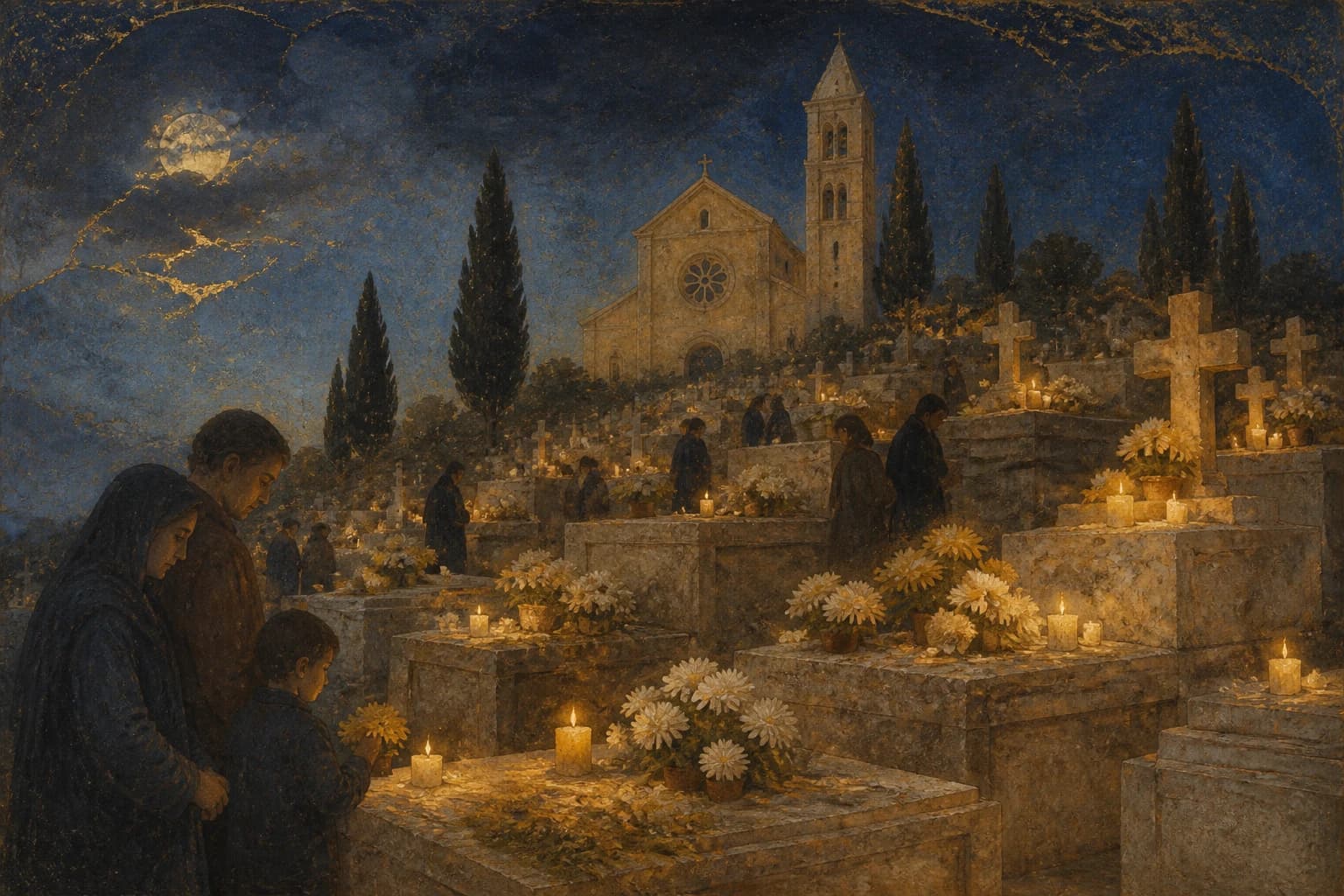
In much of the Catholic world the visible sign of these days is not a liturgy but a graveyard: families cleaning headstones, lighting candles, bringing flowers — chrysanthemums in most of Europe and Latin America — and standing around for a while. In Mexico, Día de Muertos has grown into one of the most elaborate expressions of the same instinct, with the graves cleaned and decorated and the dead spoken to by name.
The underlying belief is the communion of saints: that the Church includes the living, the dead who are being purified, and the saints in heaven, and that these three are not separated groups but one body that can still act for one another. Prayer runs in both directions. You can ask a saint to pray for you and pray yourself for someone who has died — see the guide to patron saints for the first, and these two days for the second.
That is why the calendar puts the feast and the commemoration back to back. On the first day you look at where this ends. On the second you do something for the people still on the way.